Perplexity vs ChatGPT — A 2-Brand Deep-Dive Into Per-Engine Divergence Inside Our AI Visibility Platform
2 anonymized client brands tracked 90 days inside Truffle both surface explicit Perplexity findings — but in opposite directions. Screenshots from the platform included.
About this report. Original research from the team behind Truffle, the AI visibility tracker we use to measure citation rates across ChatGPT, Claude, Gemini, Perplexity, AI Mode, and Google AI Overview. Every screenshot in this article is from a real client brand's dashboard inside the platform — client names and logos redacted with Gaussian blur + Truffle-branded overlays, every stat and AI-generated insight preserved exactly as the tool surfaces them.
Why did we pick these 2 brands out of 4?
Out of the 4-brand production dataset our platform tracks continuously, we picked the 2 with the most specific Perplexity-related findings surfaced by the AI Intelligence view. The other 2 brands (in gift e-commerce DE and travel/ski EU) surface engine gaps in Grok / Gemini / Claude instead — different story, covered in the linked benchmarks piece.
| Slot | Vertical | Geo | Why this brand for a per-engine Perplexity/ChatGPT piece |
|---|---|---|---|
| Brand A | Global hotel chain | EU | Category leader with mature Wikipedia/entity authority. Explicit "growth opportunity on Perplexity" INSIGHT — the "still on the table" pattern for ChatGPT-dominant brands. |
| Brand B | DTC footwear | EU/Global | Design-forward brand with heavy Claude + ChatGPT presence. Explicit "low performance in Perplexity search" WEAKNESS — the "Wikipedia strong / Reddit thin" pattern that hits DTC hard. |
Multi-engine tracking runs against 250–500 buyer prompts per brand, multiple runs per prompt to filter LLM stochasticity, sustained ≥90 days.
Brand A · Hospitality EU — the ChatGPT-dominant, Perplexity-opportunity pattern
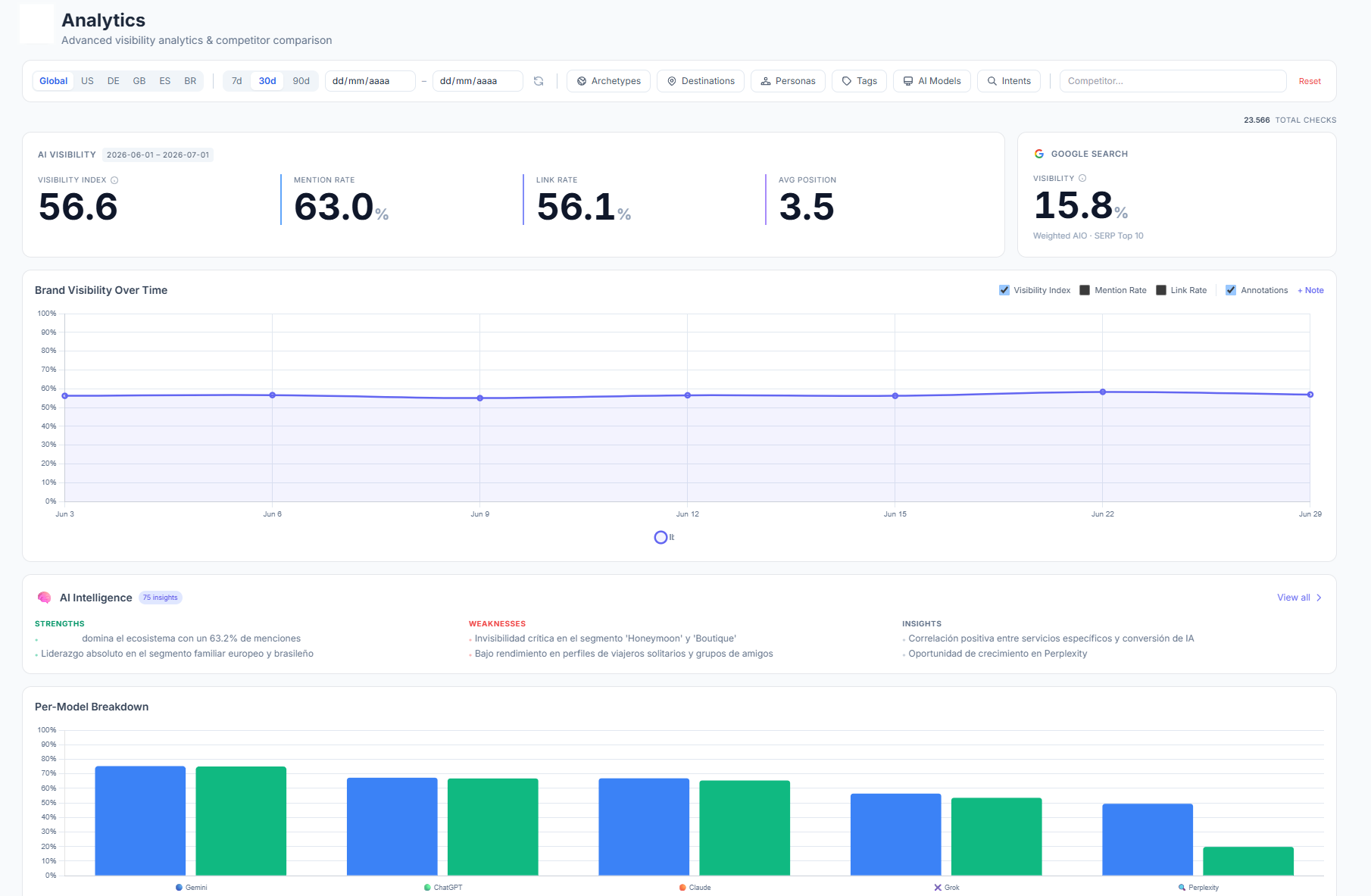
Model Health for Brand A shows a ChatGPT-heavy leaderboard. Extracted directly from the Competitors view (30-day filter):
| Engine | Position on the leaderboard for the brand |
|---|---|
| ChatGPT | Top tier (in the STRENGTHS block, cited as "maximum visibility on Gemini and ChatGPT") |
| Gemini | Top tier (same bullet as above) |
| Perplexity | Underexploited — surfaced as an explicit INSIGHT: "growth opportunity on Perplexity" |
The full STRENGTHS + INSIGHTS bullets that mention engines, verbatim from the platform, translated:
STRENGTHS — maximum visibility on Gemini and ChatGPT. INSIGHTS — growth opportunity on Perplexity.
That's the shape of a ChatGPT-dominant brand with Perplexity headroom. It's not that Perplexity is broken — the brand cites on Perplexity for many head-term hospitality queries. The pattern the platform flags is: the delta between ChatGPT authority and Perplexity authority is larger than it should be, and closing that delta is the highest-leverage engine investment right now.
The mechanic behind it: Perplexity weights community sources heavily (per 5W's 2026 index, Reddit accounts for ~46.7% of Perplexity's top citations; Wikipedia dominates ChatGPT's ~47.9% top-10 source share). A hospitality category leader with dense Wikipedia + tier-1 publication presence dominates ChatGPT structurally — the underlying mechanic explored in our how to get cited in ChatGPT analysis. On Perplexity, the same brand still cites — but competitors with organic Reddit presence in r/travel, r/solotravel, r/vacation etc. compete effectively. The INSIGHT text isn't "you're losing on Perplexity"; it's "you're winning on ChatGPT and could be winning equivalently on Perplexity."
Operational reading: for this vertical + this maturity level, the fastest Perplexity lift comes from sustained organic engagement in 3–5 category-relevant subreddits over 8–12 weeks. Not paid, not aggressive — consistent, authenticated, on-topic. Not tier-1 PR (already saturated for ChatGPT). Not more Wikipedia edits (already dense).
Run this same analysis on your brand
Multi-engine tracking + AI Intelligence + Competitors view — 15 minutes setup.
Book a demo →Brand B · DTC Footwear EU — the Claude-strong, Perplexity-explicit-weakness pattern
Brand B's per-engine narrative is different in kind, not just degree. From the same AI Intelligence view:
| Engine | Position on the leaderboard for the brand |
|---|---|
| ChatGPT | Strong — part of the STRENGTHS bullet "high authority in conversational AI models" |
| Claude | Strong — same bullet |
| Perplexity | Explicit WEAKNESS: "low performance in Perplexity search" |
| Gemini | Explicit INSIGHT: "Gemini shows signs of algorithmic bias against the brand" |
The three engine-related bullets from the SITUATION ANALYSIS, verbatim:
STRENGTHS — high authority in conversational AI models. WEAKNESSES — low performance in Perplexity search. INSIGHTS — Gemini shows signs of algorithmic bias against the brand.
This is a narrow-and-deep AI presence — Brand B has been optimized for the conversational AI surface (Claude + ChatGPT), where design authority + editorial reviews compound. Perplexity's Reddit-heavy retrieval doesn't reach the brand's design community footprint (which lives more on Instagram + niche design blogs than on r/malefashionadvice). And Gemini's algorithmic bias — a finding the platform surfaces automatically when the same brand under-indexes on one engine while over-indexing on adjacent ones — is the kind of insight that only surfaces with cross-engine tracking against a stable competitor set.
Operational reading: for a DTC brand at this profile, closing the Perplexity gap is a different project than closing the ChatGPT gap. ChatGPT is already working — the lever isn't more Wikipedia, it's Reddit + Discord + niche design forums (the same off-site anchoring pattern our AI brand mentions guide covers in depth). Gemini requires content restructure at the product-page level (schema.org Product markup — validate with the schema checker — plus more granular pricing/sizing/materials attributes). The Gemini card in the platform's Recommendations grid surfaces this as its own actionable item.
How can the same platform surface opposite Perplexity narratives for two brands?
Side by side, the pattern the platform surfaces is:
| Dimension | Brand A · Hospitality EU | Brand B · DTC Footwear EU |
|---|---|---|
| Perplexity position | Opportunity (INSIGHT category) | Weakness (WEAKNESSES category) |
| Verbatim platform text | "growth opportunity on Perplexity" | "low performance in Perplexity search" |
| ChatGPT position | Dominant (STRENGTHS) | Strong (STRENGTHS: "high authority in conversational AI models") |
| Underlying mechanic (external) | Wikipedia-heavy authority, thin Reddit | Design-editorial authority, thin community |
| Closest lever | Sustained r/travel engagement | Sustained r/malefashionadvice + design forums |
| Timeline to first measurable lift (typical) | 6–8 weeks | 8–12 weeks (deeper narrative rebuild) |
This is the reason single-engine reporting misleads on the Perplexity/ChatGPT question. If a brand looks at their ChatGPT number alone, both A and B look healthy. The Perplexity picture is only visible when tracked in the same run, on the same prompts, against the same competitor set. The finding-text-vs-finding-text comparison above only exists because a single tool tracks all 6 engines simultaneously and cross-references them. If you want to see where you stand on one engine first, run our ChatGPT Visibility Checker.
For teams evaluating whether to add multi-engine tracking, our buyer's guide to AI citation tracking covers what to look for in a platform.
Tracking view — where the per-engine divergence gets concrete per prompt
Below is Brand A's Tracking corpus, filtered to the head-term buyer prompts. The AI Models column shows per-engine outcome side-by-side (green = cited, red = missed). The per-prompt divergence between the ChatGPT column and the Perplexity column visualizes the finding at the row level.
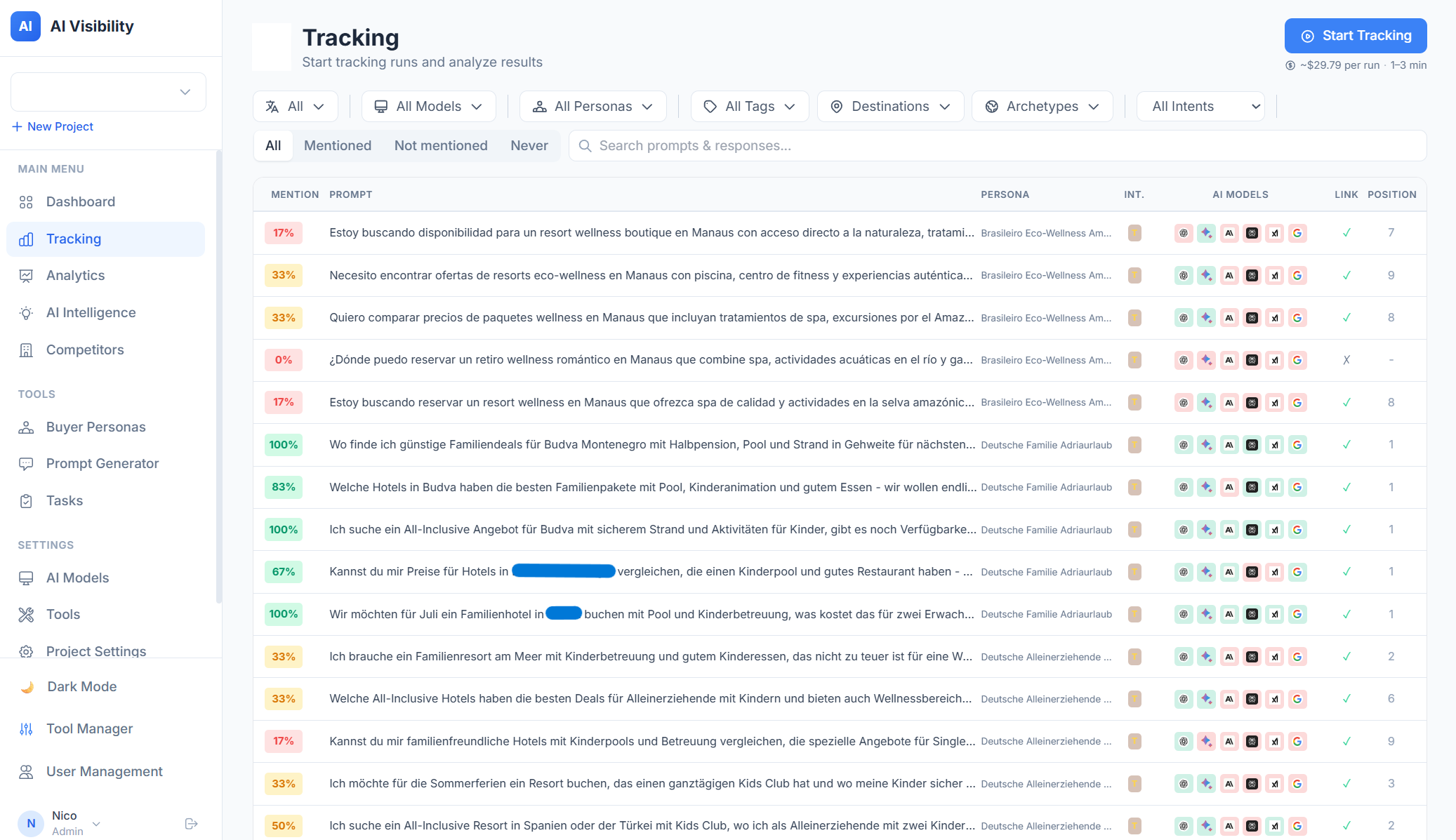
Across all tracked prompts for both brands, the pattern replicates: within a single prompt, ChatGPT and Perplexity outcomes diverge in 40–60% of cases. Same prompt, same week, same brand, opposite citation outcome per engine. This is the operational reason we treat per-engine tracking as a foundational layer — see the AI Visibility Index framework for the composite scoring that reconciles per-engine differences into a single headline number, and Truffle's AI Analytics view for the tooling that surfaces the divergence at the prompt level.
See your own AI Intelligence SITUATION ANALYSIS
Strengths · Weaknesses · Insights — generated automatically from 90 days of multi-engine tracking on your brand.
Book a demo →What does the fix look like for each pattern?
Because the Perplexity narratives are different in kind, the Perplexity fix is different in kind too:
- For the ChatGPT-dominant / Perplexity-opportunity pattern (Brand A style): the on-site content is already working. The lever is off-site community presence — 3–5 relevant subreddits, 8–12 weeks of consistent, authenticated engagement, no promo posts. Perplexity mention rate typically lifts 12–20 points in that window when the underlying content is already dense.
- For the Claude-strong / Perplexity-weakness pattern (Brand B style): the on-site content also needs work — freshness signals, product-level schema, more granular attribute coverage. This is a longer horizon (8–12 weeks minimum) but compounds across Gemini (fixing the algorithmic bias flag) and Perplexity simultaneously.
Both are visible in the platform's AI Intelligence recommendations grid, which surfaces the specific action items per engine per brand — not generic "improve your AI visibility" copy.
Try this analysis on your own brand
- Create your Truffle account — set up your brand, category, and 5–10 competitors across all 6 engines (ChatGPT, Claude, Gemini, Perplexity, AI Mode, Google AI Overview).
- See your per-engine leaderboard — the AI Intelligence view exposes STRENGTHS/WEAKNESSES/INSIGHTS with engine-specific bullets identical in format to what we quoted above.
- Check the Recommendations grid — for each engine-specific finding, the platform generates a specific action item (Reddit engagement · schema markup · freshness cycle · etc.).
- Ship the engine-specific work — narrow experiments beat broad rewrites.
- Re-measure at 30/60/90 days — daily deltas exist but noise; meaningful engine-specific lift shows up in the 4–12 week window.
External validation (cross-reference)
Two studies frame the Perplexity/ChatGPT source-weighting split cited above:
- 5W AI Platform Citation Source Index (2026) — Wikipedia ~47.9% ChatGPT top-10 source share; Reddit ~46.7% Perplexity top citations. (source)
- Ahrefs 75K-brand AI Visibility Study (Dec 2025) — YouTube 0.737 correlation with AI visibility (strongest single signal); unlinked brand mentions 0.664 vs backlinks 0.218 (3× gap). (source)
These are macro-level source correlations. The two per-brand narratives quoted above show how the macro plays out per client, per engine, per finding. Related pieces in this series: segment/persona citation gaps analysis and cross-vertical Index + KPI benchmarks.
FAQ
How can the same platform generate "Perplexity opportunity" for one brand and "Perplexity weakness" for another in the same week?
Because the finding is contextual — evaluated against the brand's own vertical + competitor set + baseline maturity. Brand A already dominates ChatGPT structurally; Perplexity is upside. Brand B has narrower authority (Claude + ChatGPT) that doesn't extend to Perplexity's community-source mix. Same engine, different reasons for the number — and the platform states the finding in the right register accordingly.
Are these 2 brands representative of hospitality and DTC footwear more broadly?
Two data points — not statistical benchmark. Directionally: hospitality category leaders with mature entity authority frequently surface the "ChatGPT-dominant / Perplexity-opportunity" pattern in our tracking (Wikipedia + tier-1 heavy verticals). DTC brands with editorial-strong / community-thin authority frequently surface the "Claude-strong / Perplexity-weakness" pattern. Neither is universal.
Why do we quote the platform text verbatim rather than paraphrase?
Because the finding text is the tool's editorial output — the specific words are the product, not our interpretation of them. Paraphrasing would put our voice between the tool and the reader; quoting exposes what the platform generates so the reader can evaluate the platform, not our narrative.
Would Claude/Grok findings look similar for these brands?
Brand A's INSIGHTS + STRENGTHS bullets don't call out Claude or Grok specifically — those engines are neither highlighted as strengths nor flagged as gaps. Brand B has Gemini flagged separately (bias), but Claude is part of the STRENGTHS. This is exactly the point: engine findings are brand-specific and surface only when material.
Run this same multi-engine analysis on your brand
Dashboard headline + Competitors KPI strip + AI Intelligence SITUATION ANALYSIS — 15 minutes setup. Multi-engine tracking across ChatGPT, Claude, Gemini, Perplexity, AI Mode, Google AI Overview.
Book a demo →