How to Get Your Brand Cited in ChatGPT Answers — the 2026 Operator's Playbook
In June 2025, AI search platforms drove 1.13 billion referral visits — a 357% increase year-over-year, with ChatGPT capturing ~80%+ of that AI referral traffic (Similarweb · TechCrunch · July 2025). The brands that appear inside ChatGPT answers capture qualified attention at scale; the ones that don't, fade out of the consideration set. Citation is the new ranking.
How ChatGPT actually decides what to cite
ChatGPT does not maintain a single ranking algorithm. It answers from two sources: parametric knowledge (encoded in model weights from training data) and live retrieval (real-time web lookups via the Bing-derived index). Industry observations through 2026 suggest roughly 60% of ChatGPT responses lean on parametric memory and ~40% on live retrieval — though the split is qualitative (OpenAI does not publish exact ratios) and the proportion varies dramatically by query type, recency requirement, and whether web search is toggled on.
The practical implication: appearing in ChatGPT answers requires two distinct optimization tracks running simultaneously.
Training data presence
Your brand needs to exist on the web at the time ChatGPT's training corpus is collected. The corpus draws heavily from a small set of high-authority domains.
Live retrieval surface
When ChatGPT triggers a web search, it retrieves from the Bing index and prioritizes recent, structured, authoritative content. Closer to classical SEO + AEO than GEO synthesis.
The two tracks operate on different timelines. Training data accumulates over months to years and shifts slowly. Live retrieval shifts within weeks of content changes. A complete ChatGPT citation strategy invests in both. For how this overlaps with — and differs from — classical SEO investments, see our GEO vs SEO guide.
The 357% growth that changes the math
Three data points from 2025–2026 explain why this discipline moved from "experimental" to "named line item" inside marketing budgets in 2026.
Referral growth
+357%1.13B referral visits in June 2025 — even at conservative growth, AI-referred sessions become a top-five traffic channel within 12 months for most B2B SaaS categories.
ChatGPT share
~80%+Of AI referral volume to the top 1,000 websites (Similarweb · 2025) — ChatGPT remains the single highest-leverage AI referral surface even as its chatbot-market web-visit share declines through 2026.
Conversion intent
14.2%vs 2.8% Google organic baseline — roughly a 5× advantage across 312 B2B tech firms (Opollo · 2026). Smaller traffic volumes, dramatically higher qualified intent.
The six-pillar framework that wins ChatGPT citations
Most "how to get cited" articles online collapse into one of six structural pillars. The team that closes gaps across all six in parallel earns citations at a fundamentally higher rate than the team that optimizes one and ignores the rest.
Wikipedia presence + entity authority
Wikipedia accounts for ~47.9% of ChatGPT's top-10 source share per 5W's analysis of ~600K citation events (5W · 2026). Brands without Wikipedia presence have no anchor for entity authority.
~47.9% top-10 shareReddit + community visibility
Reddit is the #1 single source across all major AI engines at ~40% citation frequency, with Perplexity at ~46.7% (5W · 2026).
40% across enginesYouTube mentions (underestimated)
YouTube mentions correlate at 0.737 with ChatGPT citation rates — the strongest single signal measured (Ahrefs · 75K-brand study Dec 2025). Transcripts indexed by Google, surfaced through Bing, ingested into AI corpora.
0.737 correlationBrand mentions across top 15 domains
A concentrated set of ~50 high-authority domains dominates AI citation share (5W · 2026). Mentions correlate 3× stronger with AI visibility than backlinks — unlinked mentions 0.664 vs backlinks 0.218 (Ahrefs · 75K-brand).
3× backlinks · 68% shareContent freshness (30-day window)
ChatGPT shows the strongest recency preference: 76.4% of citations come from content updated within the last 30 days. Pages frozen since 2023 cannot compete with pages updated last week.
76.4% <30 daysDirect-answer content patterns
Question-as-heading + 2–3 sentence direct answers + FAQPage schema. Ahrefs found 44% of ChatGPT citations come from the first third of content (Ahrefs · 17M citations 2025). Run a Schema Checker. Full framework: AEO Playbook.
The domains that decide AI citations — and the 8 categories
A concentrated set of roughly fifteen domains consolidates about 68% of all citation share across ChatGPT, Claude, Perplexity, Gemini, and Google AIO. They fall into eight consistent buckets.
| Category | Examples | Citation leverage |
|---|---|---|
| Consensus encyclopedias | Wikipedia · Wikidata | Highest authority anchor |
| Community discussion | Reddit · Stack Exchange · Quora | Strongest recency signal |
| Review platforms | G2 · Capterra · Trustpilot · TripAdvisor | Category-specific authority |
| Tier-one publications | TechCrunch · Forbes · Wired · The Verge · NYT | Earned media surface |
| Video transcripts | YouTube | Indirect indexing path |
| Developer platforms | GitHub · Stack Overflow | Technical category authority |
| Professional networks | LinkedIn (long-form posts) | Personal brand + B2B |
| Specialized publications | Category-specific trade press | Niche authority anchor |
The operational consequence: earning ChatGPT citations is not primarily about your own website. Roughly two-thirds of the work happens off-site — coordinating earned media, community engagement, review collection, encyclopedia presence, and video distribution across this fifteen-domain set. Brands that treat citation work as on-site SEO investment under-deliver by design.
See your brand across all 15 domains
Truffle's source mention map surfaces which of the 15 high-leverage domains already cite your brand and which are gaps — Wikipedia, Reddit, G2, TechCrunch, YouTube and the rest, weighted by your category's actual citation pattern.
Beyond ChatGPT — how Claude, Perplexity, and Gemini differ
Optimizing only for ChatGPT leaves the 22% of AI referral volume distributed across Claude, Perplexity, Gemini, and Grok unaddressed. Each has its own citation logic.
Claude
Industry observations suggest Claude favors bullet-pointed pages and explicit source attribution over equivalent prose (no single rigorous lift study located through 2026). Factual density and source transparency are consistent themes in independent analyses.
Perplexity
of top citations from Reddit. Pages without recent updates underperform sharply. Community presence is non-negotiable.
Gemini
Weights traditional authority (backlinks, DR, E-E-A-T) more than Reddit/YouTube. Powers Google AIO — see AI Overviews Explained for AIO mechanics.
Grok
Newest entrant. Early data suggests Twitter/X presence and recency-of-discussion correlate strongly, but methodology not yet mature.
Six common mistakes that suppress citation rate
After auditing brand citation strategies across the 100+ companies Truffle tracks, six mistakes consistently keep brands invisible inside ChatGPT.
Optimizing only on-site
ChatGPT cites Wikipedia, Reddit, reviews, YouTube, and tier-one media before it cites your marketing pages. On-site-only teams miss ~2/3 of available citation surface.
Fix. Allocate ≥40% of citation budget to off-site earned media, community engagement, review platforms.
Treating brand mentions as PR vanity
Brand mentions correlate 3× more strongly with AI visibility than backlinks — unlinked mentions 0.664 vs backlinks 0.218 (Ahrefs · 75K-brand Dec 2025). Most teams still measure PR by reach when AI-visibility impact is the durable metric.
Fix. Report mention volume across the top 15 domains as a primary PR KPI.
Ignoring YouTube as a citation channel
The 0.737 YouTube correlation is the highest single signal, yet most B2B SaaS teams ship zero video content. Direct conversion attribution misses the indirect mechanism.
Fix. Quarterly cadence of 1–3 short videos with full transcripts, embedded in relevant blog posts.
Freezing content after publish
The 76.4% recency premium means pages frozen since 2023 lose to pages updated last week, even when the frozen page has stronger absolute authority.
Fix. Quarterly refresh cycle on top 20–30 pages with updated stats + dateModified schema.
Pitching products to writers instead of providing factual descriptions
AI engines cite articles that mention brands as factual category options, not articles that read as sponsored content. Outreach pitched as sales rarely converts to durable citation surface.
Fix. Send clean factual product descriptions — what it does, what makes it distinct, who uses it.
Optimizing on-site only and skipping Digital PR
The meta-mistake tying 01, 02, and 05 together. AI citation rate is dominated by off-site signals: which independent reputable domains mention your brand, which third-party sites cite your work, which review platforms rank you. On-site-only teams cap their own citation surface.
Fix. Identify the 15–20 high-authority sources your category appears in (Truffle surfaces this as the source mention map inside AI Analytics), then run a focused Digital PR play.
The 6 mistakes are the 6 levers
Every mistake above maps to a measurable factor inside Truffle. Plug your brand and see which mistakes are still costing you ChatGPT citations — and exactly which domain or page to fix first.
Measuring brand citation — five metrics that matter
Each metric answers a different operator question. Reporting one in isolation either over-reports or under-reports brand visibility.
AI Visibility Index
"Trend across engines week-over-week?"
Citation rate per engine
"% prompts cite us per ChatGPT/Claude/Perplexity/Gemini?"
Share of voice
"Us vs named competitor set?"
Top 15 domain mentions
"How many high-leverage domains mention us?"
Citation position
"Source 1 or Source 5?"
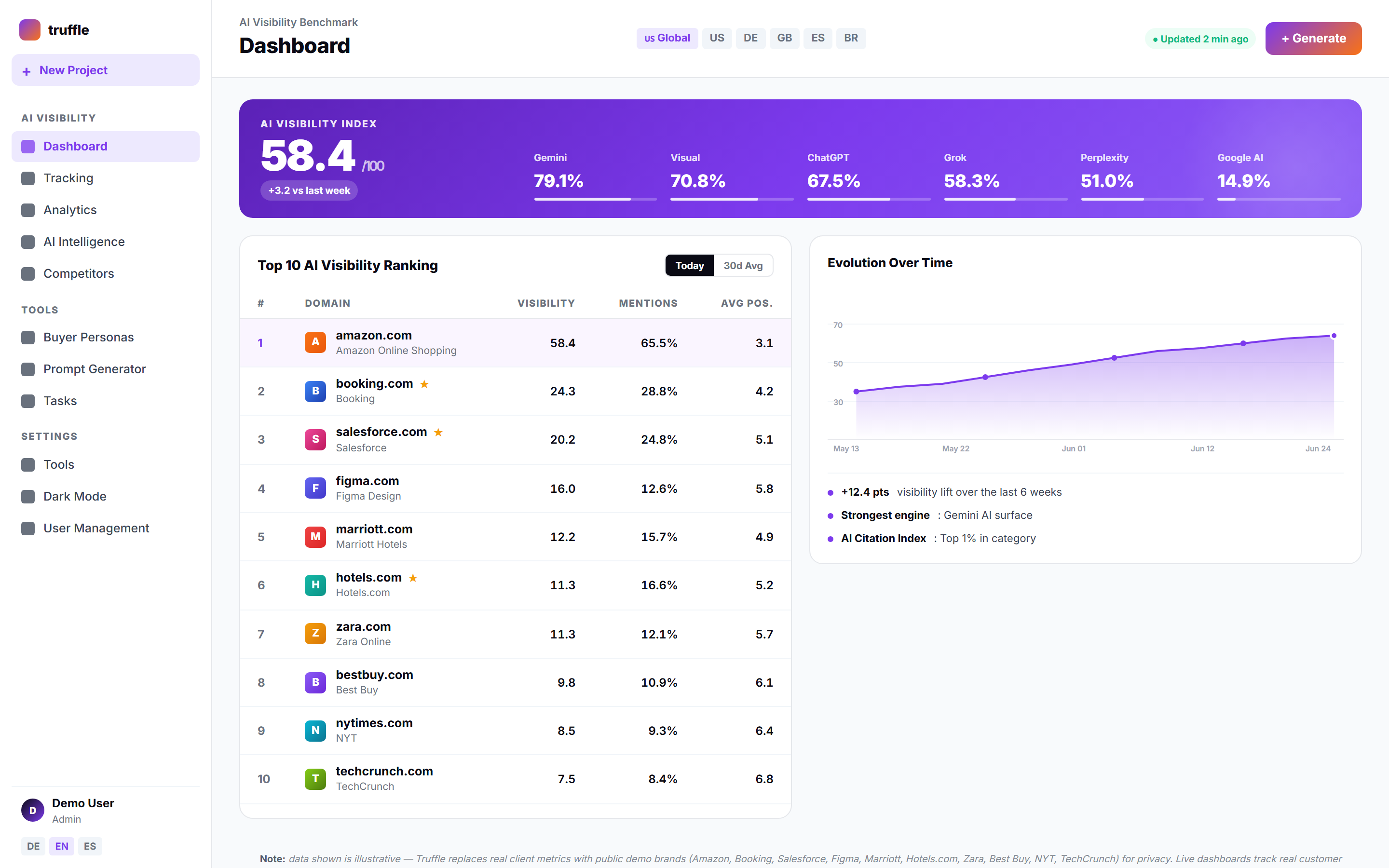
Truffle ships citation tracking across six AI engines on every paid tier
The five metrics need to be reported in the same dashboard, not three. Truffle's AI Analytics ships all five plus the composite AI Visibility Index across ChatGPT, Claude, Gemini, Perplexity, Google AI Mode, and Google AI Overview on every paid tier — same screen, no per-engine upsell. For the wider operational framework, see our Generative Engine Optimization guide.
Implementation roadmap — what to ship this quarter
You don't need a thirty-step plan. Four phases over a quarter, then continuous parallel operation.
P1
P2
P3
P4
For the technical layer (robots.txt, schema, llms.txt) that underlies all of this, see the companion LLM SEO guide →
Start with Truffle — the 5-step path from audit to ChatGPT citation
If the framework above feels right but you don't have a unified system in place yet, here's the operator path most teams follow inside Truffle to get cited inside ChatGPT — and the other five engines at the same time.
Create your Truffle account
Set up your brand, category, and 5–10 reference brands you want to benchmark across ChatGPT, Claude, Gemini, Perplexity, Google AI Mode, and Google AIO. Sign up →
Find the prompts that matter
Truffle uses AI to surface the 250–500 real prompts your category's buyers ask ChatGPT and the other engines. No manual brainstorming.
Use the answers in your content
For every prompt where you're not cited, Truffle shows on-site content gaps to close and off-site sources winning the citation. Refresh top pages and prioritize Digital PR placements.
Monitor weekly across 6 engines
ChatGPT citation rate, share of voice, average position, top-15-domain mentions, plus Claude, Gemini, Perplexity, Google AI Mode, AIO on the same screen.
See ChatGPT citations climb
Most teams land their first new ChatGPT citations within 4–6 weeks of shipping the recommended changes. The data is the proof to the CFO.
Frequently asked questions
Eight questions buyers actually ask when researching how to get their brand cited in ChatGPT.
How do I get cited in ChatGPT?
How does ChatGPT decide what to cite?
How can I get cited in ChatGPT and Perplexity?
How does YouTube help with ChatGPT citation?
How long does it take to get cited in ChatGPT?
Do I need to be on Reddit to get cited in ChatGPT?
Why does brand mention volume matter more than backlinks?
How do I track my brand's citation rate?
Track ChatGPT citations alongside SEO and GEO
Truffle ships AI Visibility Index + citation rate + share of voice + top 15 domain mentions on every paid tier — across ChatGPT, Claude, Gemini, Perplexity, Google AI Mode, Google AIO. Stop guessing if ChatGPT cites you.