You don't lose to a competitor. You lose to the answer they're in.
When AI names three brands and yours isn't one of them, nobody sends you a notification. Truffle tracks every competitor next to you: mention rate and link rate, prompt by prompt, engine by engine. When one of them takes a lead you used to hold, you hear it from us.
Illustrative data · demo brand "Flowmetrics"
A search results page showed your buyer ten options and let them choose. An AI answer shows them three and calls it a recommendation. You're either on that shortlist or you're off it, and the brands on it inherit the trust a buyer used to build over several clicks. Being invisible in an AI answer feels exactly like being fine. Nothing breaks. No report turns red. A competitor quietly becomes the default answer while you keep shipping content against a scoreboard nobody reads from anymore.
What competitor tracking in AI answers is
It measures how often AI engines name your competitors instead of you, and link to them instead of you, for the same buyer questions. Same prompts, same engines, same day. Nothing here is modelled from traffic estimates. Truffle scores the answers your buyers actually get.
The four numbers that decide the shortlist
You and your rivals each get a position on a page of ten blue links. Everyone is on the page, so the fight is over the order. You track a keyword, they track the same keyword, and the buyer sees both of you either way.
There is no page of ten. There's one answer naming a few brands, and it reads differently in ChatGPT than in Perplexity, differently per prompt, differently per country. Order stops being the fight. The fight is whether you're in the answer your competitor already owns.
How it works in three steps
From a list of rivals to an evidenced alert the day one of them takes a lead off you.
Name the competitors you know. Truffle finds the ones you don't
Add every rival you already sell against. There's no cap, so you track unlimited competitors per brand. Onboarding gets you started: it analyzes your website and proposes a competitor set in your own weight class, rather than a list of corporate giants you'll never appear next to. After that, new competitors are discovered automatically from real AI answers, including ones you didn't know you had.
Every competitor runs on your prompts, not their own
Truffle runs your prompt set daily across ChatGPT, Claude, Gemini, Perplexity and Google AI Overviews and weekly in Google AI Mode, then scores mention rate, position and link rate for you and every tracked competitor from the same answers. Same prompts, same engines, same day. That's what makes the comparison real, instead of two separate reports laid next to each other.
Get told when a lead changes hands
Truffle compares each period against the one before it and alerts you per competitor: where they outrank you, and where they appear and you don't. Every alert names the buyer question and attaches the actual AI answers as evidence. Alerts cover the competitors you defined and the unknown brands the engines surfaced on their own. You never go hunting for the shift in a dashboard. It arrives already documented.
The day the lead changed, on the record
A rolling 8-week trend of every tracked brand, with the overtake called out at the top: dated, scoped to one segment, backed by the answers that prove it.
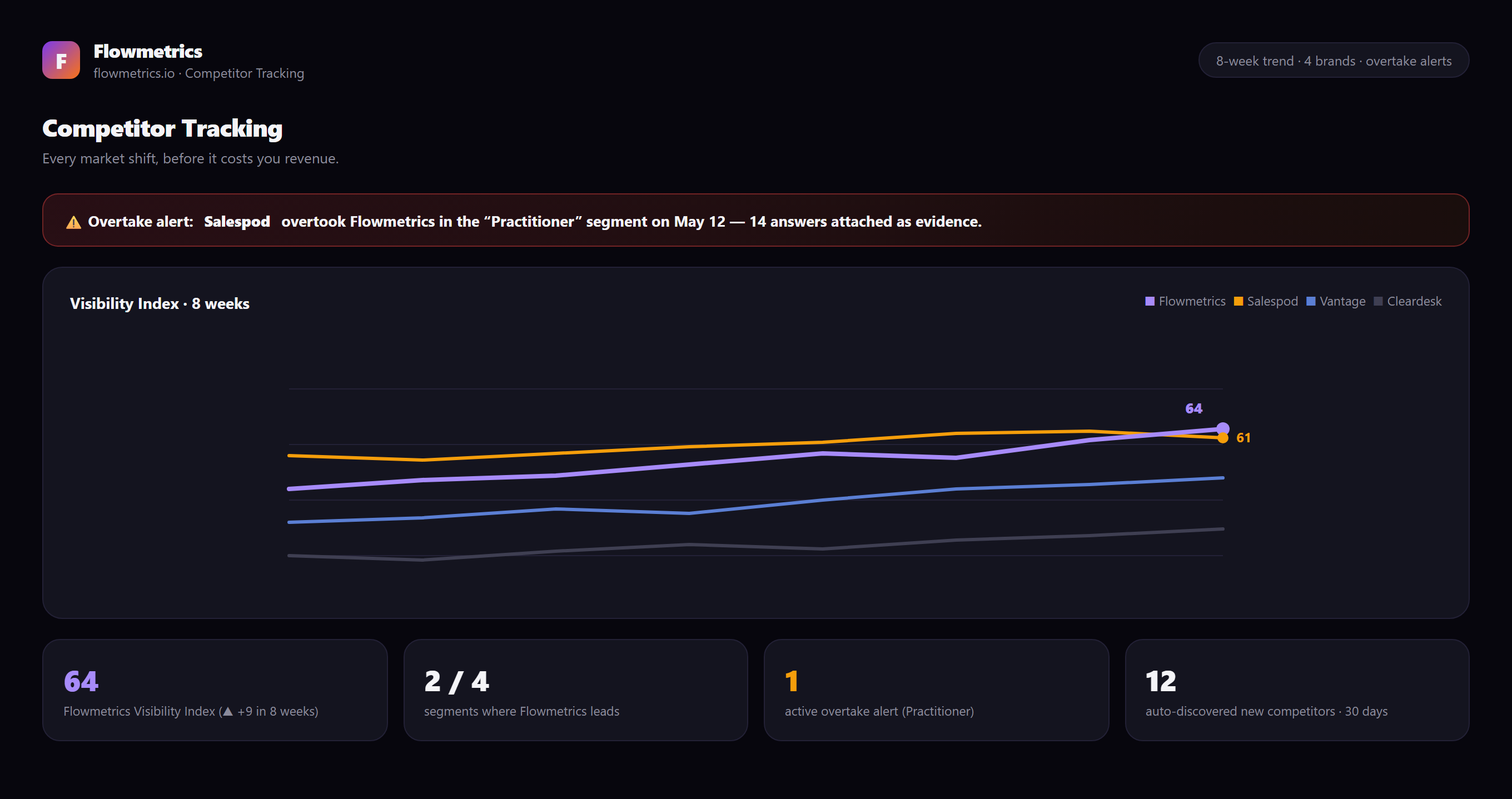
The banner is the product. Everything below it is context. Truffle opens with the thing that changed: Salespod overtook Flowmetrics in the "Practitioner" segment on May 12, with 14 answers attached as evidence. You get a date, a segment, a named rival and the receipts, so you can go and read the answers yourself. The 8-week trend underneath shows why the loss stayed invisible for so long. On the headline number Flowmetrics is winning: index 64, up 9 over the period, now nosing ahead of Salespod's 61 on the blended line. The average was green while a segment went red. That's the failure mode of a single share-of-voice number, and it's what the tiles break open: 2 of 4 segments led, 1 active overtake alert, 12 new competitors auto-discovered in the last 30 days. That last tile counts brands the engines started naming next to Flowmetrics that nobody had put on a list. Illustrative data for demo brand "Flowmetrics."
Why "we're up overall" is the dangerous sentence
Blended scores hide lead changes, because a gain in two engines mathematically covers a loss in a third. A competitor doesn't have to beat you everywhere to take the deal. They only have to be the answer to the one question your buyer asks, in the one engine your buyer uses. An alert on a single engine beats a rising average, because it's the one you can act on this week.
What you get with Truffle competitor tracking
Every capability below ships today. Nothing on this list is a roadmap promise.
Frequently asked questions
How many competitors can I track?
How is an overtake actually detected?
Which AI engines does it cover?
How often does the competitor data refresh?
Does it work per country and language?
How fast do I get the first competitor data?
Stop finding out from the deal. Find out from the answer.
See the full feature set in a 30-minute demo. Add your competitors, run them on your prompts across every AI engine, and see who's in the answer you thought was yours.
Cancel anytime · every plan tracks ChatGPT, Claude, Gemini, Perplexity, Google AI Overviews and Google AI Mode.