
Knowing you're not cited is the easy part. This is the part that fixes it.
Every AI-visibility tool can tell you a competitor is cited and you aren't. Truffle turns that gap into a contact, a pitch seeded with your own data, and a pipeline you can work. Then it keeps watching until the new citation shows up in the answer.
Source Outreach on Pro and Agency
Illustrative data · demo brand "Flowmetrics"
An AI answer isn't written from nothing. The model builds it out of a small set of pages it already trusts. Look at which pages those actually are and the pattern gets uncomfortable: they're mostly platforms and reference sites, and your own domain is barely in the running. That's why the reflex to publish more content rarely moves an AI answer. You can't publish your way onto a shortlist assembled from somebody else's pages. Somebody has to earn a place on those pages instead. Every tool on the market will happily show you that you're missing from them, then leave the hard part to you.
What source outreach actually is
Source outreach is the practice of getting your brand onto the third-party pages that AI engines already cite when they answer your category's questions. The target list matters here. It's built from the specific pages Truffle watched an LLM reach for, so it starts with observed citations rather than a domain list you bought.
The vocabulary
Targets come from a bulk domain list sorted by authority metrics. The goal is a link, a ranking signal for a search engine. Success gets counted in domains acquired. Nobody checks whether the page was ever going to influence an AI answer about your category.
Targets are the pages an LLM was observed citing for your prompts. The goal is a mention in the answer. Success gets counted in citations that show up afterwards in ChatGPT and Perplexity. The list stays short and specific, because every page on it has already steered a model.
How it works in three steps
From an observed citation gap to a placement you can point at, without leaving the dashboard or building a prospect list by hand.
Find the sources AI already cites
Truffle runs your tracked prompts daily across every AI engine on your plan (Google AI Mode weekly) and records which URLs the answers lean on. It then splits those domains into the ones that cite you and the ones that cite your competitors instead. That second group is your target list. Every entry is a page a model has already chosen to trust, so you can stop guessing at which sites carry influence.
Get the contact and a pitch seeded with your data
For each cited domain, Truffle discovers a contact route: the author, the editor, or the generic press address. That saves you the hunt for an email. It then drafts a pitch template seeded with your strongest data points and the prompt context where the gap shows, so the editor sees the actual question their readers are asking and what you'd add to the page. You review and send it yourself from your own inbox.
Track it until the citation lands
Move the opportunity across the board as it progresses: identified, contacted, in conversation, won. Follow-ups stay visible and nothing rots in a spreadsheet. Once a placement goes live, the same daily tracking that found the gap watches for the payoff. The new citation shows up per engine, so you can see it land in ChatGPT and Perplexity.
A CRM for the sources that steer AI answers
Digital PR usually dies in a spreadsheet. The outreach board keeps every opportunity in one place, ranked by whether the source actually moves the answer.
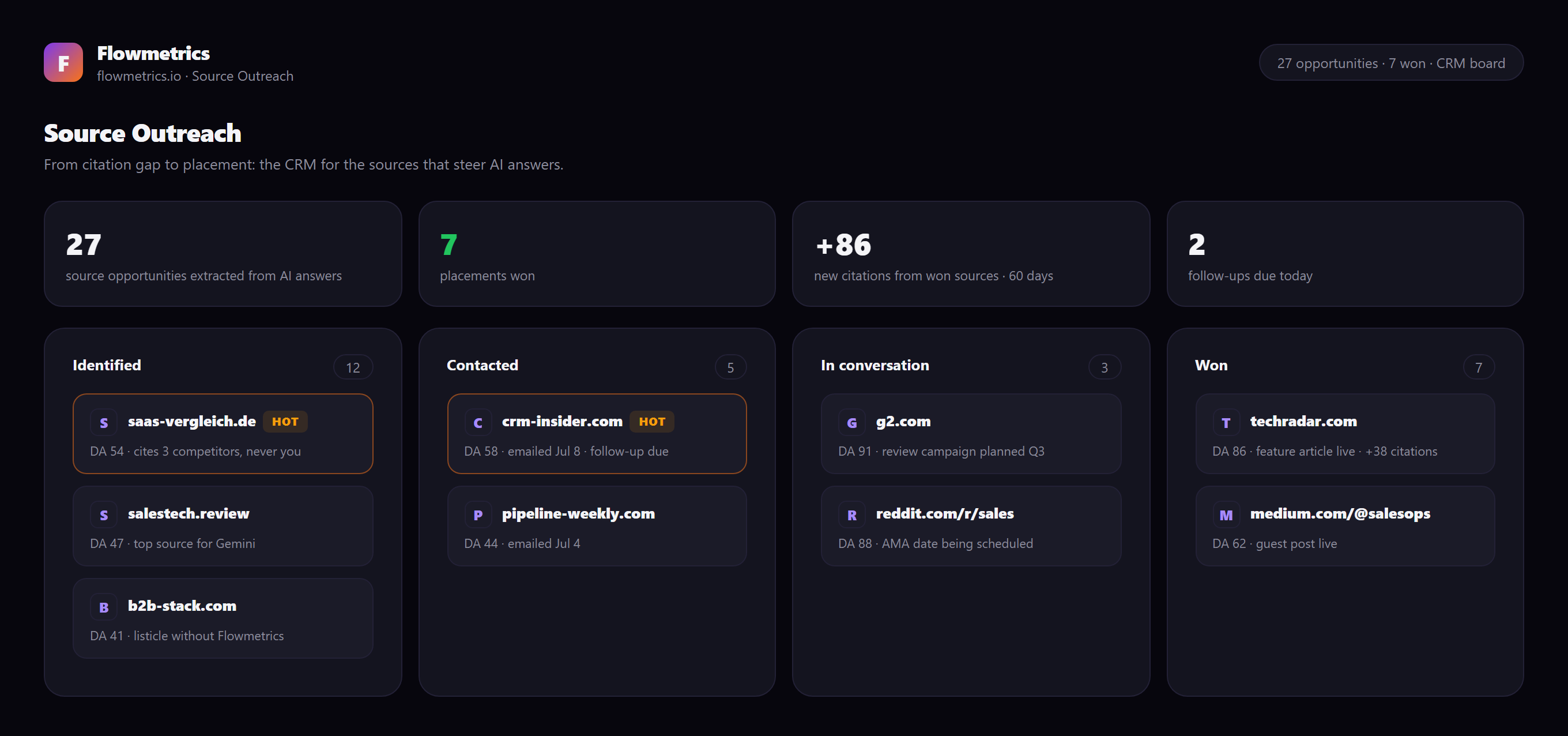
Four columns, one loop. Every card is a real cited source. It carries the domain's authority score and the reason it's on the board: saas-vergleich.de, DA 54, cites 3 competitors, never you. Or salestech.review, DA 47, top source for Gemini. The HOT tag flags the gaps worth working first. Opportunities move left to right as you work them, from Identified through Contacted and In conversation to Won, each carrying the status you logged (emailed Jul 8 · follow-up due). You send the mail; Truffle keeps the record. The tiles up top close the loop: 27 opportunities extracted from AI answers, 7 placements won, and +86 new citations traced back to those won sources over 60 days. That last number is the one to judge the work by, because it measures the outcome the outreach was supposed to buy. Illustrative data for demo brand "Flowmetrics."
This is the part that closes the loop
Every AI-visibility tool ends at the diagnosis: here's your score, here's the competitor cited instead of you, good luck. The hardest question stays yours to answer. So who do I actually email? Source Outreach answers it with a name, a contact route and a draft, then tracks the placement back into the citation data that started it. Observation becomes outreach becomes a citation you can watch land.
What you get with Source Outreach
Every capability below ships today. Nothing here is a roadmap promise.
Frequently asked questions
Where do the contacts come from?
Is this just link building with a new name?
Which plan is Source Outreach on?
Do you send the emails for me?
How do you know when a citation lands?
How fast do I get the first result?
Stop reading about the gap. Start closing it.
Source Outreach ships on Pro and Agency. Find the sources the AI engines already cite in your category, get the contacts, and send your first pitches.
Cancel anytime · Source Outreach on Pro and Agency