
Your buyers are asking AI about your category right now.
You just can't see the answers. Add the questions your buyers actually type, and Truffle runs every one of them across every LLM you care about. It records whether you're mentioned, in what position, and how that changed since yesterday.
Illustrative data · demo brand "Flowmetrics"
A buyer used to open Google and type three words. Now the first move of a buying journey is a full sentence typed into a chatbot: "best CRM analytics tool for a mid-size sales team, under $500 a month." What comes back is a shortlist of three brands. That sentence is the new keyword. Google at least handed you a results page to audit and a rank to check. A chatbot answer leaves no trace at all, and no log file anywhere records that the question was asked. If you're not in the answer you don't find out you lost the deal, because you never learn there was one. You cannot optimize for a question you have never seen.
What prompt tracking is
Prompt tracking is the practice of running the questions your buyers actually ask against every AI engine on a fixed schedule, and recording the answer each time. The question it answers is "when someone asks this exact question, does the AI say our name, and where in the answer?" Keyword rank never told you that. Each run is a data point. Enough runs make a trend you can act on.
The vocabulary
Ten blue links and one number per keyword, on a results page that looks the same for everyone who searches it. You check position 4 for "crm analytics" and call that visibility. It tells you nothing about the sentence a buyer actually typed, or what a machine said back about you.
A full buyer question, run against six AI surfaces, on a cadence you set. You get mention rate, position and the complete answer text per surface per day. You also get the gaps, where the AI answers the question without you in it at all.
How it works in three steps
From a list of buyer questions to a daily record of what every LLM says about you.
Add your prompts
Write the questions your buyers ask, or let Truffle's prompt generator draft them from a persona and your domain, then change whatever doesn't fit. Every prompt belongs to a persona, so buyer-A's questions stay separate from buyer-B's. Plans carry 10, 50 or 200+ prompts per brand.
Truffle runs them across every surface, on your cadence
Each prompt goes to all six tracked surfaces: ChatGPT, Claude, Gemini, Perplexity, Google AI Overviews and Google AI Mode. Daily refresh is the default (AI Mode runs weekly); dial any prompt set down to every 2 days, every 3 days or weekly to spread spend across the month. Runs are deduplicated and anonymous, so you're benchmarking a clean answer, not your own session history.
Read the matrix, work the gaps
Every prompt gets a row: position per surface, mention rate, and the full stored answer. Sort by mention rate to find the questions you own. Filter to zero-mention prompts to find the ones you don't. Open any run's history to see when an answer changed and what it changed to.
Every prompt × every surface, on one screen
One prompt is an anecdote. The matrix is the argument: the same question asked of every AI surface, every day (AI Mode every week), with your position in each answer.
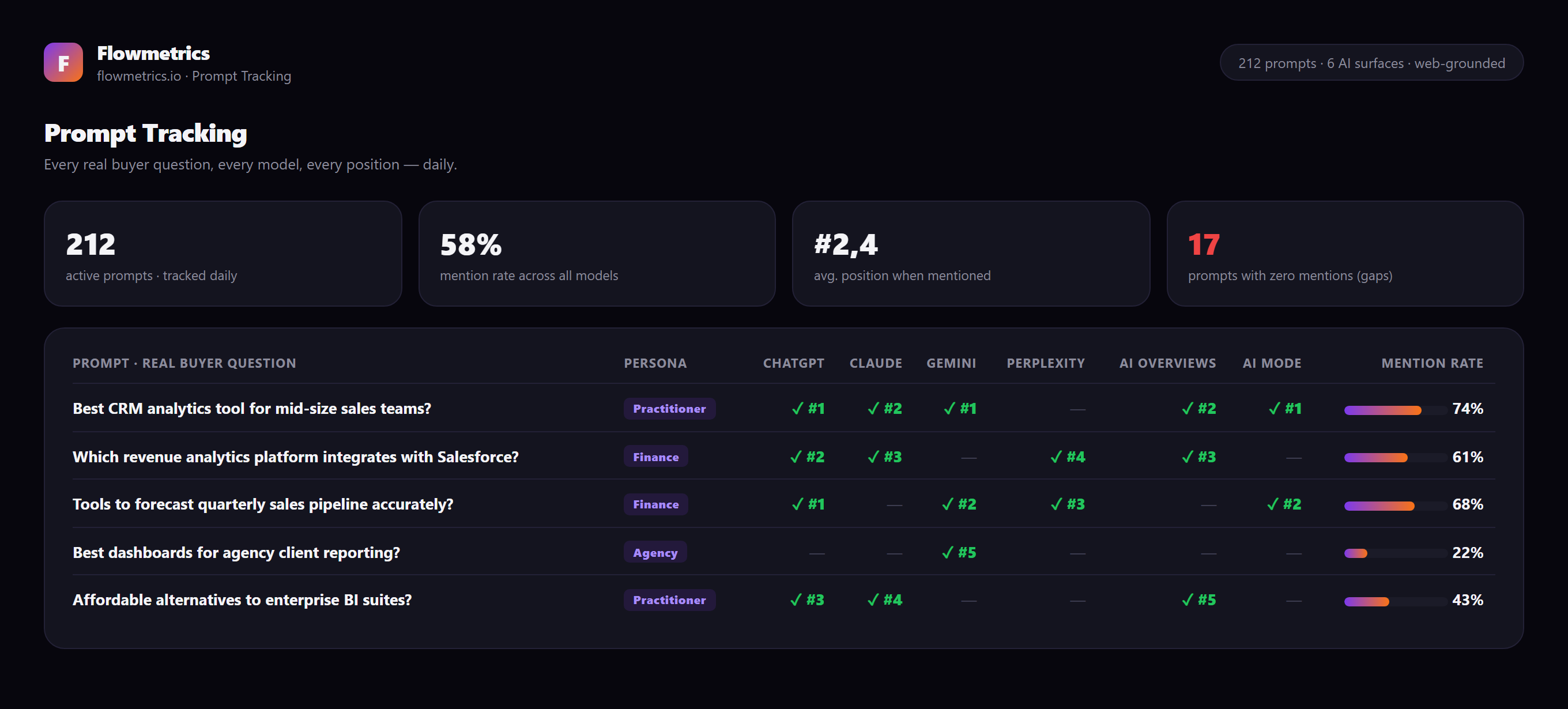
The row is the unit of work. Each line is one real buyer question, tagged with the persona who asks it, then scored across all six surfaces. A green ✓ #1 means the AI named Flowmetrics first. A dash means it answered the question without them. The mention-rate bar is simply that row's hit count over six. "Best CRM analytics tool for mid-size sales teams" lands on five of six and reads 83%, with ChatGPT, Gemini and AI Mode all putting Flowmetrics first. "Best dashboards for agency client reporting" reads 17%: one #5 from Gemini, five dashes. Read across a row and you see which surface doesn't know you. Read down a column and you see whether one engine is cold on you generally. Perplexity names Flowmetrics on two of these five questions. The two Google surfaces are not interchangeable either: AI Overviews and AI Mode disagree on three of the five rows, which is why both are tracked instead of collapsed into one Google number. Across the top sit the four stat cards: 212 prompts tracked daily, 58% mention rate, #2.4 average position when mentioned, and 17 prompts with zero mentions. That red 17 is the shortest to-do list you'll get. Seventeen questions your buyers ask where the answer belongs to someone else. Illustrative data for demo brand "Flowmetrics."
What you get with Truffle prompt tracking
Every capability below ships today. Nothing here is a roadmap promise.
Frequently asked questions
How many prompts can I track?
Where do the prompts come from? Do I have to write them all?
Which AI models do you run the prompts against?
How often does it refresh, and why not real-time?
Can I see what the AI actually said, or just the score?
How fast do I get the first data?
Stop guessing what AI says about you. Ask it every day.
See the full feature set in a 30-minute demo. Add your buyers' real questions, run them across every AI engine, and read the answer you've never been able to see.
Cancel anytime · every plan tracks ChatGPT, Claude, Gemini, Perplexity, Google AI Overviews and Google AI Mode.