Start free trial →
Feature · Citation Tracking

Every AI answer has sources. Know if you're one.

An LLM doesn't invent your shortlist. It builds it from URLs it pulled. Truffle logs every source each engine cites in your category, scores your domain's share against competitors and neutral third parties, and flags the moment an engine quietly swaps you out for someone else.

7-day trial · no credit card · cancel anytime

Source share of voice 1.284 citations · 30d flowmetrics.io 24% Competitor domains 41% Neutral third parties 35% g2.com cited by ChatGPT · Perplexity · Gemini 214 ▲ +31 flowmetrics.io cited by ChatGPT · Claude 96 ▲ +7 saastools.review cited by ChatGPT · 404 for 6 days 71 ▼ −18

Illustrative data · demo brand "Flowmetrics"

Why the citation is the impression

A classic SEO tool tells you that you rank third for a keyword. It cannot tell you that ChatGPT built its answer from a G2 category page and a Reddit thread, quoted a competitor's comparison post, and never opened your site at all. The citation list is the shortlist. If your domain isn't in it, no amount of on-page work changes the answer a buyer reads. And on the days you are cited, your analytics stay just as quiet: the reader got what they came for inside the answer and never clicked. You're being read far more often than you're being clicked, and a mention count can't see the difference.

1%
When an AI summary appeared, users clicked a link inside that summary in just 1% of visits. Clicks on a traditional search result fell to 8% of visits, against 15% of visits with no summary shown. The read still happened; the click didn't. That's the whole case for measuring the citation itself. It's the impression, and on most visits it's the only trace you get.Pew Research Center, "Google users are less likely to click on links when an AI summary appears in the results," July 2025. Browsing data from 900 US adults across 68,879 Google searches, 12,593 of which produced an AI summary, March 2025.

What citation tracking actually is

Citation tracking records the specific URLs an AI engine reached for when it answered a prompt in your category. It tells you which documents the answer was built from, which is a different question from whether your name appeared in it. Truffle runs your prompts across every tracked engine on a daily cycle and keeps the source list from every single run, so you can see who supplies the answers about your market.

The vocabulary

Citation: a source URL the engine attached to its answer. It's evidence: the answer leans on that document, and a reader can click it.
Mention: your brand name appearing in the answer text. Nice, but it can happen with no link and no source behind it.
Source share of voice: how the citations in your category split between your domain, competitor domains and neutral third parties like review sites, forums and press.
Citation drift: a source that was consistently cited for a prompt stops being cited, and a different URL takes the slot. That's the early warning that an engine changed its mind.
Source health: whether a cited URL still resolves and stays crawlable. A source that 404s or render-blocks decays out of answers over the following runs.
Generic mention counting

"You were mentioned 41 times this week." A number with no because. You can't tell which document produced the mention, whether a competitor's post was quoted next to your name, or what to change. The only move left is to write more content and hope.

Real citation tracking

The exact URL list per prompt, per engine, with the quote that was pulled. You see that a G2 page and a Reddit thread carry your category, that your own domain holds 24% of citations, and that one review site went dark six days ago. Each one is a concrete next action.

How it works in three steps

From your prompt set to a ranked list of the domains that supply the answers about your market.

1

Truffle runs your prompts and captures the sources

Every prompt in your project runs daily across ChatGPT, Claude, Gemini, Perplexity, Google AI Overviews and Google AI Mode. Truffle stores the full answer and extracts each source the engine attached to it: the URL, the engine that used it, and the passage it supported.

2

Sources get classified and scored

Each cited URL is resolved to a domain and bucketed: your domain, a tracked competitor, or a neutral third party. Truffle counts citations per source over a rolling 30-day window, tracks the trend against the previous period, and checks whether each source still resolves.

3

Act on the gap

The table ranks who actually feeds the answers in your category. Where a third party outranks you, that's an outreach target. On Pro and above, the source-outreach pipeline turns those domains into a working contact list instead of a screenshot in a deck.

Every source, ranked by how much AI leans on it

One table answers the question every marketer has about AI search: who is being cited about my category, by which engine, and is it moving for or against me?
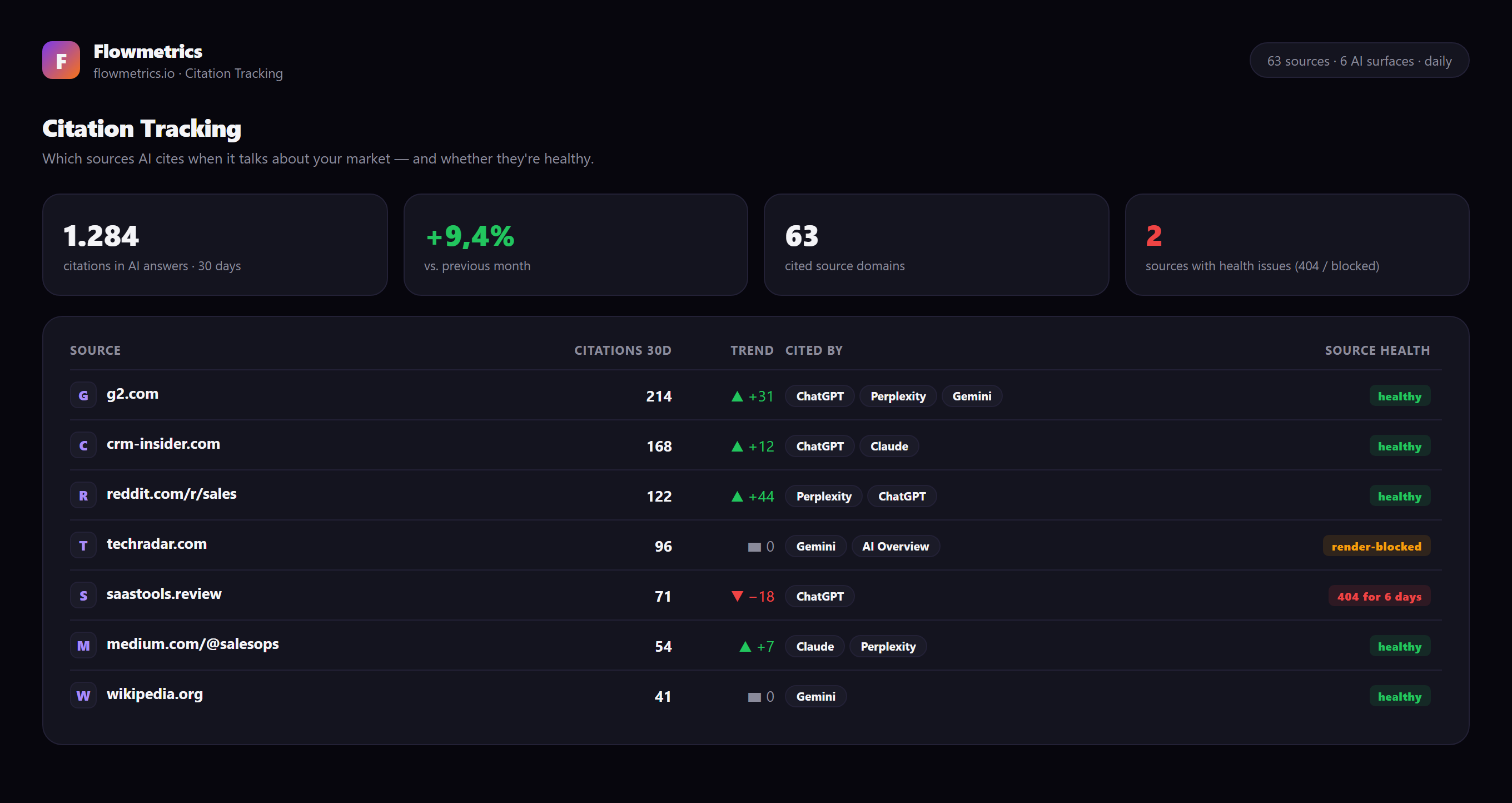
Truffle citation tracking view for demo brand Flowmetrics: header stats show 1.284 citations in AI answers over 30 days, +9,4% versus the previous month, 63 cited source domains and 2 sources with health issues. Below, a ranked sources table lists g2.com (214 citations, +31), crm-insider.com (168, +12), reddit.com/r/sales (122, +44), techradar.com (96, render-blocked), saastools.review (71, −18, 404 for 6 days), medium.com/@salesops (54, +7) and wikipedia.org (41), each with cited-by engine chips and a source-health badge.

Read it top to bottom. The header answers one question: is this getting better? 1.284 citations across 30 days, up 9,4% on the previous month, spread over 63 source domains, with 2 sources flagged unhealthy. The table below ranks those domains by how often engines actually pulled them. g2.com leads with 214 citations, reddit.com/r/sales is the fastest riser at +44, and each row's cited-by chips show which engines lean on it. medium.com/@salesops carries Claude and Perplexity but never ChatGPT. The health column is where the money is: saastools.review has returned 404 for six days and its citations are already down 18, while techradar.com is render-blocked, so it's cited today but decaying every run it can't be re-fetched. Two rows, two fixable problems, neither visible in any mention count. Illustrative data for demo brand "Flowmetrics."

The five-second read

Most of the time you won't study this table. You'll scan three columns. Citations 30d tells you who owns the category's evidence. Trend tells you where an engine is shifting its trust right now. Source health tells you which citations you're about to lose for a boring technical reason. A domain that's high, rising and not yours is your next outreach conversation.

What you get with Truffle citation tracking

Every capability below ships today. Nothing on this list is a roadmap promise.

Per prompt
The exact URLs and quotes each engine pulled for every single prompt, taken from the actual run rather than estimated at category level.
Share of voice
How your category's citations split between your domain, competitor domains and neutral third parties like review sites, forums and press.
Drift alerts
See when an engine stops citing you for a prompt and starts citing someone else, including the URL that took your slot.
Pro+
The source-outreach pipeline turns "why are they cited and we're not" into a contact list you can actually work.
Source health
Cited URLs are checked for 404s and render-blocking, so you catch a decaying citation before the engines drop it.
Daily
Sources are re-captured on a daily cycle across every tracked engine. That gives you a stable trend line instead of a number that jitters by the minute.

Frequently asked questions

How are citations actually detected?
Truffle runs your prompts against each engine and keeps the complete response, including the sources the engine attached to it. Those source URLs are parsed out of the answer, resolved to a domain, and stored against the prompt and the engine that used them, along with the passage they supported. Everything is read from the real answer rather than modelled or estimated, which is why the numbers reconcile with what you'd see if you ran the prompt yourself that day.
Which engines does it cover?
ChatGPT, Claude, Gemini, Perplexity, Google AI Overviews and Google AI Mode on every plan. Citation behaviour differs sharply between them: Perplexity attaches sources to almost everything, while other engines cite more sparingly and answer more from model knowledge. Truffle tracks each engine separately so you can see which ones actually link out in your category and which ones don't.
What counts as a citation versus a mention?
A mention is your brand name appearing in the answer text. A citation is a source URL the engine attached to the answer. They're tracked separately on purpose, because the gap between them is diagnostic: getting mentioned without being cited means the engine knows your brand but is building the answer from someone else's page, usually a review site or a competitor's comparison post. That's a completely different problem from not appearing at all, and it needs a different fix.
How often does it refresh?
Sources are re-captured once a day. It's a daily refresh rather than a live stream, and that cadence is deliberate. AI answers vary from run to run, so a single response tells you very little. Daily runs accumulated over a window give you a citation count and a trend you can actually make decisions on.
Does it work per country and language?
Yes. Language and target country are set per persona, and the citation list follows the prompt. This matters more for citations than for almost anything else. The same question asked in German and in English routinely returns entirely different source domains, like local review sites and local press that never surface in the English answer. A single English-language citation list would hide your whole position in a market you sell into.
How fast do I get the first data?
Your first run completes shortly after you add prompts, so you'll see an initial source list the same day. Citation counts and trend arrows need a window to mean anything. The 30-day figures fill in as daily runs accumulate, and you'll have a dependable read on who owns your category's sources within the first week or two.

Stop guessing why AI picked them. Read the sources it used.

A 7-day trial with the full feature set. Run your prompts across every AI engine and see the exact URLs behind every answer about your category.

No credit card · cancel anytime · every plan tracks ChatGPT, Claude, Gemini, Perplexity, Google AI Overviews and Google AI Mode.

Newcomer AI-Visibility Tracker · known from