LLM SEO: making sure AI engines can read your site
If GEO is what you publish, LLM SEO is about whether machines can fetch and read it. Crawler permissions come first, then indexable pages and structured data that matches what visitors see. Block the wrong crawler, and ChatGPT, Claude or Perplexity can skip your pages without telling you. 94% of B2B buyers research vendors inside an AI engine before clicking a SERP. The technical layer below this number determines who gets cited.
Engines and surfaces connected · 14 October 2026
| Provider | Model | Measured by Truffle |
|---|---|---|
| AI assistants | ||
| Gemini 3 | ✓ | |
| Perplexity | Sonar | ✓ |
| OpenAI | GPT-6 Luna | ✓ |
| OpenAI | GPT-4 Turbo | ✓ |
| OpenAI | GPT-4o | ✓ |
| Anthropic | Claude 5 | ✓ |
| Anthropic | Claude Haiku 4.5 | ✓ |
| xAI | Grok 4.5 | ✓ |
| Google search surfaces | ||
| AI Overview — the AI answer above the search results, not a chat assistant | ✓ | |
| AI Mode (Google's conversational search mode), measured once a week | ✓ | |
A model counts as connected when it has returned measurements in the preceding seven days; the list is taken from production, not from a roadmap. Which engines run is configurable per project, and a run measures several of them side by side — there is no lead model the rest is compared against.
What is LLM SEO?
LLM SEO (Large Language Model SEO) is the discipline of preparing a website's technical infrastructure so that AI engines can crawl, parse, index and retrieve its content with low ambiguity and high precision.
It is the prerequisite layer of AI SEO. GEO decides what to publish so models cite you. LLM SEO decides whether models can technically access and process that content at all.
One technical proposal in this area is the llms.txt file from Jeremy Howard (Answer.AI), first published in September 2024: a Markdown summary for LLMs, placed at the root of a site or, since version 2 of the proposal, under any path, and named in the manner of robots.txt. It addresses a problem the whole discipline shares: LLMs struggle to extract clean, canonical information from sites optimized for traditional SEO surfaces.
What that means in practice:
For Google, it builds on technical SEO. Google says AI Overviews and AI Mode have no technical requirements beyond normal eligibility for Search. The other engines are different: ChatGPT, Claude and Perplexity crawl with their own bots, and each can be allowed or blocked separately.
Structured data has to match the page. Google asks for exactly that and says no special markup is needed for its AI features. Around it sit entity resolution, AI crawler permissions in robots.txt and validation of the markup. An llms.txt file is optional on top.
Search and training use different crawlers. OpenAI lets you allow OAI-SearchBot, which puts pages into ChatGPT search answers, and still block GPTBot, which collects training data. Anthropic separates Claude-SearchBot from ClaudeBot the same way. Blocking a search crawler costs visibility in that engine's answers, whatever Google does with the same page.
Glossary · four canonical terms
robots.txt allowing/blocking specific AI crawlers (OAI-SearchBot, GPTBot, Claude-SearchBot, ClaudeBot, PerplexityBot, Google-Extended)The multi-engine landscape of AI search
The AI search surface is no longer "ChatGPT and others." Each engine now drives a substantively distinct query distribution. Optimizing for one and ignoring the rest leaves the others unmonitored.
| Engine | Provider | Query type | Crawler | Indexing source |
|---|---|---|---|---|
| ChatGPT (chat) | OpenAI | Conversational | GPTBot | Trained corpus + live web (Plus) |
| ChatGPT Search | OpenAI | Search-style | OAI-SearchBot | Live web |
| Claude | Anthropic | Conversational | ClaudeBot · Claude-SearchBot | Trained corpus + tool use |
| Perplexity | Perplexity | Search-cite | PerplexityBot | Live web, every query |
| Gemini | Conversational | Google-Extended | Trained corpus + Google index | |
| Google AI Overview | SERP-embedded | Googlebot | Google index + AI synthesis |
The technical implication
Allowing Google-Extended does not put a page into AI Overviews. Google states it does not affect inclusion in Google Search, and AI Overviews and AI Mode are Search features that follow Googlebot (Google). ChatGPT, Claude and Perplexity are reached through their own search crawlers, OAI-SearchBot, Claude-SearchBot and PerplexityBot, so check those separately (OpenAI).
Live AI Visibility Check — track real queries, not keyword translations
Most LLM SEO tools simulate prompts by translating SEO keywords ("best CRM" → "What is the best CRM?"). That misses how buyers actually ask. Truffle's Live AI Visibility Check polls real-time generative answers across every connected engine using the actual prompts your personas use — generated, validated and refreshed automatically. You see what ChatGPT cited yesterday, not what it might cite if your prompts were perfectly phrased.

Where LLM SEO sits in the AI SEO Stack
The 6-step LLM SEO implementation playbook
The changes themselves are small. OpenAI and Perplexity say robots.txt changes take around 24 hours to reach their systems. Whether AI answers then cite you is something to keep measuring.
AI crawler permissions in robots.txt
Before any LLM can read your site, your robots.txt must allow it. Explicit declarations reduce ambiguity:
User-agent: OAI-SearchBot
Allow: /
User-agent: Claude-SearchBot
Allow: /
User-agent: PerplexityBot
Allow: /
# Training and Gemini: your choice
User-agent: GPTBot
Allow: /
User-agent: ClaudeBot
Allow: /
User-agent: Google-Extended
Allow: /
Common failure: legacy Disallow: * rules from privacy audits silently blocking AI crawlers.
llms.txt file at the root or under a path
The llms.txt proposal (from Jeremy Howard, Answer.AI) defines a markdown file, at the root of your domain or under a path such as /docs/, that summarizes your site or that section for LLMs. Not a replacement for sitemap.xml — a complement.
> One-sentence description
## What we do
- Capability 1
- Capability 2
## Key resources
- [Pricing](/pricing)
- [Docs](/docs)
Adoption: 8.7% of the top 1,000 sites (Rankability, Jun 2026) — but 97% of published files never get requested by an AI crawler (Ahrefs, 137K sites). Cheap to ship, not a shortcut.
Schema.org markup, FAQ-priority
Schema markup signals semantic structure to LLMs. Priority order for LLM SEO:
1. FAQPage // highest AI density
2. Article // educational
3. HowTo // procedural
4. Organization // entity
5. BreadcrumbList
FAQ blocks hand an answer engine ready-made question-answer pairs — Single Grain lists FAQ schema among the elements that feed AI Overviews (Single Grain, 2026).
Entity resolution
LLMs disambiguate entities (brand, person, product, location) by matching to canonical identifiers. Your site should reference entities by their Wikidata Q-ID where applicable and use schema sameAs linking.
"https://www.wikidata.org/wiki/Q42",
"https://en.wikipedia.org/wiki/...",
"https://www.linkedin.com/in/..."
]
Common failure: 5 different founder bios across blog, about, press kit → LLMs read 5 conflicting entities.
Structured data validation, multi-surface
Schema that validates on Google Rich Results does not necessarily parse correctly for AI engines. Validate across multiple surfaces:
1. Google Rich Results Test
2. Schema.org validator
3. Live-test on Perplexity
4. Live-test on ChatGPT
Schema that validates for Google can still be unusable for an answer engine — inconsistent JSON-LD nesting is the usual reason. Test per engine, not once.
Multi-engine permission monitoring (continuous)
LLMs add new crawlers regularly. Q1 2026 added: OAI-SearchBot (ChatGPT Search), Anthropic's expanded ClaudeBot, Bytespider (TikTok AI).
Monthly minimum
Quarterly if low-traffic
robots.txt must be updated continuously, not annually.
Where AI citations actually land
Citations are split across engines, and the split differs per brand and per query set. Optimizing only for ChatGPT leaves the rest of that surface uncovered — which is why this is measured per engine, not once.
Illustrative split. There is no public industry measurement of citation share by engine — Truffle measures the actual split per brand.
LLM SEO tools in 2026, side by side
Five platforms, each built for a different kind of buyer. "Not listed" means the vendor's own page gave no figure on the date below.
| Platform | Engines at entry | Entry |
|---|---|---|
| Truffle | All, every plan | $69 |
| Profound | ChatGPT on the free Trial · up to 9 on Enterprise | Not published |
| AthenaHQ | 11 models on Starter, credit-metered | $295 |
| Schema App | Not listed | On request |
| WordLift | Not listed | €799 (Business+) |
Competitor prices as of 2026-09-17, taken from each vendor's own pricing page. Vendors change plans without notice — check with the vendor before deciding.
Which one fits
If your gap is structured data alone, a schema or entity specialist may be enough. If you need to see what every engine does with your site and act on it, you need tracking as well. Truffle is built for teams that want the multi-engine LLM SEO and GEO loop in one workspace.
Two more Truffle capabilities that close the LLM SEO loop
Capability 1 (Live AI Visibility Check) and Capability 4 (Smart Onboarding) sit inline elsewhere in this page. Capabilities 2 and 3 below complete the daily editorial + technical loop.
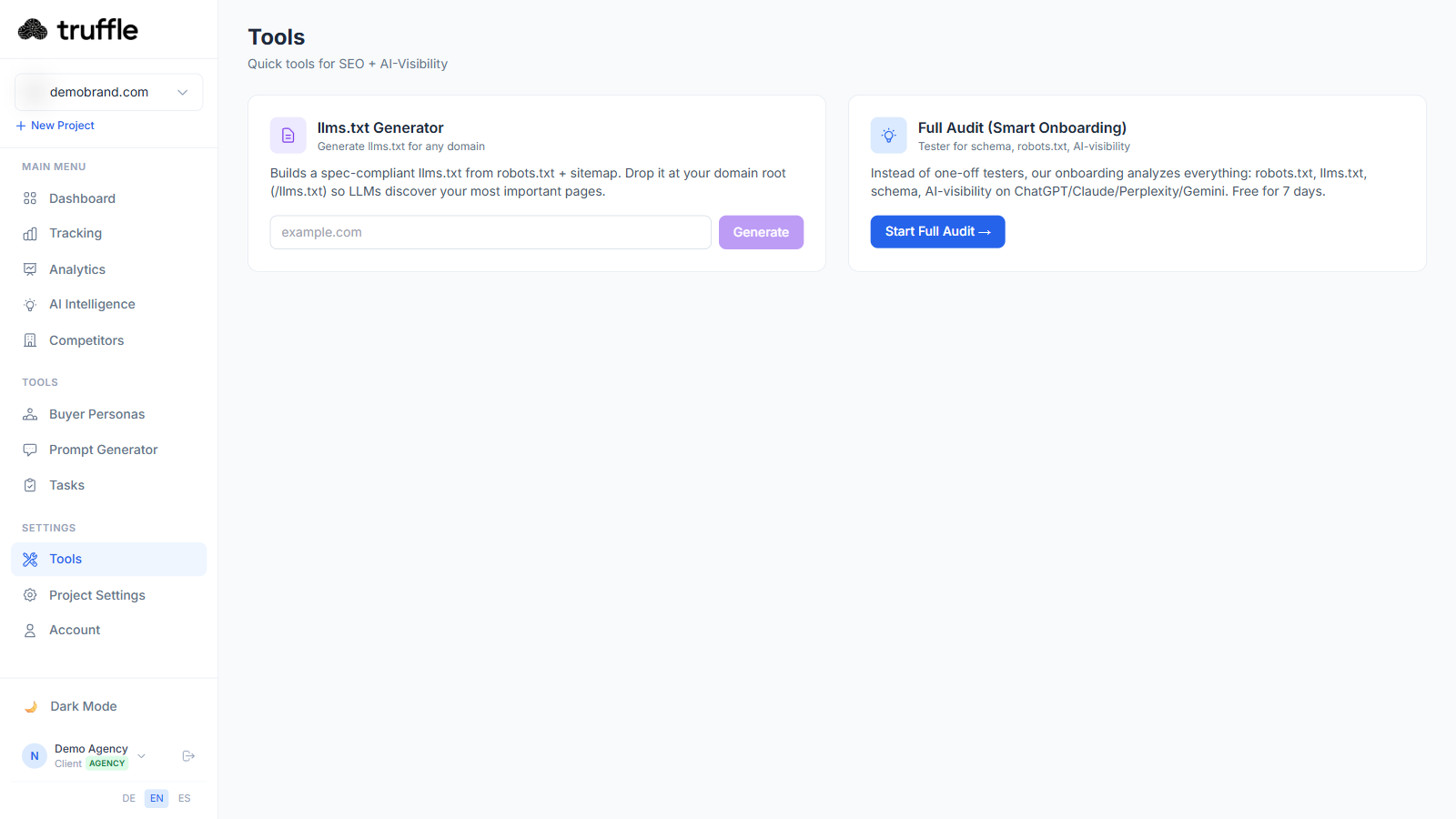
Tools — llms.txt Generator + Full Audit (Smart Onboarding)
Truffle's Tools section ships two purpose-built utilities for LLM SEO. The llms.txt Generator produces a spec-compliant llms.txt from your robots.txt + sitemap so LLMs discover your important pages. The Full Audit (Smart Onboarding) tests schema, robots.txt and AI-visibility on ChatGPT/Claude/Perplexity/Gemini in one flow.
AI Generate · 10-model prompt simulator
LLM SEO needs prompt testing across engines without paying for 10 separate API subscriptions. Truffle's AI Generate runs simulated prompts across the engines the tracker measures (OpenAI, Anthropic, Google Gemini, Perplexity, xAI, plus AI Overview and SERP top-10 simulators) from one interface. Test citation-worthiness, model entity resolution, draft schema variants — all in one workflow.

The LLM SEO tooling market in 2026
Foundational and one-time-setup-heavy, so the work is smaller than ongoing GEO services. The leverage is permanent — GEO without LLM SEO leaks citations.
click-through rate on position 1 once an AI Overview sits above it
of keywords show an AI Overview — around 30% in the long tail (German market)
of the world’s top 1,000 sites publish llms.txt — and 97% of those files are never requested by an AI crawler
Note on the figures above: market sizing and adoption rates include expert projections and trend models from industry research firms — credible directional data, but not single-source verified to a primary academic study. Detailed methodology and source list available on request.
Smart Onboarding — site analysis, personas and tracking ready in minutes
LLM SEO programs typically take 2–4 weeks to scope: analyze the site, draft buyer personas, build the initial prompt set, run the first visibility check. Truffle Smart Onboarding runs the full setup as an AI-guided 3-step wizard: Website Analysis (industry, audience, products, value proposition, detected competitors with confidence score), Context & Data (GSC and GA CSV import + extra context), and Persona Selection (5 AI-suggested personas with their tracking prompts). The first visibility check runs the same session.
Book a demo →
Frequently asked questions
What is LLM SEO?
How is LLM SEO different from technical SEO?
robots.txt. A site can be in perfect shape for Google and still be closed to them.How is LLM SEO different from GEO?
OAI-SearchBot are not shown in ChatGPT search answers (they can still appear as navigational links), however good the content is.Do I need llms.txt?
llms.txt is a proposal by Jeremy Howard, first published in September 2024, meant to help agents such as coding assistants use a website. In an Ahrefs study of 137,000 domains, 97% of the published files got no requests at all in May 2026. It takes little effort to add, but don't treat it as a substitute for crawler access.Which AI crawlers should I allow?
OAI-SearchBot for ChatGPT, Claude-SearchBot for Claude and PerplexityBot for Perplexity. Training uses other bots, GPTBot at OpenAI and ClaudeBot at Anthropic, so you can allow search and still block training. Google-Extended controls Gemini training and grounding in Gemini Apps and Vertex AI. Google states it does not affect inclusion in Google Search, which is where AI Overviews and AI Mode appear. Providers rename and add bots, so check their documentation whenever you review robots.txt.What schema markup matters most for LLM SEO?
Organization with sameAs links to your official profiles, BreadcrumbList, and FAQPage only where the questions and answers are visible on the page, as they are here.What are the best LLM SEO tools in 2026?
How long does LLM SEO setup take?
robots.txt, fixing structured data that doesn't match the page, and optionally adding llms.txt. OpenAI and Perplexity both say robots.txt changes can take around 24 hours to reach their systems. Whether AI answers then cite you is a separate question that no setup can guarantee, so keep measuring after the changes are live.Audit your technical layer first. Then let GEO compound.
LLM SEO is the foundation that makes everything above it measurable. Truffle's technical audit checks schema density, AI crawler permissions, llms.txt status and entity resolution gaps.
GDPR-ready · Encrypted backups · Cancel anytime.