
Destination hierarchy
Region above, cities and properties below. Add a destination once and it carries its own prompts, personas and competitor set.
A traveller asks 'best family hotel in Mallorca with a kids club' in ChatGPT. One property gets named. The rest are not on the list at all.
Track that answer across every destination you operate in, in the language the guest actually asks in — and see whether the assistant learned it from Booking.com or from your own site.
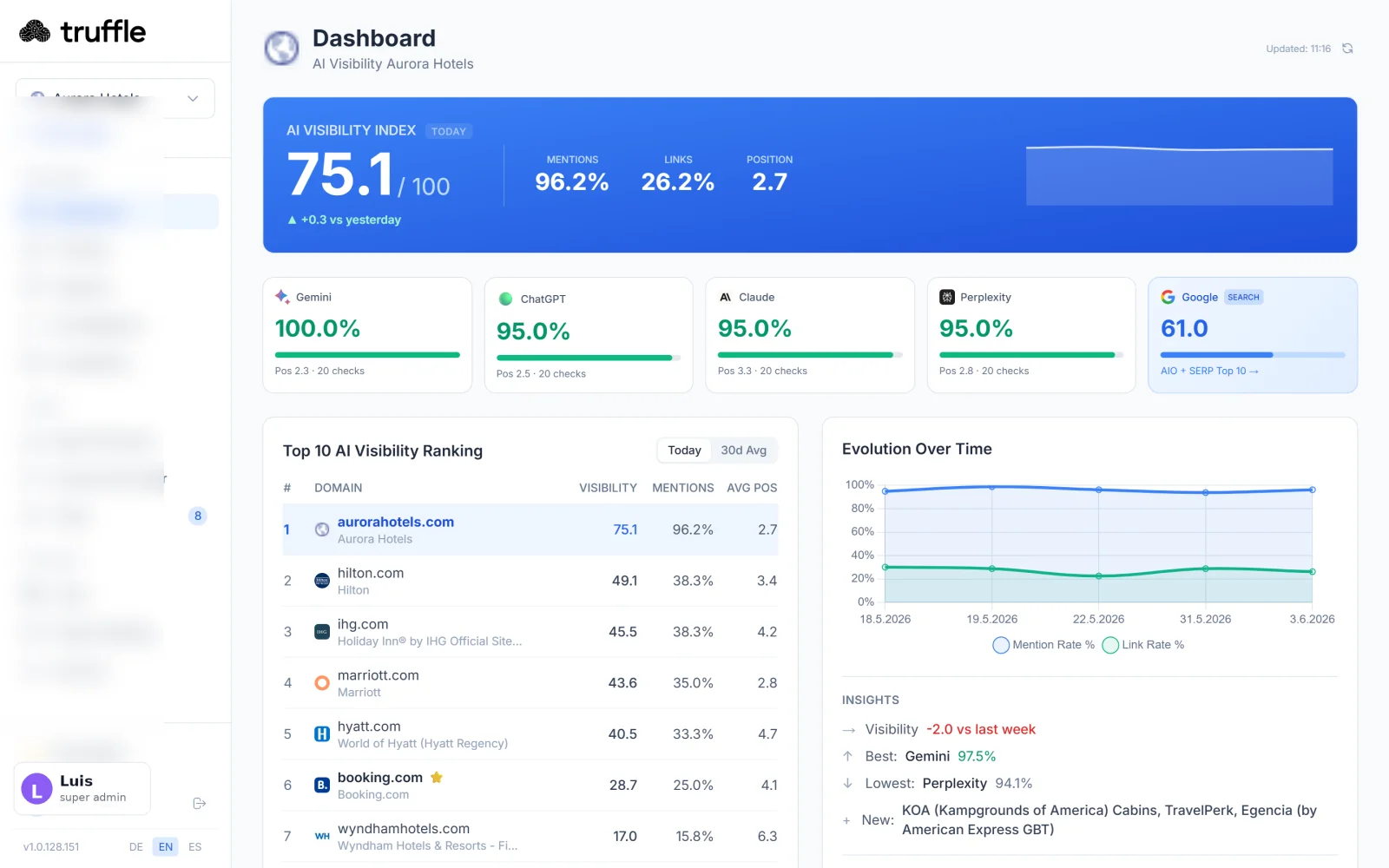
Truffle dashboard — per-LLM visibility across all 6 AI surfaces.
 ChatGPT
  Claude
  Gemini
  Perplexity
  Google AIO AI Mode
 Hotel visibility is not one number. The same brand can lead in German-language answers about Berlin and be invisible in Spanish-language answers about the same city — and a tool that reports one national average hides exactly that.
Every property, city or region is its own tracked entity, in a hierarchy — region above, individual destinations below. A group with houses in thirteen countries sees thirteen answers, not one.
The same question in German, Spanish, French, Italian, Dutch or English produces different answers and different sources. Each persona carries its own language and country, so the report separates them instead of averaging them away.
When an assistant recommends a hotel, it names a source. Truffle separates booking platforms (Booking.com, Expedia, Trivago, Agoda, Airbnb and eight more) from official tourism sources and from your own domain — because the fix is different for each.
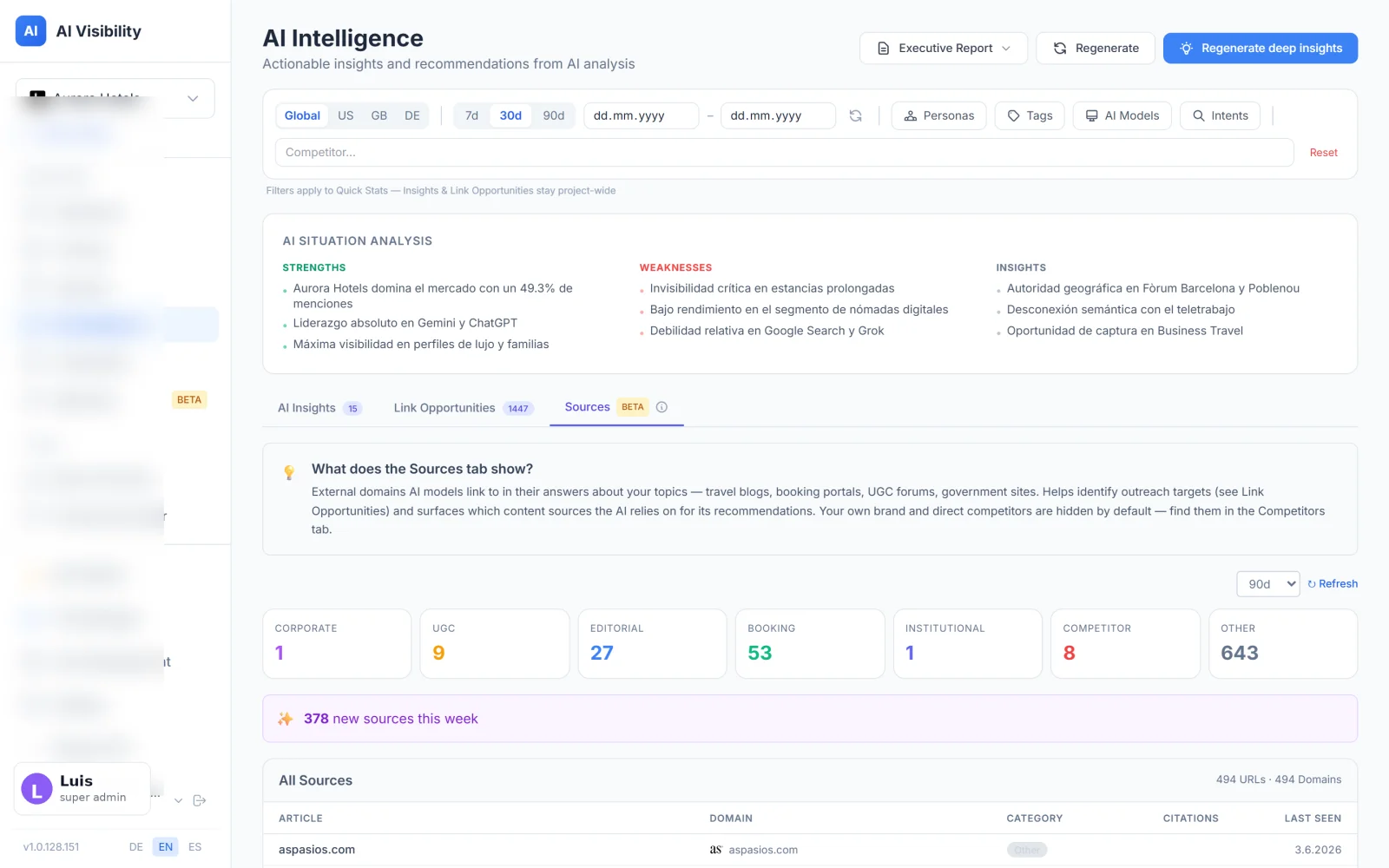
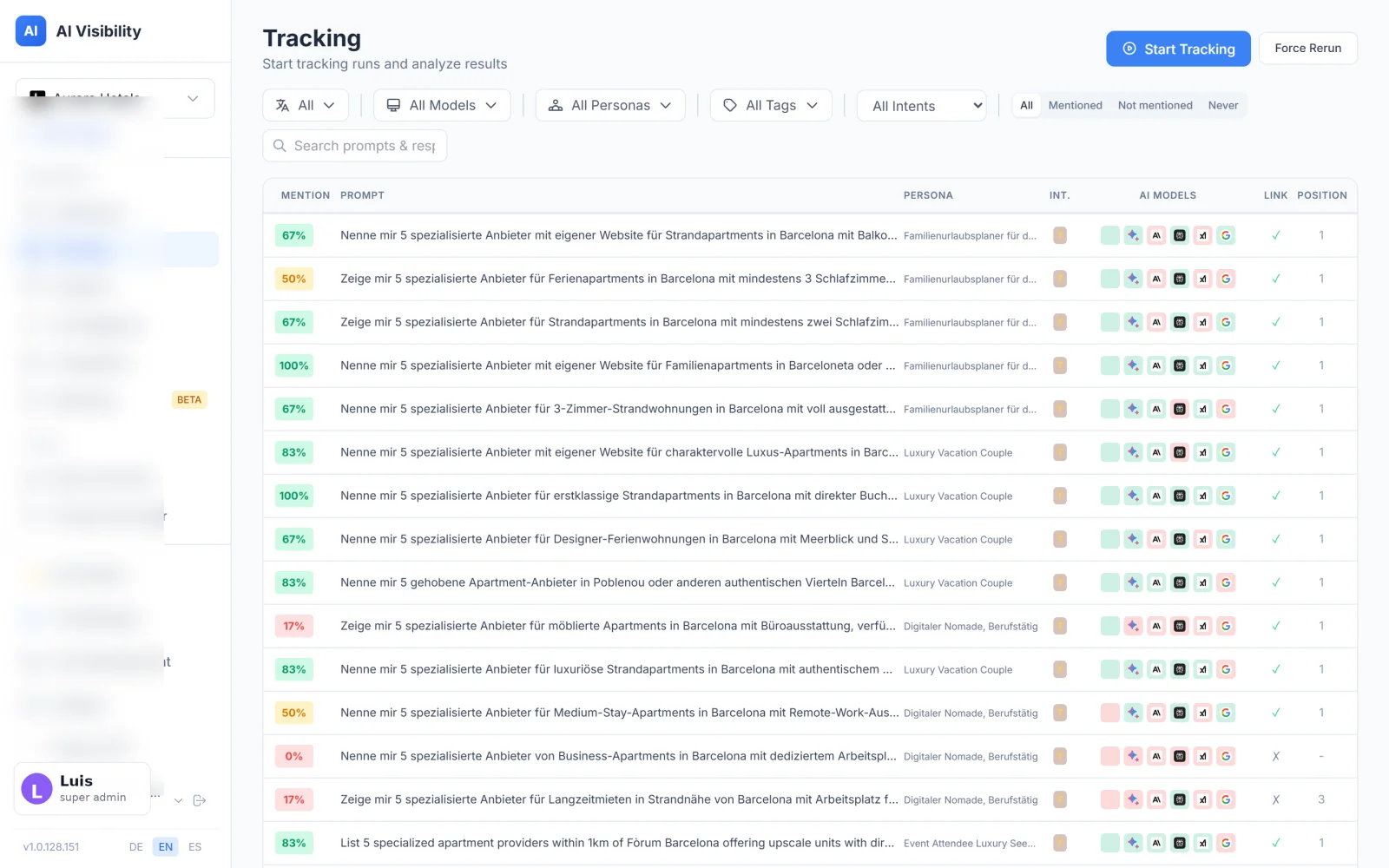
Region above, cities and properties below. Add a destination once and it carries its own prompts, personas and competitor set.
Answers in six languages stay six answers. A brand strong in its home language often disappears in the language its inbound guests use — that gap only shows if nobody averages it.
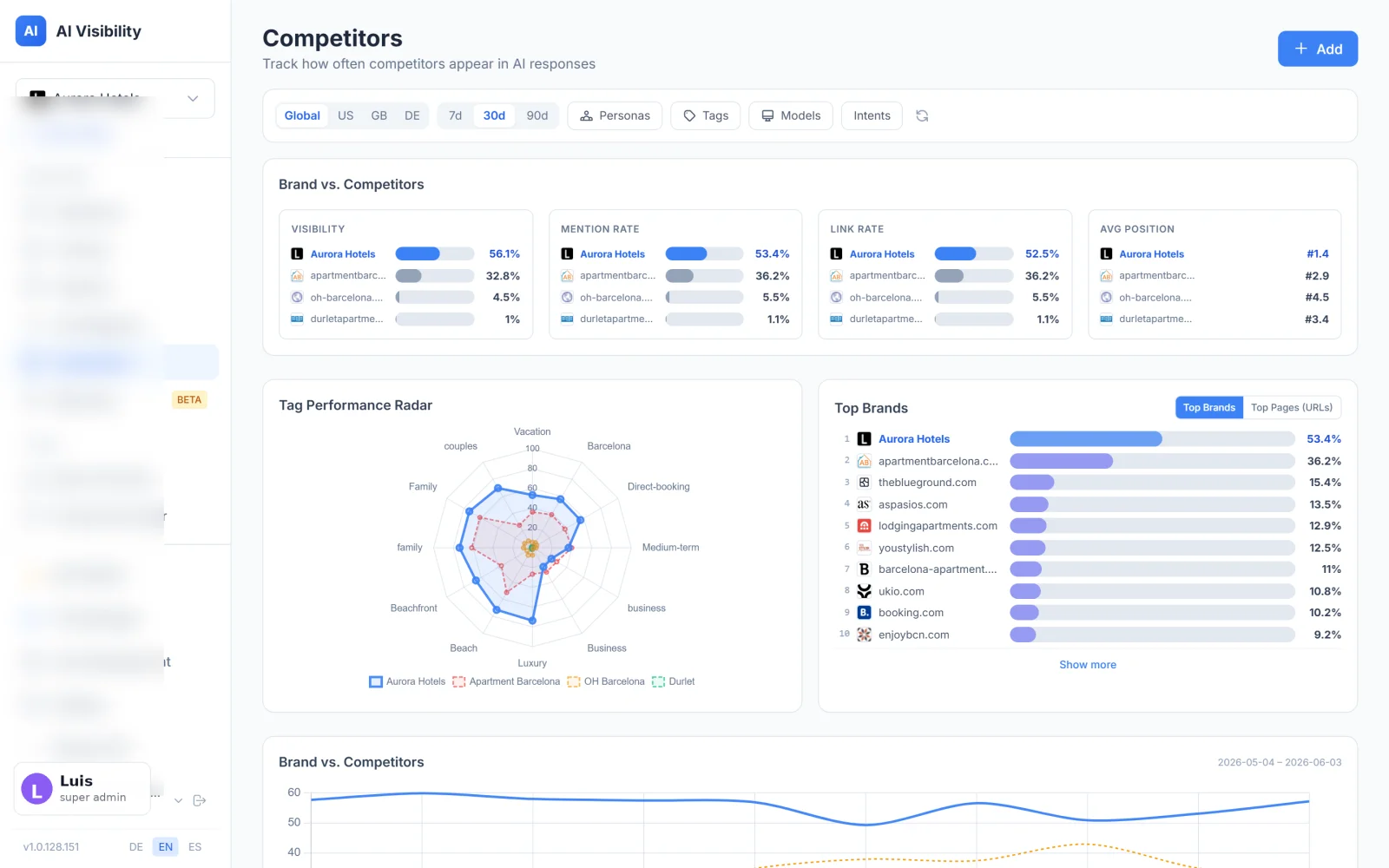
A heat map of mention rate per competitor per country, taken from the persona behind each prompt. Booking platforms are filtered out so you compare hotels against hotels.
Eleven booking platforms and the official tourism domains are classified separately. You see whether the assistant is quoting an intermediary or you.
Family, business, couples, groups — each with its own language, country and prompt set. The same property ranks differently for each.
ChatGPT, Claude, Gemini, Perplexity, Google AI Overviews and the classic SERP top ten, refreshed daily.
Onsite and offsite tasks per destination — which schema fields, which regional sources and directories to pitch, which pages to strengthen.
Map visibility shifts to actual sessions and bookings instead of guessing whether an answer moved anything.
The competitor view separates hotels from intermediaries. If an assistant names Booking.com instead of your property, that is a different problem than a competing hotel outranking you — and it has a different fix.
Comparing Truffle with another AI visibility tool? See the full side-by-side comparison hub →
Destination-level tracking does not cost extra. The Pro/Agency tier covers fifteen brand workspaces flat, which for most groups means the whole portfolio plus the competitor watch list.
Pro / Agency
$399 /month
or $367/month billed annually — save 8%
~$27 per brand/month for full coverage across every destination and language you operate in.
Region, cities, properties. The hierarchy is set up once and carries everything below it.
Which languages your guests actually ask in, and which guest types matter per destination.
Prompt set, competitor mapping and the first source breakdown per destination.
Yes. Destinations are their own entities with a hierarchy — a region above, cities or individual properties below. Each one carries its own prompts, personas and competitor set, so a group operating in several countries gets one report per destination instead of a single national average.
Yes, and this is usually where the surprise sits. Every persona carries its own language and country, so answers in German, Spanish, French, Italian, Dutch and English stay separate. A brand that leads in its home language is often invisible in the language its inbound guests use, and an averaged report hides that completely.
Yes. Sources are classified into booking platforms (Booking.com, Hotels.com, Expedia, Kayak, Trivago, Agoda, HRS, Skyscanner, Tripadvisor hotel pages, Vrbo, Airbnb), official tourism sources such as national and city tourism boards, and your own domain. An assistant naming an intermediary is a different problem than a competing hotel outranking you, and the recommended fix differs accordingly.
They are filtered out of the competitor comparison so hotels are compared against hotels. They remain visible in the source breakdown, where they belong — the point is to see them, not to rank against them.
ChatGPT, Claude, Gemini, Perplexity, Google AI Overviews and the classic SERP top ten, on every paid plan, refreshed daily.
No. The Pro/Agency tier at $399 per month covers fifteen brand workspaces with 200 prompts in total, and destinations sit inside that. There is no per-property or per-market surcharge.
Auto-generated, prioritised recommendations with impact estimates and concrete next steps. Filtered by category — Technical, Content, PR, Competitive, Brand, Strategy.
Only 1/6 model coverage on family-resort prompts. Booking + Marriott dominate this segment. Aurora's family-package landing pages lack schema markup and are buried 3 clicks deep.
FAQPage + Resort schema to /family pagesAI Mode mentions dropped from 28% to 22% since April. Cause: Google now weights structured data heavier — Aurora's Hotel JSON-LD on 60% of property pages is missing priceRange + starRating.
priceRange+starRating on 24 affected pagesAurora dominates "Green Key", "eco hotel Algarve" and 11 related prompts. Position 1.3 average across all 6 providers. This is a defensible moat — double down with editorial PR placements + sustainable-certifications landing-page hub.
Strategy + tasks included from day one.
all major AI models · cancel anytime