
The discipline behind a 50× search-volume growth in two years
"Generative engine optimization" went from fewer than 200 to over 7,800 monthly U.S. searches between mid-2024 and June 2026 — the fastest-growing SEO sub-field in a decade. This guide unpacks the working framework: what GEO is, why the curve is going vertical, the 6 pillars, the toolkit, and the five metrics that matter.
~3,800 words · 16 min read · Updated June 2026
50× search growth
"Generative engine optimization" searches climbed from ~150 to 7,800 monthly between mid-2024 and Jun 2026 (Ahrefs Keywords Explorer).
$0.8–1.5B in 2026
Published estimates for the global GEO services market spread across this range, with annual growth quoted anywhere from 20% to 50%. None of the widely circulated figures names a primary source that holds up.
multi-engine
Sites permitting all four AI crawler families (GPTBot, ClaudeBot, Google-Extended, PerplexityBot) compound visibility faster — multi-engine presence is itself an authority signal via cross-source corroboration.
What is Generative Engine Optimization?
Generative Engine Optimization (GEO) is the practice of structuring your content, technical setup, and external signals so generative AI systems — ChatGPT, Claude, Gemini, Perplexity, Grok, and Google AI Overview — retrieve your pages, cite your brand, and recommend you when users ask category questions.
The term was formalized in November 2023 by Aggarwal et al. in the paper "GEO: Generative Engine Optimization", accepted to KDD 2024. The research team — across Princeton, Georgia Tech, IIT Delhi, and the Allen Institute for AI — defined the problem: generative engines don't return ten blue links. They synthesize an answer and cite a small handful of source domains per response. Visibility is no longer about ranking #1 on a SERP. It's about being inside that short citation list.
| Search era | Mechanism | Visibility unit |
|---|---|---|
| Classical SEO | Engine ranks documents 1–10 | Position in SERP |
| Generative search | Engine synthesizes one answer, cites a short list of sources | Inclusion in citation set |
That single shift — from being ranked to being chosen — is the entire reason GEO needs its own playbook. The rest of this guide is built around it.
"Generative Engine Optimization (GEO) frames a new paradigm where source visibility is mediated by generative models. The goal is no longer to rank, but to be selected."
Aggarwal et al. · GEO: Generative Engine Optimization · KDD 2024
Key terms you'll see in this article
Why GEO matters now — the 2026 numbers
Four data points changed the conversation in 2025–2026. Falling click volume, rising buyer adoption in AI surfaces, a services market whose size nobody can pin down, higher AI referral intent. The combination is what's pushing GEO out of "experimental" into "named budget line".
of B2B buyers used generative AI as part of their vendor research path in 2026 (up from 89% in 2025).
Forrester · 2026 Buyer Insights
monthly U.S. search volume growth for "generative engine optimization" between mid-2024 and Jun 2026.
Ahrefs Keywords Explorer · Jun 2026 snapshot
is the spread across published 2026 estimates for the global GEO services market. The figures circulate between blogs citing each other.
Published estimates · no primary source verifiable (checked Aug 2026)
AI-referred sessions convert at 14.2% vs 2.8% for Google organic baseline.
Opollo · 2026 AI Search Benchmark Report (n=312)
The implication for CFOs
Smaller traffic volumes with dramatically higher conversion intent. Translation: the AI channel deserves first-class measurement, not an "Others" bucket in GA4. Once Marketing can defend AI revenue contribution numerically, the budget conversation shifts from "should we invest?" to "how much, how fast?".
GEO vs SEO — the brief version
GEO doesn't replace SEO. It extends it. The technical groundwork of SEO (crawlability, schema, freshness, authority) is still the prerequisite — generative engines retrieve from the same web. What changes is the outcome the work targets:
- SEO targets a position in a SERP that returns 10+ ranked documents
- GEO targets inclusion in the short citation set an AI references inside a single synthesized answer
Practical consequence: SEO tactics that maximize keyword density tend to underperform in GEO, where engines reward direct-answer clarity and entity authority. Conversely, SEO investments in structured data, topical authority, and citation diversity pay double — they're foundational for GEO too.
Where to dig deeper
For how Truffle implements GEO across all six major engines, see the Truffle GEO product page. For our angle on how SEO teams should redeploy the existing stack toward AI surfaces without breaking the existing rankings, see What is AI SEO.
The 6-pillar GEO framework
Most "GEO best practices" lists collapse into one of six structural pillars. Each has a different owner, cost, and timeline. Run them in priority order based on the gap your audit surfaces.
Direct-answer blocks
Engines extract paragraphs, not pages. A 40–60 word self-contained answer at the top of a section is dramatically more citable than the same info buried in prose.
- Open every section with the direct answer first
- Keep it factually scoped — no marketing modifiers
- Repeat key entities by name (avoid pronouns)
- Third-person factual phrasing beats "we / our"
Owner: Content team · Timeline: 4–6 weeks
Schema markup at page level
Structured data (Schema.org JSON-LD) pre-extracts facts the engine would otherwise infer. FAQ schema in particular has emerged as the highest-density GEO format inside the 100+ companies Truffle tracks.
- FAQPage — highest leverage
- Article with full author + dates
- HowTo for procedural content
- Organization for entity disambiguation
AI crawler accessibility
Cheapest pillar, quiet failure mode. If robots.txt blocks GPTBot, ClaudeBot, PerplexityBot or Google-Extended, you're invisible to those engines by definition — regardless of what else you optimize on the page.
- Audit
robots.txtfor AI user agents - Deploy
llms.txtdeclaring permitted use - Configure
metarobots permissions
Free llms.txt Generator →
Multi-source authority
Engines apply multi-source corroboration: a brand mentioned positively on independent domains gets higher entity confidence. The GEO equivalent of backlinks, but mentions matter more than dofollow links.
- Earned media (press, analysts, podcasts)
- Third-party reviews (G2, Capterra, Gartner)
- Community presence (Reddit, Quora, niche forums)
- Co-citation with category authorities
Owner: PR / Marketing · Timeline: 3–6 months
Multi-engine diversification
Optimizing only for ChatGPT leaves roughly 38% of queries unaddressed across Perplexity, Claude, Gemini, Grok, and Google AI Overview. Truffle's own data across 100+ tracked accounts shows sites present across 4+ platforms are 2.8× more likely to appear in ChatGPT answers themselves — cross-engine presence is itself an authority signal. Before you widen out, see where you already stand on the biggest engine with our ChatGPT Visibility Checker.
- Pick a tracker covering all 6 engines on every paid tier
- Single-engine analytics in 2026 = Bing-blind in 2008
Continuous measurement
GEO isn't one-shot. Engine retrieval shifts weekly as models update. Five metrics that work in quarterly reviews:
- Visibility Index (composite 0–100)
- Citation rate (% prompts citing you)
- Share of voice (you vs competitors)
- Average position (per engine)
- Per-engine breakdown
Pillars 1–6 already scored, ranked, and instrumented
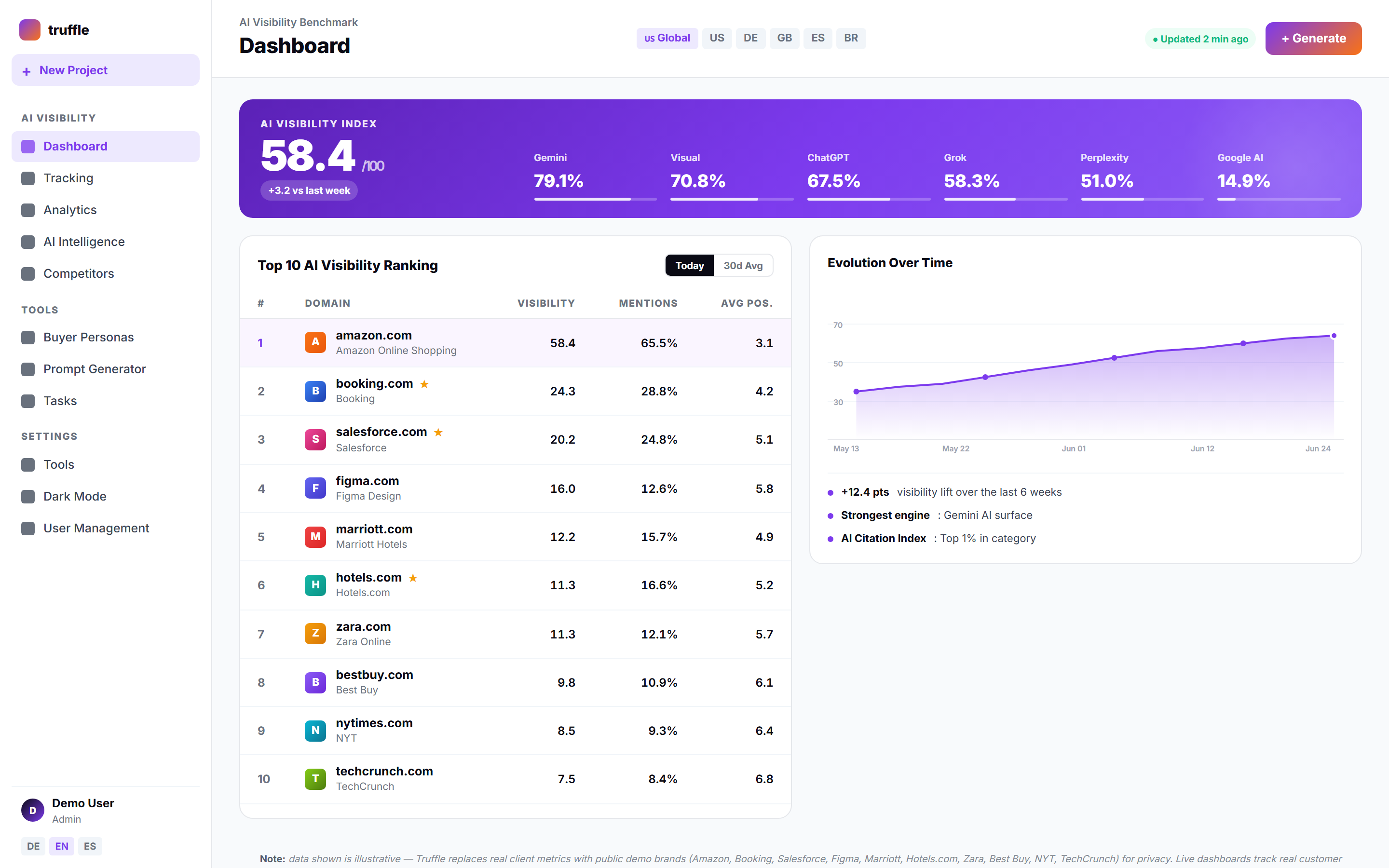
Truffle ships the full GEO scorecard — Visibility Index, citation rate, share of voice, average position, per-engine breakdown — on every paid tier. The framework above runs as a live dashboard, not a checklist.
How generative engines actually work
Most "how to do GEO" guides skip this. Understanding the mechanics makes everything above feel less like superstition. Each pillar maps to a specific stage of the retrieval-and-answer pipeline.
Query interpretation
The model classifies the question (informational / commercial / procedural) and decides if it needs fresh retrieval.
Web retrieval
The engine triggers a retrieval call (ChatGPT via Bing-derived index, Perplexity via its own crawler + multi-engine fallback).
Candidate ranking
Retrieved documents are scored on embedding similarity to the query + a quality/authority score.
Citation selection
The model picks a small set of source documents to ground the answer — your inclusion target.
Answer synthesis
Model writes a fluent answer drawing from the chosen sources and embeds citation markers in the text.
User sees the answer
With citation markers showing the small set of sources the model trusted enough to ground its answer in.
The operator takeaway
Each of the 6 pillars maps to a specific stage above. Direct-answer blocks help at Step 3 (engines prefer docs that look like answers). Schema markup helps at Step 1 (interpretation). AI crawler accessibility is the gate at Step 2. Authority signals are weighed at Step 3. Skipping a pillar means losing influence at a specific step of the pipeline.
Implementing GEO — strategic roadmap
You don't need a 30-step checklist. You need four phases run sequentially, then in parallel as each one matures.
The 4-phase roadmap
The GEO toolkit — three categories your team needs
The GEO tooling market in 2026 splits cleanly into three operational categories. Pick at least one tool in each. The real question is which combination covers tracking + content + technical without paying for overlap — and most teams find that running it all from a single dashboard removes the integration tax.
Tracking & analytics
Monitor what AI engines say about your brand, rank citations, measure share of voice.
- Truffle AI Analytics — all 6 engines on every paid tier
- Visibility Index, citation rate, share of voice on one screen
- 5–10 reference brands tracked at the project level
Content optimization
Analyze pages against GEO best practices, recommend rewrites, validate structure.
- Schema Checker
- llms.txt Generator (free)
- Free check (no signup)
- Page-level rewrite recommendations inside the dashboard
Technical & accessibility
robots.txt auditors, llms.txt validators, crawler simulators — overlap with classical SEO tooling.
- AI Citation Tracker — verify real AI citations
- ChatGPT Check — per-engine quick test
- Crawler permission audits + recommendations
The whole toolkit — without the integration tax
Truffle ships tracking, content optimization, and technical audits from a single dashboard. No glueing three separate products together with spreadsheets in the middle. Plug your brand and the full GEO stack is live in under 24 hours.
Common GEO mistakes — and the fixes
After auditing hundreds of projects across the 100+ companies Truffle tracks, the pattern of mistakes is remarkably stable. Six repeat across companies of all sizes.
Blocking AI crawlers without realizing it
Default robots.txt of many CMS templates blocks GPTBot as a "privacy" measure with no policy basis. You discover this only when an audit shows engines that should cite you don't.
Fix. Audit robots.txt, explicitly allow major AI crawlers, deploy llms.txt declaring permitted use.
Keyword-stuffing like it's 2014
Engines reward direct-answer clarity, not phrase density. Repeated keyword variations actively hurt GEO performance because they break the "concise answer" pattern engines retrieve.
Fix. Write for one explicit reader question per paragraph; let the entity authority do the heavy lifting.
No FAQ schema on FAQ-shaped content
Pages that look like FAQs (lots of H3 questions) without FAQPage schema markup leave meaningful citation visibility on the table — engines retrieve question-answer patterns most reliably when they're explicitly marked up.
Fix. Ship FAQPage JSON-LD on every page with three or more question-shaped sections. Test with Schema Checker.
Optimizing only for ChatGPT
The single-engine team eventually discovers 50%+ of their category queries flow through Perplexity, Claude, Gemini, and Google AI Mode — engines they never instrumented.
Fix. Pick a tracker covering all six major engines from day one. Single-engine analytics is structural blindness.
Reporting "mentions" without share of voice
A 12% mention rate sounds great until you see the rest of the category sits at 38%. Raw mention counts are vanity; share of voice across your category is decision-grade.
Fix. Configure 5–10 reference brands at the project level so every mention is interpretable in context. Without this, the dashboard tells you nothing about whether you're winning the category.
Not knowing which sites cite your category — and skipping Digital PR
Engines weight mentions across independent reputable sources. Most teams optimize their own site and forget that the citation set is built off-site: G2, Capterra, Reddit, niche forums, tier-1 publications. Without a Digital PR play, the citations belong to whoever asked for them.
Fix. Identify the 15–20 high-authority sources your category appears in (Truffle surfaces this as the source mention map inside AI Analytics), then run a focused Digital PR play — guest articles, expert quotes, podcast appearances, review platform updates — to plant your brand on those exact domains.
Measuring GEO success — the five metrics that matter
Each metric answers a different operator question. The trap is reporting one and missing what the others reveal.
| Metric | Question it answers | Where it shows up |
|---|---|---|
| AI Visibility Index (composite) | "Are we more or less visible than last week?" | Dashboard headline |
| Citation rate | "What % of our target prompts cite us at all?" | Per-prompt detail |
| Share of voice | "What % of category citations are us vs competitors?" | Brand vs Competitors |
| Average position | "When cited, are we cited first or last?" | Per-engine breakdown |
| Per-engine breakdown | "Which engines are working, which aren't?" | Engine table |
All five matter because each masks information the others reveal. Visibility Index alone hides where the volatility comes from. Citation rate alone hides whether you're winning or losing the category. Share of voice alone hides whether the absolute volume is growing. AI Analytics exposes the five on one screen.
The Truffle term
The AI Visibility Index is a Truffle-proprietary composite. It rolls mention rate, citation rate, position, and engine coverage into a single 0–100 number so executive dashboards have something defensible to track. Other tools sometimes call it "AI search score" or "GEO score" — same idea, different label.
Start with Truffle — the 5-step path from audit to visibility
If the framework above feels right but you don't have a system in place yet, here's the operator path most teams follow inside Truffle to go from invisible to cited in their category.
Create your Truffle account
Set up your brand, category, and 5–10 reference brands you want to benchmark against. Sign up →
Find the prompts that matter
Truffle uses AI to surface the 250–500 real prompts your category's buyers ask the engines. No manual brainstorming.
Use the answers in your content
For every prompt where you're not cited, Truffle shows which content gaps to close and which sources are winning. Use the recommendations to refresh your top pages.
Monitor weekly across six engines
Citation rate, share of voice, average position, per-engine breakdown. Same screen, no dashboard switching.
See visibility climb
Most teams land their first new citations within 4–6 weeks of shipping the recommended changes. The data is the proof to the CFO.
Frequently asked questions
Eight questions sourced from Ahrefs Matching Terms — the actual queries operators run when researching GEO in 2026.
What is generative engine optimization (GEO)?
How does generative engine optimization work?
How to do generative engine optimization step by step?
Why is generative engine optimization important?
How to measure GEO success?
What is a GEO audit?
How long does GEO take to show results?
What's the difference between GEO and SEO?
robots.txt, schema, llms.txt) that underlies all of this, see the companion LLM SEO guide →Ready to stop guessing and start measuring?
Truffle ships all six engine tracking, the AI Visibility Index, and 148+ actionable insights per project on every paid tier. Run the free check first or book a demo to see the full product.