ChatGPT Visibility Checker — The 2026 Operator's Guide to Measuring Your Brand Inside ChatGPT
A serious checker polls ChatGPT with 50–100+ prompts, 3–5 runs each, against a named competitor set — and reports the four operator KPIs (mention rate, citation rate, position, share of voice). Anything less is vanity measurement.
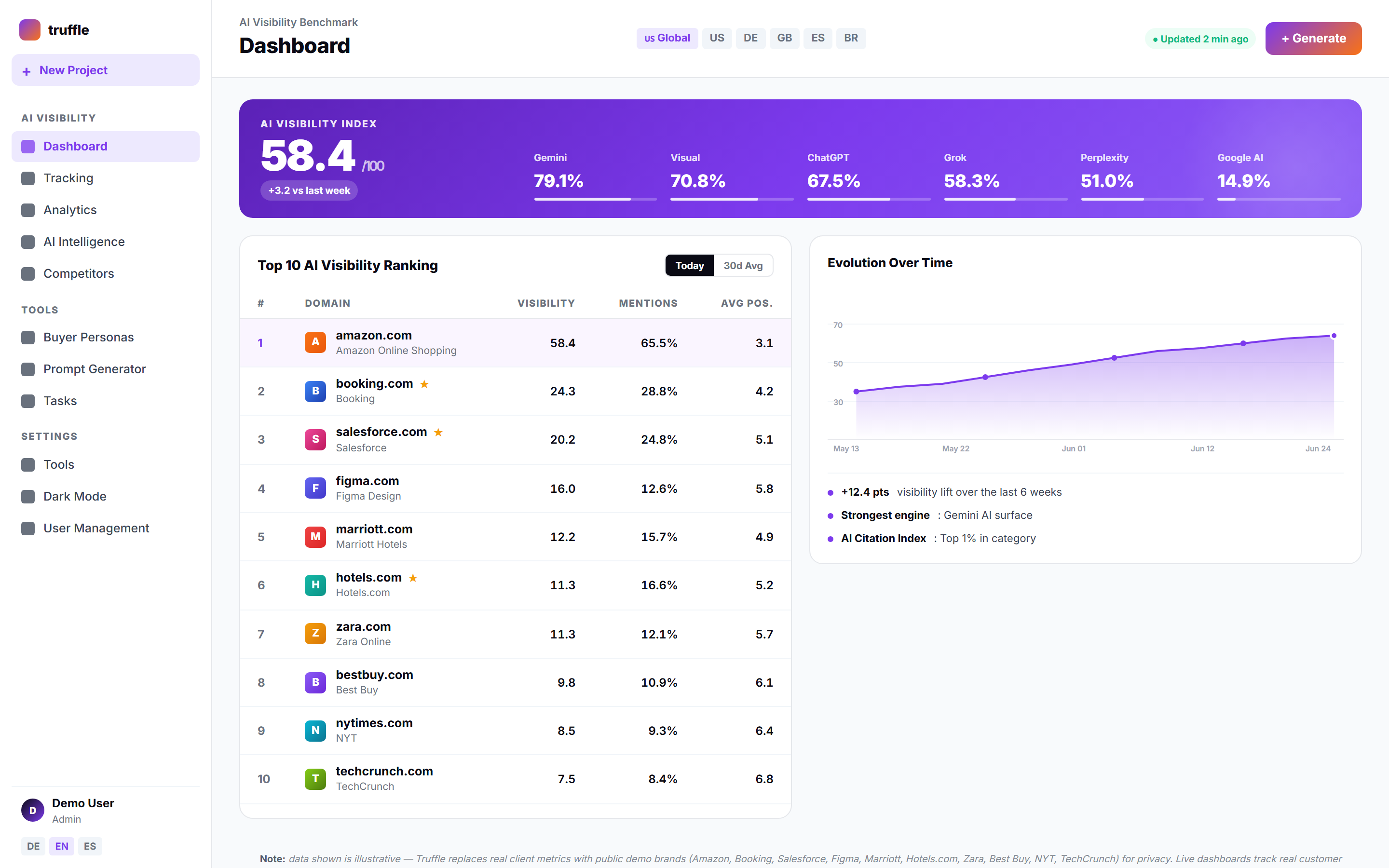
What a serious check actually returns — the AI Visibility Index headline score, the three operator KPIs underneath, and the per-engine breakdown across all six engines. Real data, brand identifiers replaced with "Demo Brand" for the public preview. See the live dashboard →
A ChatGPT visibility checker polls ChatGPT with a curated prompt set, parses the responses for your brand's presence, and reports four operator KPIs: mention rate, citation rate, position, and share of voice. The mechanism is prompt-based polling at scale because single-shot manual checks are statistically meaningless — ChatGPT responses are stochastic and an honest baseline needs 3–5 runs per prompt across 50–100+ prompts.
SECTION 1 · MECHANISMWhat a ChatGPT visibility checker actually does
A serious checker performs four steps in sequence — running them once is a manual check, running them on a weekly cadence is a tracking program. The mechanism is consistent across platforms, with differences only in prompt corpus size, polling frequency, and engine coverage.
Prompt corpus curation
A curated set of prompts the buyers in your category actually ask ChatGPT — from customer interview transcripts, top organic SEO queries reframed conversationally, sales discovery questions, comparison queries ("X vs Y"), and buyer-persona variants. Free starter checks use 25–50 prompts; serious tracking scales to 250–500.
Multi-run polling (3–5×)
Each prompt sent to ChatGPT's API 3–5 times to produce statistically stable mention rates. Single-shot manual checks materially under- or over-report because LLM responses are stochastic — the same prompt at different times can return different brand sets. 3–5 runs is the minimum to filter noise from signal.
Response parsing
Three signals extracted per prompt: was your brand mentioned? (string match + entity disambiguation), was it cited with a link? (citation extraction), what position? (1st, 2nd, 3rd in response order). The parser also extracts every other brand mentioned — that's how share of voice gets computed.
Aggregation into operator KPIs
Signals aggregate weekly into mention rate, citation rate, average position, share of voice, plus the source mention map (Wikipedia, Reddit, G2, tier-1 publications). A complete checker also computes a composite AI Visibility Index — a 0–100 headline number.
SECTION 2 · WHY MANUAL FAILSWhy a single manual check misleads (and what to do instead)
Most teams start by typing "best [category] tools 2026" into ChatGPT once, screenshotting the result, and concluding their brand is or isn't visible. That conclusion is statistically wrong for three reasons.
LLM responses are stochastic
Ask ChatGPT the same question at 10 AM and 4 PM and you can get materially different brand sets — different recommendations, different ordering, different citations. A single response is a single sample from a distribution. Concluding visibility from one sample is like concluding a coin is loaded after flipping it once.
One prompt is a fraction of the category's surface
Your buyers don't only ask "best [category] tools." They ask "best X for Y team size," "alternatives to [competitor]," "is [your brand] good for [use case]," "X vs Y," "cheapest X with feature Z," dozens of variants. A serious check polls 50–100+ prompts.
Without a benchmark, the result has no operational meaning
"We were cited 4 of 10 prompts" sounds great or terrible depending on whether your category leader was cited 3 or 9. A check without a named reference set produces numbers no executive can act on.
The fix: use a checker that polls 50–100+ prompts, 3–5 times each, against ChatGPT + Claude + Gemini + Perplexity + AI Mode + Google AIO simultaneously, with a named competitor benchmark set. That's the difference between vanity measurement and operator-grade measurement.
SECTION 3 · SETUPHow to run your first ChatGPT visibility check in 15 minutes
Most teams over-engineer the first check. The minimum viable check is fast — and the action layer that converts insights into commits is the actual work.
Set up brand + competitors
Sign up for a Truffle account, enter your brand name + 1-line description + domain, then add 5–10 reference brands you'd reasonably expect ChatGPT to mention in the same answer as yours.
Let the auto-prompt engine surface the corpus
Instead of manually curating prompts (the step that kills most tracking programs in week 4), Truffle's auto-prompt engine surfaces the 50–250 real prompts your category's buyers ask, generated from your brand + category + competitor inputs.
Run the first poll batch
The checker polls ChatGPT (plus other engines on a tracking plan), 3–5 runs per prompt. The first batch returns within ~10 minutes for a 50-prompt corpus. You'll see the four operator KPIs the moment the batch completes.
The 15-minute setup is what most teams under-estimate when they think "AI visibility tracking is a quarterly project." Setup is fast; the program is operational from week 1. The hard work is the action layer — schema updates, direct-answer rewrites, Digital PR placements, Wikipedia article updates, YouTube cadence.
See how a ChatGPT visibility check works
Truffle tracks your brand and 5–10 reference competitors across ChatGPT and the other 5 engines, with headline KPIs for each.
Book a demo →SECTION 4 · KPISThe six KPIs a serious ChatGPT visibility checker surfaces
Every operator-grade checker reports the same six KPIs. Dashboard layouts vary; metrics are the consensus across the category.
Mention rate
% of prompts where your brand is named in the ChatGPT response (with or without a link). Headline first-screen metric. 25% means 1-in-4 prompts surface your brand somewhere in the answer. Benchmark ranges vary by category — interpret against your named competitor set, not cross-industry averages.
Citation rate
% of prompts where your brand is cited with attribution + link. The harder, more durable signal — reflects ChatGPT trusting your content for a specific claim. Typically lower than mention rate; brands with the gap have entity authority but weak content readiness (no schema, stale content, no direct-answer passages).
Average position
When cited, where do you appear — Source 1, Source 5? ChatGPT orders citations by relevance scoring; Source 1 captures dramatically more click-through. Average ~1.5–2.5 is competitive; 4+ means you're cited but as a footnote — signal to improve direct-answer passage placement near the top of pages.
Share of voice
Your % of category mentions captured across your competitor benchmark set. If 40 combined mentions and 8 are yours, share of voice is 20%. The metric a CFO actually wants when asking "are we winning or losing the category." Always report alongside mention rate.
Source mention map
Which off-site domains drove your mentions — Wikipedia, Reddit, G2, Capterra, TechCrunch, YouTube, LinkedIn, and the rest of the top 15 high-leverage domains. Ahrefs found unlinked web mentions correlate with AI citations at 0.664 vs backlinks at 0.218 — a 3× gap in favor of mentions (Ahrefs · 75K-brand Dec 2025).
AI Visibility Index (composite)
The 0–100 headline number that aggregates the five KPIs above (see the AI Visibility Index guide for full methodology). The executive headline — marketing leaders show CFOs because it summarizes a 20-row scorecard into one trend line. Use the underlying five for operator deep-dive.
SECTION 5 · THE JOURNEYThe visibility journey — from invisible to Source #1
Every brand sits somewhere on the visibility journey. The check tells you which ring you're in today; the optimization work moves you toward the center. The concentric model below maps the four states most brands move through, with the binding constraint at each stage.
The four visibility states
Where the check places you on day one — and the binding constraint that moves you one ring inward.
The journey is rarely linear — brands typically improve on 1–2 factor groups while regressing on others. The Index trend over 90 days is the honest read.
SECTION 6 · INTERPRETATIONSix patterns that map to specific optimization work
A check returns numbers; the value is in the interpretation. Six patterns consistently emerge — each maps to specific work.
Low mention rate (<10%), low citation rate
ChatGPT doesn't know your brand exists. Binding constraint: off-site entity authority.
Mention rate well above citation rate
ChatGPT mentions you but doesn't cite. Binding constraint: content readiness.
Citation rate decent but position 4+
Cited but consistently a footnote. Binding constraint: passage placement.
Share of voice below category leader
Losing the competitive frame. Binding constraint: brand mention volume on canonical citation set.
Strong on one engine, weak on others
Win ChatGPT but lose Perplexity (or reverse). Binding constraint: engine-specific source weighting.
Index volatile week-over-week, no trend
5+ point swings without changes on your side. Normal noise, not program failure.
SECTION 7 · FREE VS PAIDWhat "free" ChatGPT visibility checker means (and the real trade-off)
Free tiers are the right place to start. The trade-off is honest, not hidden.
Free tier SNAPSHOT
- 20–50 prompts
- 1 brand
- ChatGPT-only
- Single-run polling
- No competitor benchmarking
- Weekly or monthly refresh
Paid tier PROGRAM
- Full prompt corpus (250–500)
- 5–10 competitor benchmark
- All 6 engines (ChatGPT + Claude + Gemini + Perplexity + AI Mode + AIO)
- 3–5 multi-run polling for statistical stability
- Daily or weekly refresh
- Source mention map across top 15 domains
- AI Visibility Index composite score
The honest framing: free is right for "do we have a problem here?" Paid is right for "how do we systematically close the gap on a weekly cadence?" Most teams start free, validate the gap, then upgrade when ready to convert insights into committed editorial changes (typically 4–6 weeks in).
Book a demo to see the full multi-engine, multi-run, named-competitor benchmark.
SECTION 8 · INTEGRATIONHow to use a checker inside your marketing stack
A checker is most valuable wired into a weekly action loop. Three integration patterns are consistent across the 100+ companies Truffle tracks.
Weekly content meeting
Index + per-engine breakdown is the opening slide of the content team's weekly meeting. The factor group that's binding constraint (Wikipedia thin, schema missing, YouTube empty) becomes the editorial sprint. Action loop: check → identify constraint → ship change → check next week.
PR/comms KPI shift
Source mention map becomes the PR KPI. PR teams stop reporting reach + impressions, start reporting mention volume across the top 15 high-leverage domains. Quarterly PR sprint targets 3–5 highest-leverage domains where the brand is absent.
Executive monthly reporting
AI Visibility Index trend (30-day rolling) + delta vs named competitor set lands in monthly marketing executive deck. Index is the headline; per-engine breakdown is the supporting detail. Most teams add the Index to existing organic visibility scorecard rather than building a separate AI dashboard.
The common thread: the checker earns its cost only when its insights become commits. Platforms that ship the action layer (Truffle included) make this easier; platforms that ship only monitoring leave the value extraction to the team.
FAQFrequently asked questions
What is a ChatGPT visibility checker?
Is there a free ChatGPT visibility checker?
How is a checker different from typing into ChatGPT manually?
How often should I run a check?
Does a ChatGPT checker also check other AI engines?
What are typical mention rate and citation rate benchmarks?
What's the difference between mention rate and citation rate?
How long until I see improvement after acting on a check?
See how Truffle checks ChatGPT visibility
Plug your brand into Truffle. Get the mention rate, citation rate, position, share of voice, AI Visibility Index, and the source mention map. The honest baseline you need before the optimization work begins.
Book a demo