What Is the AI Visibility Index? — The 2026 Composite Score That Measures Your Presence Inside Generative Answers
A single 0–100 score that summarizes how often, how prominently, and how positively your brand surfaces inside ChatGPT, Claude, Gemini, Perplexity, AI Mode, and Google AI Overview. The headline metric the AI visibility category is consolidating around — and the one Truffle built its dashboard around.
The Index is a single number a marketing leader can show a CFO — derived from four operator KPIs aggregated across six engines and six factor groups, benchmarked against your named competitor set.
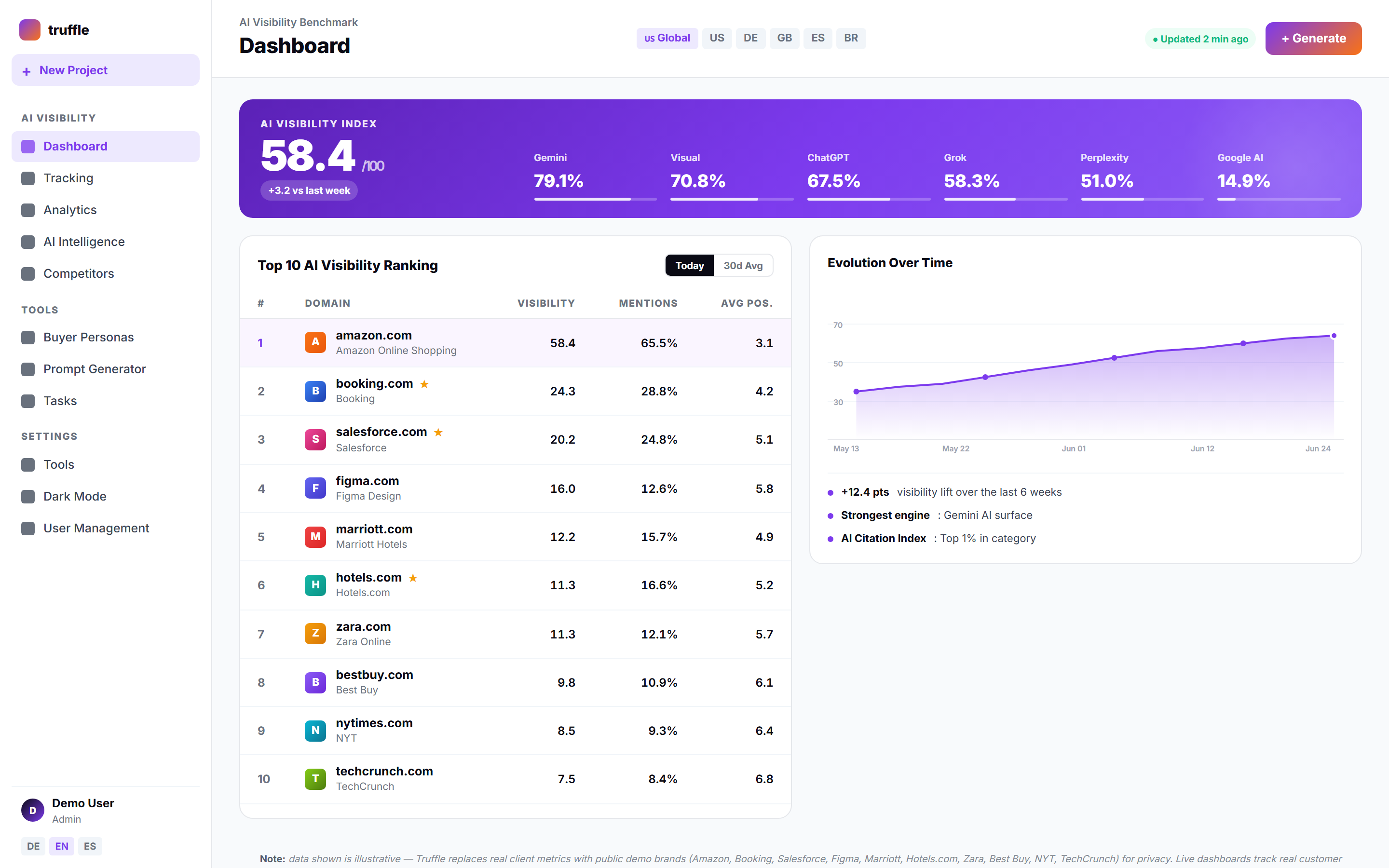
The AI Visibility Index is a single composite score (typically 0–100) that summarizes how often, how prominently, and how positively your brand surfaces inside generative AI answers across the major engines. It aggregates four operator KPIs (mention rate, citation rate, average position, share of voice) into a single headline number a marketing leader can show a CFO without a 20-slide deck.
SECTION 1 · DEFINITIONWhat the AI Visibility Index actually is — and why a composite score matters
The Index is a 0–100 composite score derived from polling the major generative AI engines with a curated prompt corpus and aggregating the response signals across four operator KPIs:
Mention rate
% of prompts where your brand is named in the answer — "does the engine know we exist?"
Citation rate
% of prompts where your brand is named with attribution + link — "does the engine trust our content?"
Average position
When cited, are you Source 1 or Source 5? First source captures most click-through.
Share of voice
% of category mentions captured by you vs your named competitor set.
A leader who tries to govern AI visibility on four KPIs in parallel ends up with a 20-row scorecard that no executive looks at. The Index collapses those signals into one headline number — the same way classical SEO collapses position tracking + organic clicks + impressions + CTR into a single "organic visibility" trend line. The Index doesn't replace the four KPIs; it summarizes them.
For the operator definitions and KPI mechanics underneath, see our AI Citation Tracking buyer's guide and AI Brand Mentions guide.
SECTION 2 · COMPOSITIONHow the Index is computed — six factor groups, one composite score
Every serious AI Visibility Index implementation (Truffle's, the broader category's) aggregates the same six factor groups. Exact weighting varies by platform and category, but the composition is consistent across published industry methodologies.
Mention surface — breadth across engines
The breadth of where you're surfaced. A brand mentioned in 2 of 6 engines has a different Index than a brand mentioned in 6 of 6, even at identical mention rates per engine. Cross-engine presence is itself an authority signal — engines apply multi-source corroboration.
Citation depth — attribution vs naked mention
When you're surfaced, are you cited (attributed + linked) or just mentioned (named without link)? Citations carry a stronger authority signal because they reflect the engine retrieving and trusting your content for a specific claim. Both matter — citations weighted higher because they map more directly to traffic.
Position quality — Source 1 vs Source 5
Source 1 in a Google AI Overview citation panel captures dramatically more click-through than Source 5. Being the source the engine anchors its opening sentence on is materially different from being a footnote. Position is one of the cleanest measurable variables that moves real-world traffic.
Share of voice — category competitive frame
A brand cited 15% of the time looks worse than a brand cited 30%, until you learn the first sits in a category where the leader is cited 22% and the second sits in a category where the leader is cited 78%. The Index includes share of voice against a named reference set — that's the metric a CFO actually wants.
Source mention map — off-site corroboration
AI engines apply multi-source corroboration. Ahrefs' 75,000-brand study found unlinked web mentions correlate with AI citations at 0.664 vs backlinks at 0.218 — roughly a 3× gap in favor of mentions (Ahrefs · 75K-brand Dec 2025). Brands missing on Wikipedia, Reddit, G2, TechCrunch have a structural ceiling.
Content readiness — schema, freshness, entity authority
The on-site half: schema markup (FAQPage, HowTo, Article, Organization), direct-answer passages near the top of pages, content freshness, author signals. 76.4% of most-cited ChatGPT pages were updated within the last 30 days (Ahrefs · 17M citations 2025).
SECTION 3 · WEIGHTINGWhere the Index weight lives — the stacked allocation across the six factor groups
The composition above translates to typical weighting bands across published industry methodologies. The exact weighting varies by category and platform, but the directional allocation is consistent — and visualizing it as a stacked bar shows immediately where investment effort should land if you want to move the Index.
Typical AI Visibility Index weight allocation
Directional weighting across the six factor groups — the share each contributes to a composite Index score.
Directional weighting band. Different platforms publish slightly different exact percentages; the consistent finding is that off-site factors (mention map + mention surface = ~38%) outweigh on-site factors (content readiness alone) for mature programs.
The strategic read: ~38% of the Index weight lives off-site (source mention map + mention surface), ~30% on-site (content readiness + position quality through schema), and ~32% competitive frame (citation depth + share of voice). Teams that under-invest in off-site PR, Wikipedia, and community presence run into a structural ceiling on Index movement regardless of how much they optimize their own site.
SECTION 4 · BENCHMARKSThe Index by industry — what a "good" score looks like
Benchmark ranges vary significantly by category. Numbers below reflect typical observed ranges across published industry analyses and observational data through 2026. Treat as orientation, not prescription — measure your own baseline before drawing strategic conclusions.
| Industry segment | Top-quartile Index range | Notes |
|---|---|---|
| B2B SaaS (mid-market) | 35–55 | High-AIO category, fragmented citation, Reddit + G2 dominate; well-defended pillar pages + earned media move Index fastest |
| B2C consumer brands | 50–70 | Wikipedia + review-platform presence dominates; PDP schema + editorial mentions move the Index |
| Hospitality / travel | 40–60 | Booking platforms, TripAdvisor, category review sites carry disproportionate weight; Place/LocalBusiness schema foundational |
| Professional services | 25–45 | Lower category-level AIO triggering; where it does trigger, tier-1 publications + professional associations dominate source mention map |
| E-commerce (DTC) | 45–65 | Product schema + review platform presence + Reddit category threads dominate; AI-referred visitors convert at meaningfully higher rates than organic |
| Fortune 500 enterprise | 60–85 | Strong on every factor — Wikipedia, dense earned media, category-leading review counts, established schema. The leading benchmark |
The Index range is wide because the underlying citation surface is wide. A B2B SaaS company in cybersecurity competes against a very different citation set than a B2B SaaS company in design tooling. Benchmark against your direct category competitors, not against cross-industry averages.
For broader category context, see our GEO vs SEO guide and How to Get Cited in ChatGPT.
See your AI Visibility Index in 5 minutes
Plug your brand and 5–10 reference competitors into Truffle. Get your headline Index, the per-engine breakdown, and the factor-group contribution map.
Book a demoSECTION 5 · LEVERSSix levers to move your AI Visibility Index
Each lever pulls a different factor group — Wikipedia moves source mention map, schema moves content readiness, freshness moves position quality. The compound impact is multiplicative because the factor groups are independent.
Wikipedia + entity authority
Wikipedia accounts for ~47.9% of ChatGPT's top-10 source share (5W · 2026). Brands without a properly-sourced Wikipedia article are structurally capped on Index.
Reddit + community presence
Reddit is the #1 single source across major AI engines at ~40% citation frequency — Perplexity at ~46.7%. Identify 3–5 subreddits where your category lives and engage authentically.
YouTube + full transcripts
YouTube mentions correlate at 0.737 with ChatGPT citation rates — the strongest single signal measured (Ahrefs 75K-brand). Quarterly cadence of 1–3 short videos with transcripts is the highest-leverage Index move most teams aren't making.
Tier-1 earned media
Forbes, TechCrunch, Wired, Verge, and category trade press are heavily weighted at the synthesis stage. Switch your PR KPI from "reach" to "mention volume across the top 15 high-leverage domains."
Schema on extractable content
2026 studies report ~28–30% AIO citation lift on pages with FAQPage schema (Stackmatix). Deploy FAQPage on every page with three+ question sections, HowTo on procedural content. Run a Schema Checker.
Content freshness
76.4% of most-cited ChatGPT pages updated within 30 days; pages 90+ days stale drop 40–60% in citation rate (Ahrefs · 17M citations 2025). Quarterly refresh cycle on top 20–30 pages with updated stats + dateModified schema.
SECTION 6 · INTERPRETATIONSix common mistakes when interpreting the Index
After helping teams instrument the Index across categories, six interpretation mistakes consistently lead to wrong strategic conclusions.
✗ Mistake 1 — Tracking the Index without per-engine breakdown
A flat composite Index can hide that you're winning ChatGPT, losing Perplexity, and stagnating in Gemini. Fix: always report Index alongside per-engine citation rate and share of voice.
✗ Mistake 2 — Comparing Index across categories
A 45 in B2B SaaS is competitive; a 45 in DTC e-commerce is below median. Fix: set up 5–10 named reference brands at project setup and treat your delta vs those brands as the headline, not the absolute Index.
✗ Mistake 3 — Over-investing on-site when off-site is the gap
Most teams reach for schema first because those changes feel under control. But for B2B SaaS, off-site (Wikipedia, Reddit, earned media) is often the binding constraint. Fix: audit factor-group contribution before deciding where to invest.
✗ Mistake 4 — Misreading Index volatility as program failure
Generative engines update model weights and retrieval on irregular cadences; a 5-point swing week-over-week without anything changing on your side is normal noise. Fix: use 30-day rolling averages for executive reporting.
✗ Mistake 5 — Setting Index targets without per-category benchmarks
"Let's hit an Index of 70 by Q3" without context may be impossible (Fortune-500-dominated category) or trivial (emerging niche). Fix: set targets as deltas vs your named competitor set, not absolute numbers.
✗ Mistake 6 — Treating the Index as the deliverable, not the input to an action loop
Teams that report Index weekly without converting per-engine insights into shipped editorial changes leave platform value on the table. Fix: designate one owner whose weekly job is converting Index insights into committed editorial changes.
SECTION 7 · GETTING STARTEDStart with Truffle — the 5-step path from Index baseline to action loop
If the Index framework above feels right but you don't have a unified system in place yet, this is the operator path most teams follow inside Truffle to ship the Index program end-to-end.
FAQFrequently asked questions about the AI Visibility Index
What is the AI Visibility Index?
How is the AI Visibility Index calculated?
What is a good AI Visibility Index score?
How is the AI Visibility Index different from share of voice?
What's the difference between AI Visibility Index and citation rate?
How often should I check my AI Visibility Index?
Which off-site sources move the AI Visibility Index most?
How does the Index account for negative mentions?
See your AI Visibility Index
Plug your brand into Truffle. Get the headline Index, the per-engine breakdown, the factor-group contribution map, and the specific recommendations to move the score in the next 30 days.
Book a demo