AI Citation Tracking — the 2026 Buyer's Guide to Tools, Platforms and Workflows
The AI citation tracking category went from zero dedicated platforms in 2023 to 22+ evaluable tools by 2026 (Rankability · 2026), with pricing spanning roughly $29/month at entry-tier monitors up through enterprise custom contracts. Picking the wrong platform costs months of migration overhead and stalls your action cadence; picking the right one wires your team to defend AI visibility before competitors notice the channel exists.
What AI citation tracking actually is
AI citation tracking is the discipline of measuring whether — and how — large language models (ChatGPT, Claude, Gemini, Perplexity, AI Mode, Google AI Overview) mention or cite your brand when users ask category questions. Where classical SEO rank tracking tells you "your page ranks #3 for keyword X," AI citation tracking tells you "across 200 prompts in your category, your brand is cited in 18% of ChatGPT answers and 32% of Perplexity answers, ranked 2nd in share of voice behind competitor Y."
The shift in measurement unit is the entire game. SEO measures positions in a list. AI citation tracking measures presence inside synthesized answers. The metrics, instrumentation, and tooling are different. For the broader GEO discipline that contextualizes this, see our Generative Engine Optimization guide.
Prompt-driven, not query-driven
Classical SEO scrapes Google for a keyword. AI citation tracking runs a curated prompt set across multiple LLM APIs and parses the synthesized responses for brand presence.
Multi-engine by definition
A complete tracking footprint covers 5–10 generative engines simultaneously, not just Google. ChatGPT drives ~80%+ of AI referral volume (Similarweb · 2025), but Perplexity/Claude/Gemini drive disproportionate share for technical and research queries — single-engine tracking is a structural blind spot.
Citation vs mention as separate signals
A citation attributes information to your source with a link. A mention names your brand without linking. Both matter and they map to different optimization tracks (content + schema for citations; entity authority + earned media for mentions) — serious tools track them as separate KPIs.
The market in 2026 — three category buckets
Twenty-two evaluable tools cluster into three operational categories. Choosing the wrong category for your team's stage costs months of mis-routed budget.
Enterprise visibility
Multi-engine coverage (10+ engines), page-level citation attribution, prompt volume data from behavioral panels, agent analytics, API access, SOC 2 certification, dedicated customer success.
Mid-market action
Multi-engine tracking (typically 5–6 engines), prompt-level competitive benchmarking, citation rate per engine, share of voice scorecards, action-layer features. This is the band where Truffle's AI Analytics competes.
Self-serve monitors
Entry-tier brand monitors. Single-engine or two-engine coverage, citation frequency counts, basic prompt library, light reporting. Useful for early-stage teams testing the channel.
Citations vs mentions — the distinction that changes everything
Most "AI brand monitoring" articles online treat citations and mentions as interchangeable. They're not. The distinction maps to different optimization tracks and different KPIs.
Engine attributes with link
Engine names without link
Serious platforms track both as separate metrics. Tools that conflate them into a single "brand visibility" number obscure the optimization decision. For tactics earning citations specifically, see our How to Get Cited in ChatGPT guide.
The eight capabilities that separate real platforms from monitors
Tool buyers consistently under-evaluate AI citation tracking platforms because the feature lists look similar. Eight capabilities consistently separate the platforms that build durable AI visibility programs from the monitors that produce dashboards but no action.
| # | Capability | Why it matters | Standard tier |
|---|---|---|---|
| 01 | Multi-engine coverage (5+ engines) | ChatGPT ~80%+ of AI referrals but Perplexity/Claude/Gemini drive disproportionate share for technical and research queries — single-engine is a structural blind spot | Mid-market + |
| 02 | Citations vs mentions separated | Conflating them obscures the optimization track that fixes each | Mid-market + |
| 03 | Prompt volume data | Without this, you optimize for prompts no one runs | Enterprise + Truffle |
| 04 | Share of voice vs named competitors | Absolute citation rate without context misses competitive trends | Mid-market + |
| 05 | Action layer (recommendations, not just metrics) | Tracking that stops at dashboards rarely shifts the underlying citation rate | Mid-market + |
| 06 | Schema + technical audit integration | Citation rate depends on schema correctness; tracking that ignores schema misses 30% of fix space | Mid-market + |
| 07 | Agent Analytics (AI crawlers consuming content) | Reveals consumption before citation, predicting future visibility | Enterprise |
| 08 | API + workflow integration | Pulling citation data into the same dashboard as SEO + revenue is what moves budget | Enterprise + Truffle |
Most teams over-weight capabilities 1 and 2 (table stakes in 2026) and under-weight capabilities 5, 7, and 8 (the durable competitive advantage). For the AEO framework that contextualizes capability priority, see our AEO Playbook.
| Mention | Prompt | Persona | Int | AI Models | Link | Pos |
|---|---|---|---|---|---|---|
| 17% | Best AI visibility tracking tools 2026 | B2B SaaS marketer | G C ✦ P X G
|
✓ | 3 | |
| 100% | Name good providers for AI brand citation tracking | Enterprise CMO | G C ✦ P X G
|
✓ | 1 | |
| 17% | How much does an enterprise GEO platform cost vs mid-market? | B2B SaaS marketer | G C ✦ P X G
|
✓ | 4 | |
| 0% | Which platforms have a free trial for AI citation tracking? | B2B SaaS marketer | G C ✦ P X G
|
✗ | – | |
| 0% | Best AI brand mention monitor for mid-market | B2B SaaS marketer | G C ✦ P X G
|
✗ | – | |
| 0% | Which AI visibility platform supports SOC 2? | Enterprise CMO | G C ✦ P X G
|
✗ | – | |
| 17% | Best platform to track ChatGPT brand mentions over time | Mid-market growth | G C ✦ P X G
|
✓ | 2 | |
| 0% | How often should I poll AI engines for brand visibility? | Mid-market growth | G C ✦ P X G
|
✗ | – | |
| 17% | Top AI citation tracking software for SMB founders | SMB founder | G C ✦ P X G
|
✓ | 1 | |
| 100% | Compare AI citation tracking tools by engine coverage and price | Enterprise CMO | G C ✦ P X G
|
✓ | 1 |
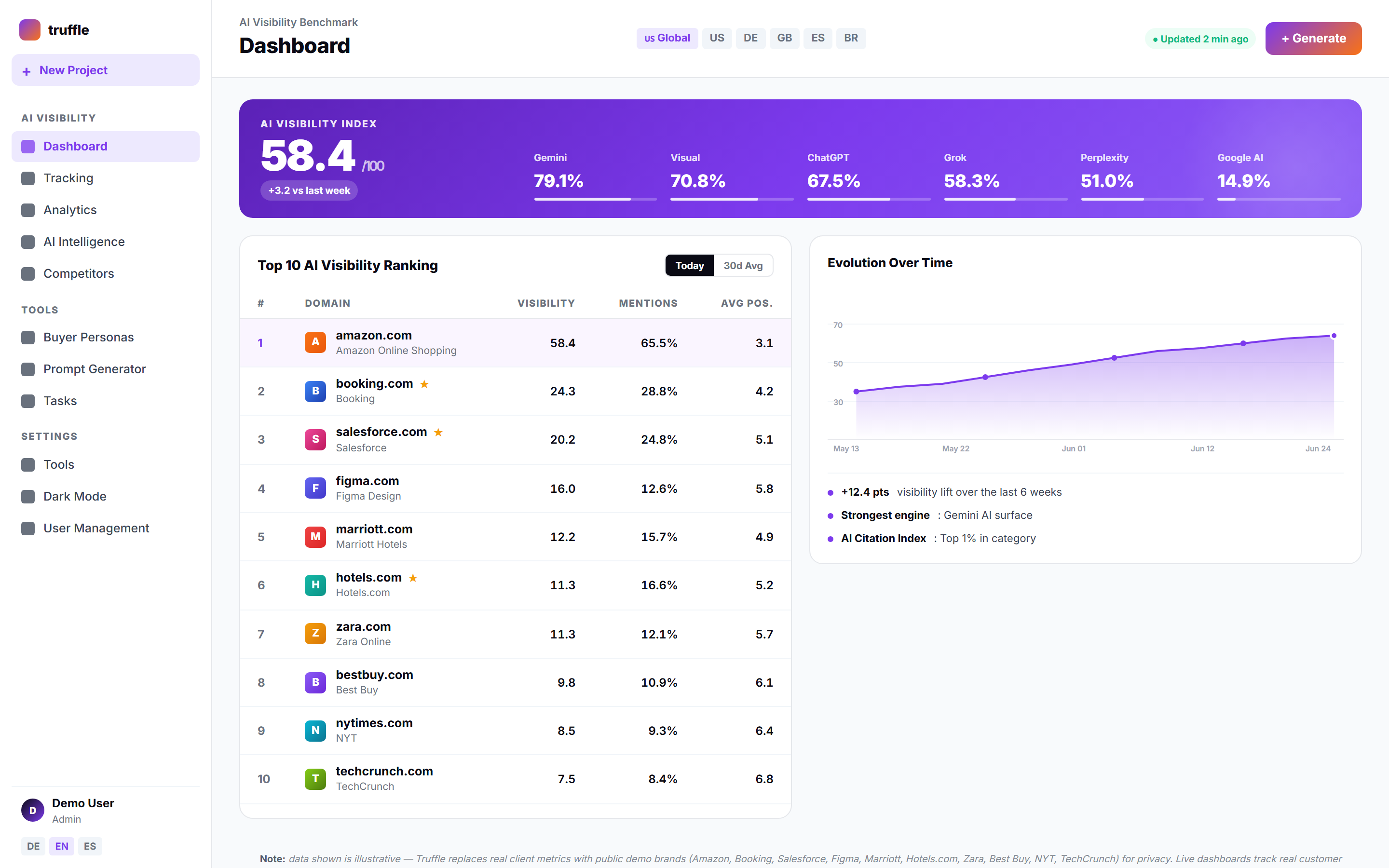
Every prompt in your category, polled across the six engines, with mention rate and citation depth tracked per-prompt. Real Truffle UI · brand identifiers replaced with "Demo Brand" for the public preview. See the live tracking view →
Seven leading platforms compared head-to-head
The seven platforms most frequently shortlisted by buyers in 2026, side by side on the eight capabilities. Compositions update quarterly as the category matures.
| Segment | Engines | Cit/Mention | Action layer | Prompt vol | Pricing | Best for |
|---|---|---|---|---|---|---|
| Mid-market action-layerTRUFFLE FIT | All 6 (ChatGPT · Claude · Gemini · Perplexity · AI Mode · AIO) | ✅ separated | ✅ Strategy Recs + AI Generate every paid tier | ◐ Tier-dependent | Mid-market accessible | Series A–C SaaS + agencies wanting all 6 engines + action layer |
| Enterprise behavioral research | 10+ engines | ✅ | ✅ deep custom | ✅ Behavioral panel | $1,000+/mo custom | Fortune 500 + enterprise behavioral research depth |
| Content-engineering workflow | 5+ engines | ✅ | ✅ Workflow integration | ◐ Limited | Mid-market SaaS | Content ops teams wanting tight tracking → fix loop |
| Entry-tier brand monitors | 2–3 engines | ◐ Limited | ✗ Monitoring-first | ✗ | $29–200/mo | Bootstrapped startups testing the channel |
Truffle competes in the mid-market action-layer segment — the band where most B2B SaaS teams find the highest ROI per dollar. The differentiator: all six engines on every paid tier (no per-engine upsell) plus the action layer that closes the tracking → fix loop. Create a Truffle account to see your AI citation baseline across all engines in under 5 minutes.
Build vs Buy — when to engineer in-house
A small minority of buyers consider building citation tracking infrastructure in-house. Four operational questions determine whether build is genuinely better than buy.
01 · Do you have dedicated ML/data engineering capacity (3+ FTEs)?
Citation tracking infrastructure requires LLM API integration across 5+ providers, prompt set curation, response parsing pipelines, brand entity recognition, citation extraction, share-of-voice computation, dashboard layer, and ongoing maintenance. Below 3 FTEs dedicated, the math rarely pencils against a commercial platform.
02 · Are your tracking needs sufficiently non-standard?
Roughly 90% of enterprise tracking needs are well-served by a commercial platform + custom prompt sets. Non-standard includes proprietary engine integrations (private LLMs, internal copilots), exotic regulatory environments (financial services, healthcare with PHI), or research-grade methodology requirements.
03 · Is 12-month TCO lower than the commercial alternative?
Build TCO: ML FTEs ($300K–$500K loaded annually), LLM API costs ($5K–$50K/mo), infrastructure ($2K–$10K/mo), maintenance burden (10–20% of build cost annually). Commercial platforms at enterprise tier sit at $25K–$50K/year. Build math rarely wins under $200K annual budget commitment.
04 · Is the buy decision reversible if your needs evolve?
Switching commercial platforms is a 1–3 month migration. Rebuilding in-house infrastructure if you eventually outgrow it is a 9–18 month exercise. The reversibility asymmetry usually argues for buying first, building only if buy demonstrably under-serves after 12+ months.
Buy a category-B mid-market platform that ships action layer on every tier, then revisit build only after you've operated tracking for 12+ months and have specific documented gaps.
Pricing tiers explained — what you actually get
Public pricing for the category ranges from $20/month to $3,000+/month. The capability boundaries between tiers are more consistent than the marketing copy suggests.
Self-serve monitors
- ChatGPT + 1 other engine
- Brand mention counts
- Weekly reports
- 25–100 tracked prompts
- Citation vs mention separation
- Action layer
- Share of voice
- Prompt volume data
Action platforms
- 4–6 engines
- Citation + mention separated
- Share of voice
- Action recommendations
- 250–1,000 prompts
- Weekly cadence
- Behavioral panel data
- Agent analytics
- Enterprise API
- SOC 2
Visibility platforms
- 8–10+ engines
- Behavioral panel + prompt volume
- Agent analytics
- API + workflow integration
- SOC 2 + dedicated CS
- Custom prompts at scale
- Procurement cycle 3–6 months
- Custom contract negotiation
- Onboarding ramp 4–8 weeks
$400 – $1,200 mid-market band, without the enterprise sales call
Truffle ships all six engines + Strategy Recommendations + AI Generate on every paid tier — no per-engine upsell, no behavioral panel gating. Self-serve signup, scale when the data proves itself.
Stack recommendations by company size
The right tracking stack depends on team size, content volume, and how much of the AI search budget you're defending. Three configurations cover most B2B SaaS situations.
Startup / bootstrapped
- An entry-tier brand monitor ($29–$99/mo)
- + manual Wikipedia + Reddit monitoring
- + the free Truffle check quarterly
Mid-market
- Truffle AI Analytics (action layer every tier)
- + A classical SERP feature tracker for AIO
- + Schema Checker for the schema layer
Enterprise
- An enterprise behavioral-panel platform
- + Truffle for action-layer workflow
- + A content-engineering integration tool
- + Custom BI dashboards via API
Three operational rules across all stacks
Six mistakes when picking a citation tracking platform
After advising tool selection across the 100+ companies Truffle tracks, six mistakes consistently lock teams into the wrong vendor.
Optimizing for the lowest sticker price
The $29/month monitor that doesn't separate citations from mentions, doesn't ship action layer, and covers two engines costs more in mid-market opportunity loss than the $400/month platform that does. Tooling cost is rarely the dominant cost.
Picking the loudest brand on the analyst report
Marketing footprint inflates with funding rounds — the platform with the largest analyst presence is rarely the platform that ships the right action layer at mid-market pricing. Match platform to operational stage, not brand recognition.
Ignoring action layer in capability comparison
Vendors that show "we track ChatGPT, Claude, Perplexity, Gemini" but don't show "we recommend specific page-level changes" sell monitoring, not optimization. The action layer is what converts tracking data into citation rate improvements.
Picking single-engine tools to save money
Single-engine tracking is a structural blind spot — ChatGPT drives ~80%+ of AI referrals (Similarweb · 2025), but Perplexity/Claude/Gemini dominate technical and research queries. If budget forces single-engine, choose ChatGPT — but plan migration to multi-engine within 6 months.
Not budgeting for prompt set curation
The tracking platform is half the cost. The other half is curating the 250–1,000 prompts that actually reflect how your category's buyers ask AI engines. Budget 20–40 hours of marketing analyst time in month 1.
Treating the dashboard as the deliverable
The most expensive misconception. Citation tracking exists to feed an action loop — teams that set up tracking then report citation rates monthly without acting on them leave 80%+ of the platform's value on the table. Fix: from week 1, designate one owner whose weekly job is converting insights into shipped editorial changes (schema, direct-answer rewrites, Digital PR placements).
Skip the 6 mistakes — start with the action layer
Every mistake above maps to a measurable factor inside Truffle. Plug your brand and see your AI citation baseline across all six engines with weekly Strategy Recommendations on what to fix first.
Implementation roadmap — first 90 days
A new citation tracking program doesn't need a 30-step plan. Three phases, 90 days, then continuous operation.
Procurement & pilot
Run the eight-capability evaluation against 3 shortlisted vendors. Demand demo accounts. Pilot for 7 days each. Confirm the action layer specifically — not just the dashboard. Sign annual contracts only after the pilot confirms action layer integrates with your team's workflow.
⌑ Deliverable: signed contract + accessPrompt curation + baseline
Curate 250–1,000 prompts reflecting your category's buyer queries. Sources: customer interview transcripts, sales discovery questions, top organic SEO queries reframed conversationally, competitor analysis prompts, support ticket categories. Run the full set to establish citation rate baseline.
⌑ Deliverable: prompt set + baseline reportShip fixes + re-track
Identify the top 10 gaps from baseline. Ship fixes — schema deployment, direct-answer rewrites, freshness refreshes, off-site mention work — and re-track at week 12. Document the lift. Action loop becomes monthly cadence from week 13 onward.
⌑ Deliverable: 90-day citation rate deltaFor the technical layer (robots.txt, schema, llms.txt) that underlies tracking accuracy, see the companion LLM SEO guide →. Per-engine specifics: Google AI Overviews + SEO vs GEO mechanics.
Start with Truffle — the 5-step path from baseline to action loop
If the buyer's framework above feels right but you don't have a unified system in place yet, here's the operator path most teams follow inside Truffle to ship the citation tracking program end-to-end.
Create your Truffle account
Set up your brand, category, and 5–10 reference brands you want to benchmark across ChatGPT, Claude, Gemini, Perplexity, AI Mode, and Google AIO. Sign up →
Find the prompts that matter
Truffle uses AI to surface the 250–500 real prompts your category's buyers ask. No manual brainstorming during the prompt curation phase that kills most tracking programs in week 4.
Use the answers in your content
For every prompt where you're not cited, Strategy Recommendations show the specific on-site fix (passage shape, schema, freshness) and the off-site source winning the citation. Ship editorial changes weekly.
Monitor 6 engines + SoV + position
Citation rate per engine, share of voice vs your named competitor set, average citation position, top-15-domain mention map — same screen, no per-engine upsell.
See citation rates climb
Most teams land their first new citations within 4–6 weeks of shipping the recommended changes. The cross-engine citation rate is the proof to the CFO.
Frequently asked questions
Eight questions buyers ask when evaluating citation tracking platforms.
What is AI citation tracking?
What are the best AI citation tracking tools in 2026?
How much does AI citation tracking software cost?
What is the difference between citation tracking and brand monitoring?
Should I build my own AI citation tracking system or buy a platform?
Which AI citation tracking tools have action layers?
How many AI engines should my tracking cover?
How long does it take to set up citation tracking?
See AI citation tracking that actually ships action layer
Truffle ships citation rate + share of voice + action recommendations across all 6 AI engines on every paid tier. Mid-market pricing. No enterprise sales call required.