
Inside Google's AI Overview — the answer above the answer
AI Overviews now appear on ~48% of US queries (BrightEdge, Mar 2026) — though different trackers report anywhere from 16% to 65% depending on methodology. The pipeline that picks 5–15 cited sources from a candidate pool of 500 is now the most consequential ranking process on the web — and only ~38% of those cited pages even rank in the organic top 10 anymore (down from ~76% mid-2025, per Ahrefs). This guide unpacks the mechanics, the six factors that decide your citation, and what it takes to ship a page Gemini wants to quote.
of US queries trigger an AIO (BrightEdge, Mar 2026 · 9-industry tracker)
range across methodologies: 16–65%
of AIO citations come from organic top-10 pages
(down from ~76% mid-2025, per Ahrefs)
citation-rate lift on AIO surface with FAQPage schema
(varies by category)
word-count correlation with citation rate
(Ahrefs, 174,000-page analysis)
What is a Google AI Overview, exactly?
A Google AI Overview (AIO) is a Gemini-generated summary that appears above the traditional ten blue links on certain search queries. It synthesizes information from a handful of web sources, embeds inline citations to those sources, and lets the user expand the panel or follow up with related questions — all without leaving the SERP.
Google publicly launched AI Overviews in May 2024 during Google I/O (Google Search Central, 2026). The panel has four operational components:
- Summary text — a 100–300 word synthesized answer, in some categories with bullet points
- Cited sources — a small set of source links (a handful, typically 5–15) shown as cards or inline citations
- Follow-up questions — suggested related queries the user can click
- "Show more" / expansion — additional context Gemini surfaces on demand
The mental model that matters: when an AIO triggers, the destination of the user's click shifts. The first thing they read is the summary; the citations sit visually below it. A page that ranks #4 organic but is cited as Source 2 inside the AIO has fundamentally more impressions than a page that ranks #1 organic but is not cited. Position inside the AIO panel matters more than position in the blue links underneath, for queries where the panel triggers.
For broader terminology used across this article (citation rate, share of voice, multimodal content, semantic completeness), see the GEO glossary. For the wider framework that contextualizes AIO inside the multi-engine landscape, see our Generative Engine Optimization guide.
How AI Overviews actually pick their sources
The Gemini synthesis layer doesn't read the entire web for each query. Based on Google's Generative AI optimization documentation and reverse-engineering analyses published throughout 2026, the AIO pipeline narrows hundreds of candidate documents down to the handful that ultimately surface in the panel via a multi-stage process.
Semantic retrieval
Google retrieves a candidate pool from its index using semantic similarity to the query — closer to embedding-based search than to classical keyword matching. It grabs documents whose meaning aligns with the question, not whose URL text matches it.
E-E-A-T threshold filter
The candidate pool is filtered against Google's Expertise, Experience, Authority, Trust signals. Binary pass/fail gate, not a sliding scale. Across the 2026 AIO citation studies (Ahrefs, BrightEdge, SE Ranking), AIO-cited sources skew heavily toward Wikipedia, established review platforms, tier-one publications, government and academic domains — low-authority pages are dropped at this stage regardless of query match quality.
Gemini passage re-ranking
Survivors are re-ranked at the passage level, not the page level. Gemini scores 100–300 word chunks of each document on extractability, factuality, and freshness. This is where short, self-contained, definitional paragraphs dramatically outperform paragraphs that bury the answer mid-page.
Data fusion into the panel
Top-ranked passages are fused into the final summary. Citations are placed inline, with the highest-scoring passage typically anchoring the opening sentences. Sources whose passages contradict the dominant narrative may be dropped, even if they cleared the E-E-A-T gate.
The implication for content teams is concrete: optimizing for AIO is not about writing longer articles. It's about ensuring that at least one passage in your top pages is the passage Gemini wants to quote when the query triggers a panel.
When AI Overviews show up — and when they don't
AIOs do not trigger uniformly across all queries. The panel appears more often where Google's models judge a synthesized answer is more useful than a list of links, and less often where users explicitly want comparison shopping, transactional flow, or local results.
A practical consequence: the same article can sit in the top 3 organic positions for 200 queries and only show up inside the AIO for 40 of them. The 40 are where the panel triggers — and where the citation race actually matters.
The six ranking factors that decide your citation
Derived from Google's official documentation, 2026 reverse-engineering analyses, and benchmarks correlated with cited vs uncited pages. None are myths.
Answer every implicit sub-question
Pages that cover a topic in full — answering all the implicit sub-questions a buyer would ask — are favored over pages targeting a single narrow query. A page that answers "what is X, why does X matter, how to do X, examples of X" outperforms three pages each covering one slice, because Gemini synthesizes from sources that ground multiple sub-queries at once.
Source: ZipTie · Topical Authority 2026Factual density > word count
Ahrefs' analysis of 174,000 AIO-cited pages found near-zero correlation (0.04) between total word count and citation rate. The average cited page is ~1,282 words, with 53.4% under 1,000 words. What matters is a self-contained, factually dense passage (typically 40–100 words for paragraph-style snippets) sitting near the top of the relevant section. Burying the direct answer mid-article forfeits citation eligibility.
Source: Ahrefs · 174K AIO Pages 2026Clear the binary authority gate
E-E-A-T isn't a sliding scale — it's a pass/fail gate for AIO eligibility. The signals Google evaluates:
- Author bylines with verifiable credentials on every article
- About pages with clear ownership, location, contact paths
- Original research, surveys, proprietary data (not derivative aggregation)
- Third-party citations of the brand on independent reputable domains
- Wikipedia, Wikidata, and category-authority site presence
Pre-extract the facts
Structured data tells Gemini what each section contains before it has to infer it from layout. Multiple 2026 analyses report pages with FAQPage schema show ~28–30% improvement in AI citation rate on the AIO surface (with category and query-type variance). The signal direction is consistently positive; the magnitude varies. Priority schemas:
- FAQPage — highest leverage
- HowTo — lets Gemini lift step structure verbatim
- Article with author + dates — for freshness signals
- Organization — for entity disambiguation
Text + images + video + schema
Pages combining text with original images (with proper ImageObject metadata, alt text, captions), supporting video, and structured data consistently show higher AIO selection rates than text-only pages. Gemini can connect text entities to images and YouTube content; the biggest lift comes from strong image metadata and relevant videos that reinforce the page's claims. Even one original photograph, one diagram with proper schema, and one short embedded video moves the needle.
Query-dependent — evergreen vs topical
For evergreen definitional queries ("what is X"), the AIO tolerates older sources and rotates citations slowly. For topical or moving queries ("X in 2026", "latest X update"), the panel rotates citations every few weeks toward more recent sources.
A 2022 guide on "what is GEO" can sit in an AIO for months. The same page targeting "GEO best practices 2026" needs quarterly refreshes to defend its citation.
Stop scoring each factor in a spreadsheet
Truffle scores the six AIO factors for every page in your category and tells you which ones to fix first. Semantic completeness, passage extractability, schema gaps, E-E-A-T signals, multimodal coverage, freshness — all live, weekly.
Why traditional SEO rankings no longer guarantee AIO citations
Among the most jarring 2026 data points: only ~38% of AIO citations now come from pages ranking in the organic top 10, down from roughly 76% in mid-2025 — a structural shift driven by Google's query fan-out architecture (Ahrefs · 174K-page analysis, 2026).
In other words: Google's organic ranking model and Google's AIO citation model have diverged materially. A page can:
- Rank #1 organic for the query and still not be cited in the panel
- Rank #25 organic and be cited as the second source inside the panel
- Be invisible in the SERP entirely and still anchor an AIO summary if it has the right passage shape and E-E-A-T
The implication for SEO teams is structural: classical SEO investments are necessary but no longer sufficient for AIO visibility. Building for the AIO is a parallel optimization track that overlaps with SEO on technical foundations (crawlability, schema, freshness) but diverges on content patterns (direct-answer passages, multimodal content, narrower passage targeting).
For our angle on how SEO teams should redeploy the existing stack toward AI surfaces without breaking the existing rankings, see What is AI SEO.
Building for AIO inclusion — five deliverables this quarter
You don't need a 30-step plan. Five concrete deliverables move the needle measurably within a single quarter.
- Rewrite the first 200 words of your top 20 pages as direct-answer passages. If the article opens with marketing fluff or background context, the AIO has nothing to lift. Replace opening paragraphs with self-contained 100–150 word answers to the page's primary question.
- Deploy
FAQPageschema on every page with three or more question-shaped sections. The citation-rate lift from this single change is documented across 2026 studies (~28–30% on AIO surface, with category variance). - Add at least one original image and one short video per top page. Multimodal lift is real and underutilized — even a single original photograph with proper
ImageObjectschema plus a supporting embedded video moves selection rate measurably. - Build verifiable E-E-A-T signals on every article. Author byline with credentials, About page polish, original data references, third-party brand mentions. This is the binary gate from Stage 2 of the pipeline.
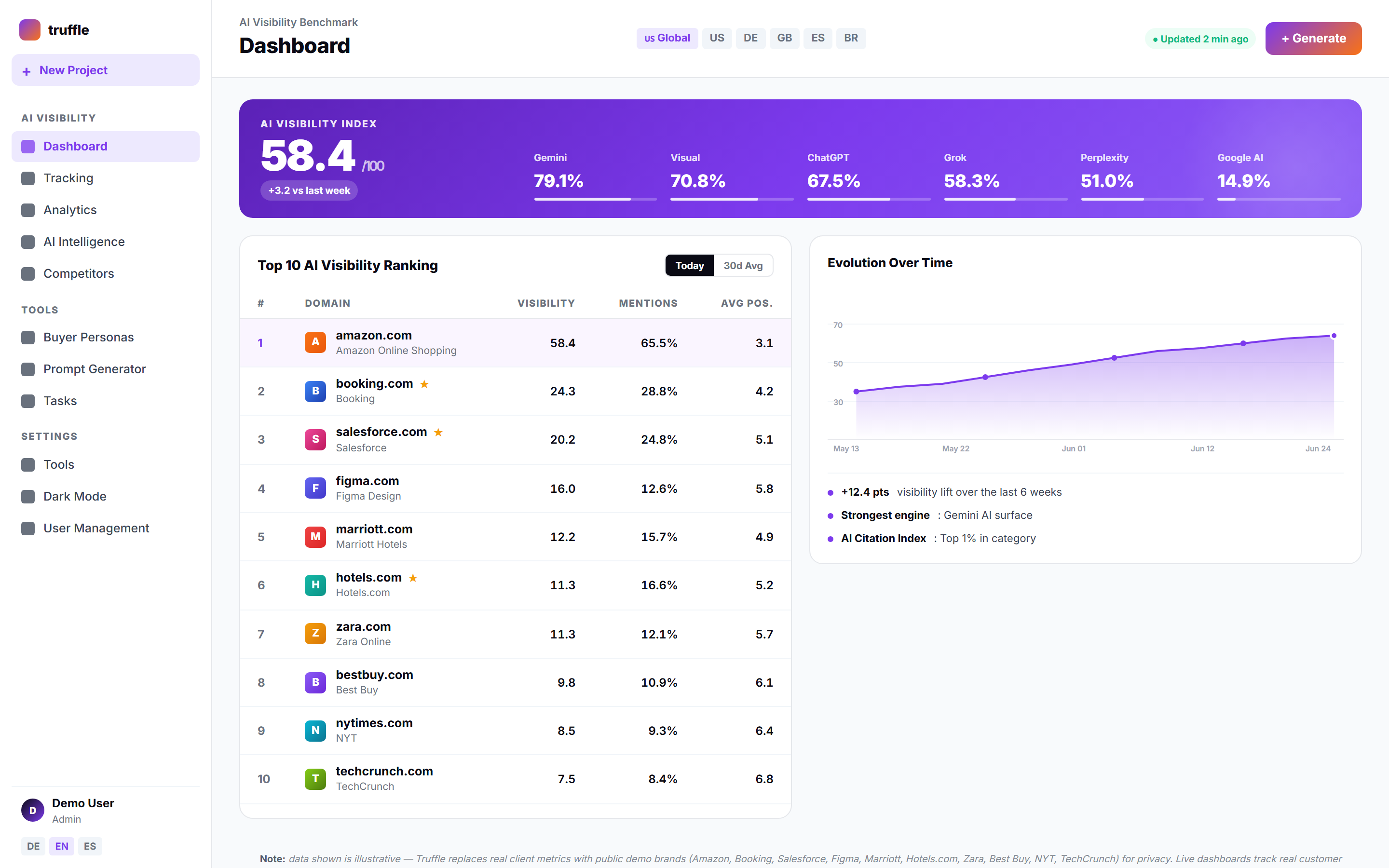
- Track AIO appearance rate and citation share weekly. You cannot defend an AIO investment without measurement. Truffle's AI Analytics tracks AIO across the wider citation landscape — appearance rate, citation share, position inside the panel, and per-engine breakdown across all six generative engines on every paid tier.
For the wider GEO framework that situates AIO optimization inside the multi-engine landscape, see our Generative Engine Optimization guide.
What does NOT trigger an AIO citation — six myths
After auditing AIO performance across categories, five repeat myths are responsible for most wasted optimization effort.
Myth 01"Ranking #1 organic guarantees AIO inclusion"
Strong organic rankings are correlated with AIO inclusion but not predictive of it.
Myth 02"Longer content gets cited more often"
The 4,000-word ultimate guide is at no advantage over the 1,500-word focused article — and at a disadvantage if its direct answer is buried past the first 200 words.
Myth 03"Keyword density helps AIO citation"
False, and possibly counterproductive. Gemini's passage re-ranker rewards direct-answer clarity, not phrase repetition.
Myth 04"An AIO citation guarantees traffic"
AIO citations do drive traffic, but the click rate varies dramatically by query type and source position. The first cited source typically captures more clicks than positions 2–5 combined.
Myth 05"Blocking GPTBot in robots.txt keeps me out of Google AIO"
A common confusion. GPTBot is OpenAI's crawler; it has nothing to do with Google AIO selection.
GPTBot. The fix most people reach for is wrong too. Google-Extended governs training and grounding for Gemini, and Google states it “does not impact a site’s inclusion in Google Search”. AI Overviews are part of Search, so setting it changes nothing there. Two controls do reach AI Overviews. The Search generative AI control in Search Console, available to all websites since 31 August 2026, excludes a whole site. Page by page, nosnippet prevents content “from being used as a direct input for AI Overviews and AI Mode”, and it removes your ordinary search snippet in the same move. Opting out is usually counterproductive: it’s an inclusion not an extraction policy.Myth 06"AIO citation is an on-site SEO problem"
The most expensive myth to operate under. AIO citations are heavily influenced by off-site signals: which independent reputable domains mention your brand, which third-party sites cite your work, which review platforms rank you.
The 6 myths are the 6 levers
Every myth above maps to a measurable factor inside Truffle. Plug your brand and see which myths are still costing you AIO citations — and exactly which page to fix first to flip the score.
Measuring your AIO presence
AIO measurement requires its own metric set, parallel to (but distinct from) classical SEO KPIs.
AIO appearance rate
"% of our target queries where an AIO triggers at all?"
Tracking dashboardCitation rate
"% of triggered AIOs where our brand is cited?"
Per-query detailCitation position
"When cited, are we Source 1 or Source 5?"
Source ranking viewCTR from AIO
"What click-through do we earn when cited?"
GA4 / referrer analysisAttributed conversions
"What conversions trace back to AIO sessions?"
Attribution modelStandalone AIO trackers exist, but the modern stack tracks AIO as one engine inside a multi-engine dashboard. Truffle's AI Analytics ships AIO as a first-class engine alongside ChatGPT, Claude, Gemini, Perplexity, and AI Mode on every paid tier — same screen, no dashboard switching.
A practical caveat: AIO measurement is noisier than classical SEO measurement. The panel triggers inconsistently across user contexts (logged-in vs anonymous, US vs EU, device type). Plan for a 30-day baseline before drawing conclusions about citation rate trends.
For the technical layer (robots.txt, schema, llms.txt) that underlies AIO inclusion, see the companion LLM SEO guide →
Start with Truffle — the 5-step path from audit to AIO visibility
If the framework above feels right but you don't have a system in place yet, here's the operator path most teams follow inside Truffle to go from invisible to cited inside Google's AI Overview panel.
Create your Truffle account
Set up your brand, category, and 5–10 reference brands you want to benchmark against in your AIO panel. Sign up →
Find the prompts that matter
Truffle uses AI to surface the 250–500 real prompts your category's buyers ask — including the ones that trigger AIO panels. No manual brainstorming.
Use the answers in your content
For every prompt where you're not cited, Truffle shows the content gaps to close (passage shape, schema, freshness) and which sources are winning.
Monitor weekly across six engines
AIO appearance, citation rate, position inside the panel, plus the other five engines (ChatGPT, Claude, Gemini, Perplexity, AI Mode) — same screen.
See AIO citations climb
Most teams land their first new AIO citations within 4–6 weeks of shipping the recommended changes. The data is the proof to the CFO.
Frequently asked questions
What is a Google AI Overview?
When did Google AI Overviews launch?
Do AI Overviews replace SEO?
Why are my pages not appearing in AI Overviews?
How do I see if my brand appears in AI Overviews?
Can I opt out of AI Overviews?
nosnippet: Google says it prevents content from being used as a direct input for AI Overviews and AI Mode, and in the same sentence that it applies to web search results, so it takes your search snippet with it. The Google-Extended user-agent is a different control: it concerns training and grounding for Gemini, and Google states it does not affect inclusion in Google Search. For brands that want category visibility, excluding the site is usually a bad trade.Are AI Overviews available worldwide?
Do AI Overviews affect organic traffic?
Track AIO citations alongside the other five engines
Truffle ships Google AI Overviews as one of six first-class engines on every paid tier — alongside ChatGPT, Claude, Gemini, Perplexity, and AI Mode. AIO appearance rate, citation position, and competitor share, all on one dashboard.