
GEO vs SEO in 2026 — and where AEO completes the triplet
Gartner predicts a 30% drop in traditional search volume by end of 2026. That's not the end of SEO. It's the end of SEO as the only optimization track. This guide unpacks the triplet, what changes between SEO and GEO, and which KPIs defend the investment in quarterly reviews.
~4,200 words · 17 min read · Updated June 2026
30% search drop
Traditional search volume projected to drop 30% by end of 2026 as AI Overviews absorb queries (Gartner).
4–5× conversion lift
AI-referred B2B tech visitors convert at ~14.2% vs 2.8% organic baseline (Opollo · 312-firm benchmark 2026).
3 tracks, 1 workflow
SEO + AEO + GEO operate as one editorial workflow with separate KPI scorecards, not three teams.
The semantic shift in one sentence
SEO optimizes pages to rank in a list of ten links. GEO optimizes content to be cited inside a single synthesized answer. That one sentence is the entire shift. The list-of-links search engine treats your page as a candidate for a position in a ranked set. The generative engine treats your page as a candidate source whose passage may or may not get quoted inside an AI-generated answer.
Position matters in SEO. Inclusion matters in GEO. Everything downstream — content patterns, authority signals, KPIs, tooling — flows from that distinction. For our broader framework around Generative Engine Optimization and the Google-specific surface, see AI Overviews Explained. For the terminology used throughout — citation set, share of voice, AI Visibility Index — see the GEO glossary.
The operator takeaway
Once you internalize "rank vs cite", every optimization decision becomes easier to triage. Does this work move the team toward better rank (SEO), better answer extraction (AEO), or better citation in a synthesized answer (GEO)? If none, deprioritize. If two, you've found leverage.
Why SEO vs GEO is incomplete framing
The full picture is the SEO/GEO/AEO triplet, sequential not exclusive. Each track grew out of the previous one, inherits its foundations, and targets a different layer of how search engines surface answers in 2026.
Search Engine Optimization
Ranked positions in a list of links
Answer Engine Optimization
Direct answers extracted from page content
Generative Engine Optimization
Citations inside AI-synthesized answers (Aggarwal et al., KDD 2024)
Most teams in 2026 don't run three separate tracks — they run one editorial workflow that optimizes for all three simultaneously, with KPIs reported by track. The page that ranks #3 organic, lifts a featured snippet, and gets cited in the AI Overview is the same page. The optimization decisions that produced it were SEO + AEO + GEO compounded. For the technical layer underneath all three — robots.txt, schema deployment, multi-engine instrumentation — see What is LLM SEO.
GEO vs SEO — the side-by-side
Seven dimensions where SEO and GEO genuinely diverge — laid out as two opposing cards, not a side-scrolling table.
Traditional Search
Generative Engine Optimization
The unspoken layer
The engines retrieving content still depend on the same underlying signals: crawlability, schema, freshness, entity authority. SEO foundations remain prerequisites — covered in the next section.
What stays the same — the 5 foundations
SEO investments that pay double in 2026 because GEO engines retrieve from the same web index. Strip them out and both tracks fail simultaneously.
Crawlability
Same fix for Googlebot and AI crawlers (GPTBot, ClaudeBot, Google-Extended). One configuration change, two tracks of payoff. Deploy llms.txt declaring permitted use via the free generator. The cost of skipping it is structural invisibility.
Schema markup
Article, Organization, HowTo, FAQPage. FAQPage drives ~28–30% citation rate lift on AIO vs equivalent pages without it (Stackmatix; Frase 2026). Run Schema Checker on your top 20 pages.
Freshness signals
dateModified, last-updated banners, quarterly refreshes on topical pages. Defends organic rankings and AI citation persistence simultaneously.
Topical authority
The cluster model SEO already knows. Generates entity authority signals that generative engines weight heavily. The work is unchanged; the payoff doubles.
Site health
Core Web Vitals, mobile performance, HTTPS, clean canonical URLs. Both tracks benefit; neither tolerates a slow, broken site. Maintenance budget stays the same.
What's different — four divergence points
Where GEO genuinely demands a different approach, not just a doubled investment. Read each as a shift from left to right.
From page to passage
Engines don't extract pages — they extract self-contained passages near the top of the relevant section. Ahrefs found 0.04 correlation between total word count and AIO citation rate across 174,000 cited pages. The long guide can rank #1 organic and still not be cited if the answer is buried past the first 200 words. Practical: rewrite the first 200 words of every top page as a self-contained answer.
From density to clarity
SEO content rewards keyword density and semantic variation. GEO rewards a direct, factual, list-or-definition answer with minimal marketing modifiers. Pages that read like keyword exercises underperform in GEO.
From backlinks to mentions
The GEO equivalent of backlinks is being mentioned across multiple independent reputable domains — even without dofollow links. A brand on 5 independent domains beats a brand with 3 backlinks and no organic discussion.
From CTR to citation rate
GEO requires its own metric layer because the user often gets the answer without clicking. AI Analytics exposes the five GEO KPIs on one screen. The KPI shift is the most disruptive operationally.
Running both tracks in parallel
The operational question most companies stall on isn't what to optimize — it's who owns it and how the budget gets split.
Team organization patterns
Single SEO team absorbs GEO
Same head of SEO, same writers, expanded KPIs. Lowest org overhead.
Embedded GEO specialist
One named owner of GEO KPIs reporting to the SEO lead. Balanced.
Separate squads
Independent GEO team, own head, budget, roadmap.
Budget rule of thumb — how the SEO/GEO split evolves
Trigger for rebalancing is the board-level question "what % of qualified leads now mention an AI engine as their first touchpoint" — once that crosses ~15–20% (a threshold consistent with 2026 B2B buyer behavior observed across the 100+ companies Truffle tracks), GEO gets its own line item.
Stop running three trackers for one team
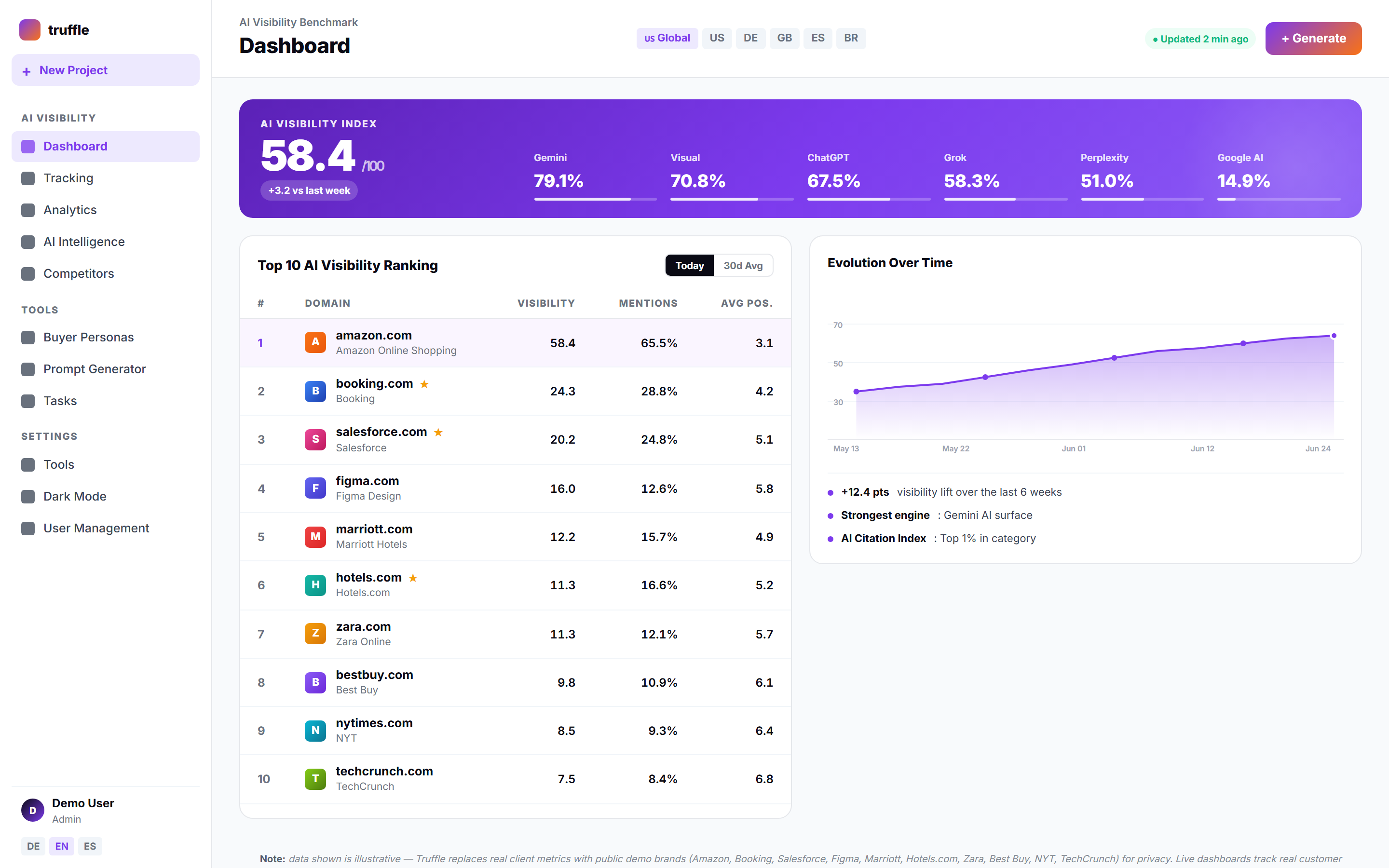
Truffle ships SEO + GEO + AEO instrumentation on every paid tier — organic rankings, citation rate, share of voice, AI Visibility Index, and per-engine breakdown for all six generative engines on the same screen.
KPIs for each track
Three scorecards with one cross-track number that ties them together.
Classical organic metrics
- Organic rankings — top 10 share
- Organic CTR — click-through from SERP
- Organic sessions — GA4 source/medium
- Attributed conversions — organic revenue
- Featured snippet rate — overlap with AEO
Answer extraction metrics
- Featured snippet appearance
- Voice search inclusion
- People Also Ask rate
- Direct-answer extraction
AI citation metrics
- AI Visibility Index — composite 0–100
- Citation rate — % prompts citing brand
- Share of voice — vs competitors
- Average citation position — 1 vs 2–5
- Per-engine breakdown
Brand mention volume — the one metric to report quarterly
Third-party domains independently mentioning your brand across the open web. Correlates with both organic rankings (over time) and AI citation rate, because it's the underlying entity authority signal that all three tracks reward.
Standalone trackers exist for each individual track, but the modern stack tracks all three scorecards on one dashboard. Truffle's AI Analytics ships SEO + GEO + AEO instrumentation on every paid tier — same screen, no per-engine upsell.
When SEO alone is enough
Not every category has migrated to AI-mediated search. Four contexts where investing heavily in GEO before SEO is consolidated would be premature.
Are you targeting transactional + shopping queries?
"Buy X" · "price of Y near me" · "best Y on Amazon" — Google holds back AIOs to preserve the shopping/local SERP that monetizes ads. SEO + local SEO + product schema dominate; GEO is structurally suppressed.
Are you operating in YMYL under strict regulation?
Medical, legal, financial advice — AIOs trigger less often, citation sets are smaller, and editorial authority (E-E-A-T) matters more than passage extraction patterns. SEO foundations remain the dominant lever.
Is your business hyper-local B2C?
"Hair salon Madrid Centro" · "best paella Barceloneta" — local SEO, Google Business Profile, and review velocity dominate. Even when AIOs appear, they cite local sources Google already ranks well in classical SERPs.
Is your category in a B2B niche where buyer research hasn't migrated yet?
Some industrial, enterprise, regulated sectors still have buyers who default to traditional search behavior, vendor websites, and analyst reports. GEO investment here is a 2027–2028 bet, not 2026. Measure category AIO appearance rate before committing.
The principle
GEO is mandatory in categories where AI engines mediate buyer research. SEO is mandatory in categories where buyers still navigate the SERP. Measure your category before extrapolating headlines.
Common misconceptions that misdirect investment
Five myths consistently steer optimization investment in the wrong direction across the 100+ companies Truffle tracks. Click each to see why it's false.
01
"GEO replaces SEO"
+
False. GEO extends SEO — it doesn't replace it. The foundational layer (crawlability, schema, freshness, entity authority) remains identical and is necessary for both tracks. Reality: teams that scrap SEO to "pivot to GEO" lose both rankings and citations simultaneously because the GEO track is built on top of SEO foundations.
02
"SEO is dead"
+
Demonstrably false. Gartner's own 30% drop projection means 70% of search behavior still flows through traditional SERPs by end of 2026 (Gartner, Predicts 2024). Reality: what's dead is "SEO as the only optimization track" — the shift is real but partial, not total.
03
"We can keep doing SEO and ignore GEO"
+
False in any category where AIOs appear on 30%+ of tracked queries. Once Google's AIO eats the top-of-fold position above the ten blue links, SEO-only optimization caps the addressable click volume. Reality: in high-AIO categories, ignoring GEO is choosing to lose half of category-level impressions to competitors who optimize for it.
04
"AI traffic doesn't convert"
+
False — and the opposite is usually true. Opollo's 2026 benchmark across 312 B2B tech firms found AI-referred visitors converting at 14.2% vs 2.8% for Google organic — roughly a 5× advantage (Opollo, 2026). Other data converges directionally: Semrush ~4.4× cross-industry (June 2025), Shopify ~50% higher on product detail pages (Q1 2026). Reality: smaller traffic volume but dramatically higher qualified intent.
05
"GEO is purely an on-site SEO problem"
+
The most expensive misconception to operate under. AI citations are heavily influenced by off-site signals: which independent reputable domains mention your brand, which third-party reviews rank you, which podcasts and community threads cite you by name. Reality: teams that only optimize on-site (schema, direct-answer paragraphs) without parallel Digital PR work leave a meaningful chunk of citation lift on the table. Fix: identify the 15–20 high-authority sources your category appears in (Truffle surfaces this as the source mention map in AI Analytics) and run a focused Digital PR play to plant your brand on those exact domains.
The 5 myths are the 5 levers
Every misconception above maps to a measurable factor inside Truffle. Plug your brand and see which myths are still costing you SEO rankings or GEO citations — and exactly which page or off-site source to fix first.
Implementation roadmap — running both tracks operationally
Four phases over a quarter, then continuous parallel operation. Most teams arrive at a stable 60/40 or 50/50 SEO/GEO split.
Joint audit
SEO audit + GEO audit on the same property. The free check gives a first score for the GEO half. Output: unified gap map.
Gap-prioritized optimization
Optimize the bigger gap first. Asymmetric gaps are the norm — 50/50 effort wastes the first quarter.
Instrumentation
Both KPI scorecards in the analytics layer. Cross-reference with GA4 — most teams discover the AI channel is under-credited.
Continuous parallel
Weekly scorecards, quarterly reviews, budget rebalances when cross-track KPIs cross thresholds.
Start with Truffle — the 5-step path to running both tracks
If the framework above feels right but you don't have a unified system in place yet, here's the operator path most teams follow inside Truffle to operate SEO + GEO + AEO from one dashboard.
Create your Truffle account
Set up your brand, category, and 5–10 reference brands you want to benchmark against across SEO and AI surfaces. Sign up →
Find the prompts that matter
Truffle uses AI to surface the 250–500 real prompts your category's buyers ask — both the ones that trigger AI Overviews and the ones that run through classical SERPs.
Use the answers in your content
For every prompt where you're not cited (or ranking), Truffle shows the content gaps and which sources are winning each side. Refresh your top pages with both SEO and GEO in mind.
Monitor SEO + GEO + AEO weekly
Rankings, citation rate, share of voice, average position, per-engine breakdown across six generative engines — same screen, no dashboard switching.
See both lines climb
Most teams land their first new AI citations within 4–6 weeks while defending existing SEO rankings. The unified scorecard is the proof to the CFO.
Frequently asked questions
Eight questions buyers actually ask when researching the SEO/GEO/AEO triplet.
What's the difference between GEO and SEO?
Is GEO replacing SEO?
What's the difference between SEO, AEO, and GEO?
Do I need both GEO and SEO?
What are the KPIs for GEO vs SEO?
Is SEO dead?
Should I prioritize GEO or SEO in 2026?
How is GEO different from traditional SEO?
Stop running SEO blind on the AI half of the SERP
Truffle ships SEO + GEO + AEO instrumentation across all six engines on every paid tier. The AI Visibility Index, citation rate, share of voice — all on one screen with your SEO scorecard alongside.