AI Brand Mentions in 2026 — the operator's guide to measuring, increasing, and defending your presence
AI Overviews trigger on ~48% of US queries in BrightEdge's March 2026 tracker (the range across methodologies sits 16–65%). Roughly 60% of US consumers use generative AI to research high-stakes purchases (Pew · Brookings 2026). The discipline of measuring, increasing, and defending how often your brand surfaces inside synthesized AI answers moved from "interesting metric" to "primary marketing KPI" in 2026.
What "AI brand mentions" are — and why they differ from traditional brand monitoring
An AI brand mention is any instance where a large language model — ChatGPT, Claude, Gemini, Perplexity, AI Mode, or Google AI Overview — names your brand inside a synthesized answer to a user query. The mention may or may not link back to your site; it may or may not attribute a specific claim; it may include positive sentiment, neutral framing, or competitor-comparative context. The unit of measurement is "your brand surfaced in the answer," not "your page appeared in a list of links."
Traditional brand monitoring tools count brand name occurrences across the open web — blog posts, social media, news articles, forums. AI brand mentions are upstream of that web: they happen inside synthesized AI responses that the user never sees on a crawlable URL. The two disciplines feed each other but require different instrumentation.
| Discipline | Where mentions appear | Measurement | Time horizon |
|---|---|---|---|
| Traditional brand monitoring | Open web (blogs, social, forums, news) | Crawl + index + count | Hours to days |
| AI brand mentions | Inside LLM-generated answers | Prompt-based polling + response parsing | Days to weeks |
For the broader operational framework that contextualizes AI brand mentions inside GEO/AEO, see our Generative Engine Optimization guide. For the technical distinction between mentions and citations (mention = named, citation = named + linked), see our AI Citation Tracking buyer's guide.
The platform leaderboard problem — ChatGPT vs Perplexity disagree 20–40% of the time
Most teams running their first AI mention tracking pilot discover the same surprising signal: ChatGPT and Perplexity return materially different brand leaderboards for the same prompt. The mechanism is mechanical, not random.
ChatGPT · "best [category] tools 2026"
- Brand A (category leader)
- Brand C
- Brand E
- Brand B
- Brand D
positions 2–5 diverge
Perplexity · same prompt
- Brand A (category leader)
- Brand B
- Brand D
- Brand F
- Brand C
Independent observational analyses through 2026 consistently surface the same pattern: when asked head-term queries like "best [category] tools 2026," the two engines often agree on the top-ranked brand, but diverge substantially on positions 2 through 5. Industry researchers attribute the gap to different retrieval architectures and source weighting.
The mechanism is mechanical: ChatGPT weights training data heavily — Reddit and major publications (Forbes, TechCrunch, Wired) carry disproportionate weight at synthesis. Perplexity is search-first by design and crawls the web live for nearly every query — off-site authority (earned media, recent press, fresh blog mentions) shows up faster. Claude prioritizes depth and structured content; Gemini integrates with Google's wider ranking signals.
The practical consequence: a brand that ranks #2 in ChatGPT's leaderboard may rank #4 or be entirely absent in Perplexity's leaderboard for the same prompt. Tracking only one engine produces a systematically incomplete view of brand visibility.
The polling-based measurement model — 4 steps borrowed from election forecasting
The serious method for measuring AI brand mentions is statistical polling, not anecdotal checking. Define a representative sample, run repeated draws, aggregate to stable estimates.
Define your prompt corpus
250–500 high-intent queries. Sources: customer interview transcripts, top organic SEO queries reframed conversationally, sales discovery questions, competitor-aware comparison queries, buyer-persona variants.
Run each prompt 3–5×
LLM responses are stochastic — the same prompt at 10 AM and 4 PM may surface different brand sets. Running each prompt 3–5 times per engine produces aggregate brand-mention rates that stabilize statistically.
Record 4 fields per response
- Brand mentioned? (yes/no)
- Position (1st, 2nd, 3rd)
- Competitors named
- Sources cited
Aggregate weekly into 4 KPIs
- Mention rate
- Average position
- Share of voice
- Source mention map
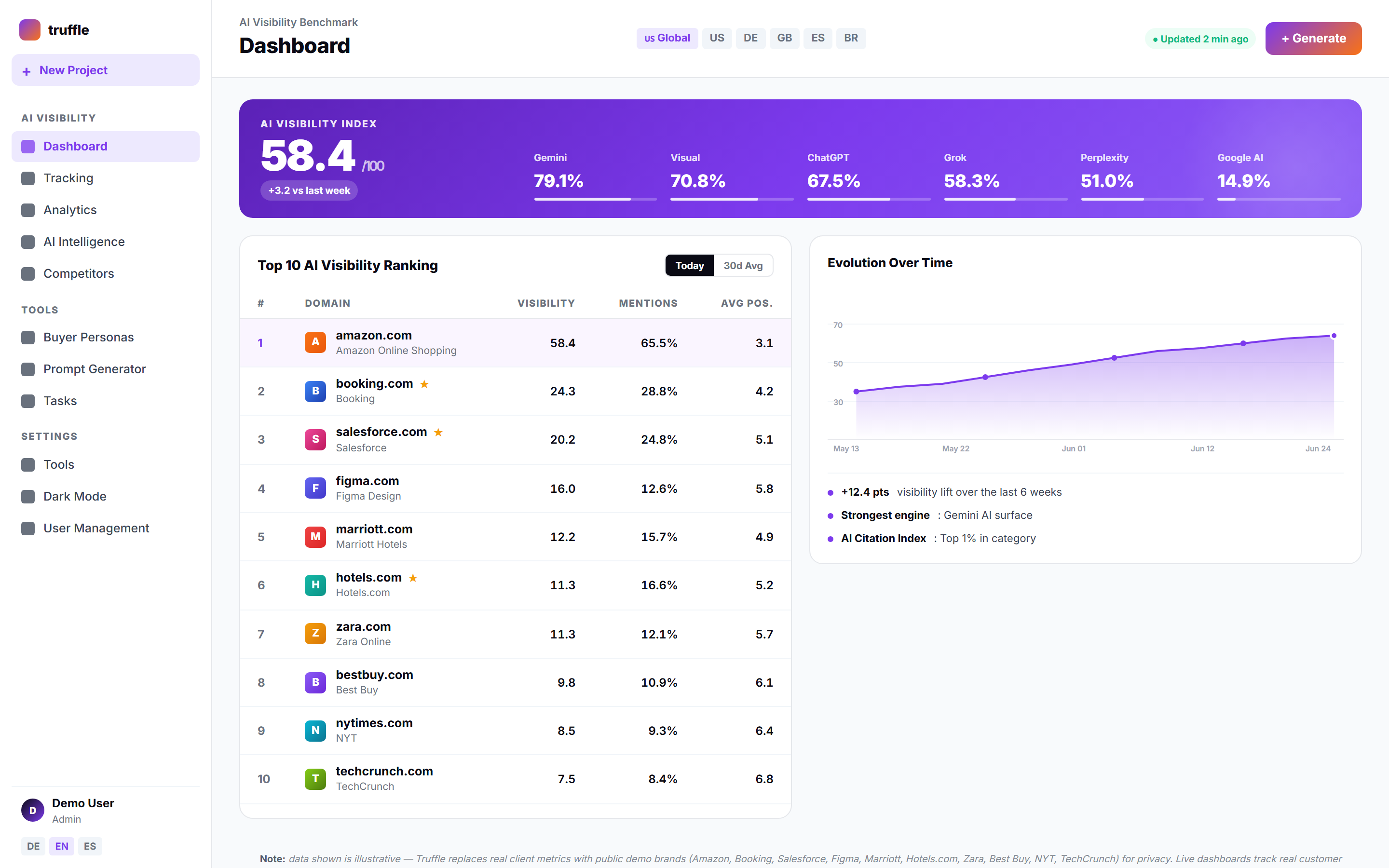
The output of running the polling model for 4–6 weeks is a baseline. Without a baseline, every subsequent intervention is a guess. With a baseline, every shipped change has a measurable lift signal. Truffle's AI Analytics ships all four KPIs across the six major engines on every paid tier. For a quick ChatGPT-only baseline before committing to full multi-engine polling, run our ChatGPT Visibility Checker.
Manual vs automated tracking — the 2-hour-per-week threshold
A manual workflow can track brand mentions across ChatGPT, Claude, and Perplexity in a single 45-minute round. The operational tipping point where automation pays off is roughly 2 hours per week of manual effort.
| Approach | Time cost | Scale ceiling | Best for |
|---|---|---|---|
| Manual polling45 min per round (1 engine batch) | ~50 prompts × 3 engines weekly = 150 data points | Pilots · validating the channel · pre-Series A | $0 tooling · ~$200/week labor at $80/hr |
| Semi-automated2–4 hrs/week setup, 30 min/week run (spreadsheet + scripts) | ~150 prompts × 4 engines weekly = 600 data points | Series A teams · short-term validation programs | Light tooling cost · ~$300/week labor |
| Fully automated1–2 weeks setup · ongoing 30 min/week QA | 250–1,000 prompts × 6 engines weekly = 1,500–6,000 data points | Series A+ · serious citation program · cross-engine coverage | $200–$700/mo platform · negligible ongoing labor |
Six levers to increase AI brand mentions
After auditing brand mention performance across the 100+ companies Truffle tracks, six levers consistently move the underlying mention rate. Treat them as parallel investments, not sequential phases.
Wikipedia article presence
ChatGPT pulls heavily from Wikipedia at synthesis. A brand or product category without a properly-sourced Wikipedia article has no entity authority anchor inside the model's parametric memory. Foundation lever — build first.
Reddit + community presence
Reddit is the #1 single source across all major AI engines, at ~40% citation frequency. Perplexity pulls 46.7% of top citations from Reddit. Identify 3–5 subreddits where your category is discussed and engage authentically.
Earned media on tier-one publications
Forbes, TechCrunch, Wired, The Verge, NYT, and category-specific trade press are heavily weighted by ChatGPT at synthesis. PR effort focused on these domains compounds your mention rate at scale.
Review platform optimization
G2, Capterra, Trustpilot, and category-specific review platforms factor into AI category-comparison answers. A category leader with 200 G2 reviews outranks a category leader with 30 reviews in many AI comparison prompts.
YouTube content with full transcripts
YouTube mentions correlate at 0.737 with ChatGPT citation rates — the strongest single signal of any factor measured. Short videos with full transcripts feed indexing → AI training corpora → mention probability simultaneously.
Direct-answer content on your site
Question-as-heading + 40–60 word direct answers + FAQPage schema. This is the half of the work most teams over-invest in — the other five levers usually return more leverage per hour. Full pattern: AEO Playbook.
See which lever moves your mention rate
Truffle's Strategy Recommendations map every lever to your category's specific gaps — Wikipedia thin, Reddit absent, schema missing — and rank them by expected lift. No generic playbook; per-brand actionable.
Mentions vs Citations vs Share of Voice — the KPI hierarchy
Three KPIs commonly conflated by teams new to AI brand visibility. Reporting only one under-reports performance; reporting all three with engine breakdown defends the budget to the CFO with structurally complete data.
The KPI hierarchy maps to different optimization tracks — knowing which KPI is weakest tells you which lever from the prior section to invest in. For deeper KPI mechanics across the GEO triplet, see our GEO glossary.
Brand vs. Competitors
Top Brands · category share
Brand vs. Competitors · over time 2026-03-28 → 2026-06-26
Your brand's share of voice across the category, ranked vs your named competitor set — Demo Brand at #3, two leaders above, seven challengers below, full 3-month trend. Real Truffle UI · brand identifiers replaced with generic placeholders ("acme.com", "globex.io"...) for the public preview. See the live competitors view →
Six common mistakes that under-report AI brand mention performance
Six mistakes consistently lead teams to under-report their real AI mention footprint.
Tracking only ChatGPT
ChatGPT captures ~80%+ of AI referral volume to top sites (Similarweb · 2025) but the remaining share — Perplexity, Claude, Gemini, Grok — drives disproportionate volume for technical, professional, and research-grade buyer queries. Single-engine tracking is a structural visibility blind spot for B2B categories.
Fix. Cover at least 5 engines from day 1; use share-of-voice per engine as the dashboard headline.
Single-shot polling
Running a prompt once is a single noisy sample. LLM responses are stochastic; running 3–5 times per engine produces materially more stable aggregates. Teams reporting on single-shot data systematically over- or under-state mention rates by a meaningful margin (variance depends on engine, query type, and time of day — but it's consistently directional).
Fix. Configure 3–5 runs per prompt per engine; aggregate to weekly stable estimates.
Confusing mentions with citations
A brand mentioned heavily but rarely cited needs content work. A brand cited rarely but never mentioned needs entity authority work. Reporting "AI visibility" as a single composite number obscures which optimization track to invest in.
Fix. Track and report mention rate and citation rate separately, never as a single composite.
Ignoring sentiment and context
A brand mentioned negatively in 30% of category prompts is in a worse competitive position than a brand mentioned positively in 25%. Mention rate without sentiment polarity is incomplete.
Fix. Classify each mention as positive / neutral / negative / comparative-against-competitor at parsing time.
Treating PR mention volume as vanity
Brand mentions across the open web correlate 3× more strongly with AI visibility than backlinks. PR efforts measured by reach or impressions miss the durable AI-visibility impact.
Fix. Switch the PR KPI to mention volume across the top 15 high-leverage domains.
Treating mention tracking as a one-shot baseline
The most expensive misconception. Mention rates drift weekly — competitor entries, engine model updates, fresh PR, Wikipedia edits, Reddit threads going viral all move the baseline. Teams that run polling once at kickoff and "check in quarterly" miss 70%+ of competitive movement.
Fix. Weekly re-polling + monthly source mention map review + quarterly prompt corpus refresh. Continuous defense is the program.
Skip the 6 mistakes — get the baseline today
Truffle ships 3–5× polling, citations vs mentions separated, sentiment classification, and weekly re-polling out of the box on every paid tier. The 6 mistakes don't happen by design — the platform handles them.
Implementation roadmap — the continuous loop
A new AI brand mention program lands in four phases over roughly a quarter — and never finishes. Continuous polling is the program; everything else is the on-ramp to continuous.
Continuous defense loop
Weekly polling · monthly scorecard · quarterly business review · re-prompt corpus weekly to detect drift · refresh prompts quarterly as the category evolves.
Baseline
250-prompt corpus, 3× each across 3 engines. Record mention rate, position, competitors, sources.
Gap analysis
Top 10 prompts where you're absent but competitors appear. Map each gap to one of the 6 levers.
Lever execution
Schema + direct-answer (2–6 wks fast wins) parallel to off-site (8–16 wks). Run all in parallel.
Tracking cadence
Weekly polling. Refresh corpus quarterly. Defending position is continuous, not a one-shot.
For the technical layer (robots.txt, schema, llms.txt) that underlies the entire loop, see the companion LLM SEO guide →
Start with Truffle — the 5-step path from baseline to defended mention rate
If the polling model feels right but you don't have a unified system in place yet, here's the operator path most teams follow inside Truffle to ship the brand mention program end-to-end.
Create your Truffle account
Set up your brand, category, and 5–10 reference brands you want to benchmark across ChatGPT, Claude, Gemini, Perplexity, AI Mode, and Google AIO. Sign up →
Find the prompts that matter
Truffle uses AI to surface the 250–500 real prompts your category's buyers ask. The polling corpus is auto-curated.
Use the answers in your content
For every prompt where you're not mentioned, Truffle's Strategy Recommendations show which of the 6 levers needs work and the specific page or off-site source to fix first.
Monitor 4 KPIs × 6 engines
Mention rate + position + share of voice + source mention map across all six engines, polled weekly with 3–5 runs per prompt for statistical stability.
See mention rates climb and hold
First new mentions land in 4–6 weeks. The continuous loop catches new competitor entrants and engine drift before they erode your position.
Frequently asked questions
Eight questions teams ask when scoping an AI brand mention program.
What are AI brand mentions?
How do I see if AI mentions my brand?
How do I track brand mentions in AI search results?
Do brand mentions impact visibility in AI search?
How do I get brand mentions in AI search engines?
How do I track brand mentions in Google AI Overviews?
How is increasing visibility with AI brand mentions different from SEO?
What is the difference between brand mentions and brand citations in AI?
Start defending your AI brand mentions today
Plug your brand into Truffle and see the baseline polling-based scorecard across all six generative engines in under 5 minutes. The continuous loop is the program.