
AI SEO Software in 2026:
the categories, and what to look for
Search "AI SEO software" and you get two very different products dressed in the same words. One helps you write and optimize pages faster. The other tells you whether ChatGPT, Perplexity, and Gemini mention your brand when someone asks a buying question. Both call themselves AI SEO. They solve different problems.
Category 1 is AI-assisted traditional SEO. Content generators, keyword clustering, on-page grading, technical crawlers with an AI layer. Mature, and good at making the classic work faster. It optimizes your inputs.
Category 2 is AI-visibility software, or GEO tooling. It tracks how your brand shows up inside AI answers instead of where you rank in Google. Newer, and thin. It measures the output.
Both are "AI" and both are "SEO." But one optimizes the page, and the other measures the answer. This guide sorts out which you need, and what to check before you pay.
The two things people mean by "AI SEO software"
The first category is AI-assisted traditional SEO. These are the tools most teams already own: content generators, keyword clustering, on-page grading, internal-link suggestions, technical crawlers with an AI layer bolted on. The job is the classic one, rank in Google's blue links and, increasingly, get pulled into AI Overviews. AI just makes the work faster. You draft briefs in minutes, cluster a thousand keywords without a spreadsheet, and get a page score before you hit publish.
The second category is newer. Call it AI-visibility software, or GEO tooling, or SEO software for AI search. Instead of tracking Google rankings, it tracks how your brand shows up inside AI answers. When a buyer asks an assistant "what's the best CRM for a small agency," these tools measure whether you get named, in what position, with a link or without, and how that compares to competitors. Google's ten blue links don't tell you any of this. The answer happens inside the model.
The confusion is understandable. Both are "AI" and both are "SEO." But one optimizes the page, and the other measures the answer.
The two categories, side by side
| Dimension | Category 1: AI-assisted traditional SEO | Category 2: AI-visibility / GEO platforms |
|---|---|---|
| What it optimizes | The page: content, structure, technical health | The answer: how AI engines describe and cite you |
| Main output | Faster drafts, keyword clusters, page scores, crawl fixes | Mention rate, position, citations, competitor share in AI answers |
| Tracks AI answers? | ✗ | ✓ |
| Persona / segment tracking | ✗ | ✓ |
| GSC / GA4 tie-in | For rankings and traffic | Ties AI mentions to clicks and conversions |
| Best for | Producing and cleaning lots of pages | Seeing and improving how you show up in AI answers |
What AI-assisted SEO tools do well
The AI-powered SEO software in category one is mature. It's good at what it does.
Content generation and editing cut drafting time hard. Keyword clustering groups intent so you build topic hubs instead of cannibalizing yourself. On-page tools catch missing headings, thin sections, and entity gaps. Technical crawlers flag the broken canonicals and orphan pages that quietly drain crawl budget.
If your problem is "we need to produce more good pages and keep them technically clean," this category is where you spend money. Don't over-think it. A team publishing twenty articles a month gets real leverage from AI drafting and clustering. That work still matters, because AI engines pull from pages that rank and read well. Good classic SEO feeds good AI visibility.
The limit is scope. These tools optimize inputs. They don't tell you what the AI engines say about you.
Why AI-visibility software is the under-served category
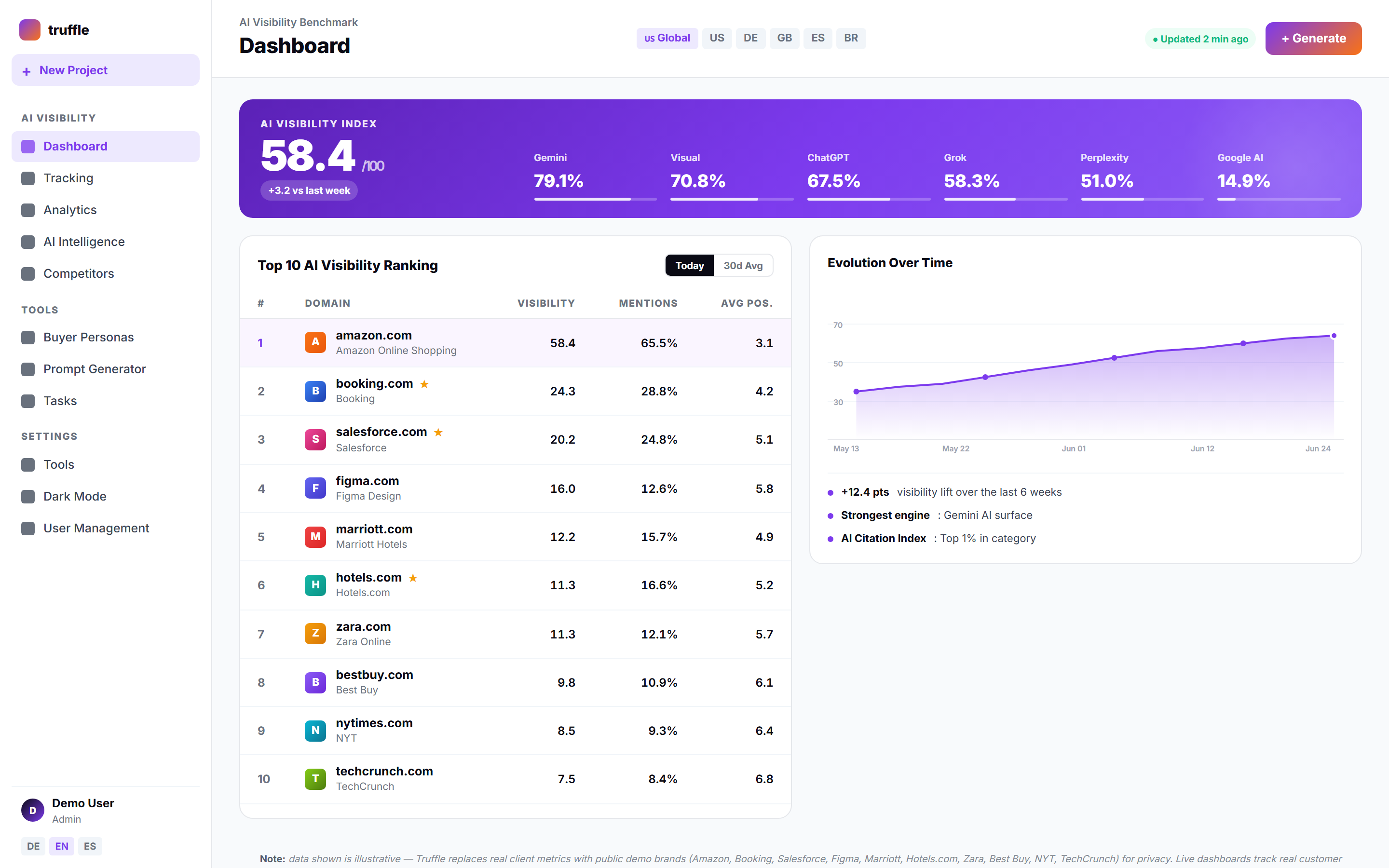
Here's the gap. More buyers now start with an assistant instead of a search box. They ask a question, read a synthesized answer, and often act on three or four brands the model named. If you're not in that answer, you're invisible, and no rank tracker will warn you.
Illustrative: one brand's mention rate across five engines. A visibility tool watches all of them and flags where you drop out. A rank tracker watches none of it.
That's the problem AI-visibility tools exist to solve, and the category is thin. Plenty of vendors added an "AI" checkbox to a legacy rank tracker. Far fewer built for the way answers actually work: many engines, many phrasings, many buyer types, results that shift week to week. Measuring this well is harder than pinging one API and counting mentions.
This is where Truffle sits. It's an AI SEO platform built to track and improve how you appear inside AI answers, not to replace your content tooling. If you already run a content stack you like, Truffle handles the layer that stack can't see.
What to look for in an AI visibility platform
If you're evaluating the best AI SEO software for the answer layer, these are the things that separate a real tool from a dashboard.
1Coverage of AI engines
ChatGPT, Claude, Perplexity, and Gemini give different answers to the same question. A tool that watches one engine gives you a slice. Check the model catalog and confirm it's open and updated as new models ship, not frozen to whatever was current at launch.
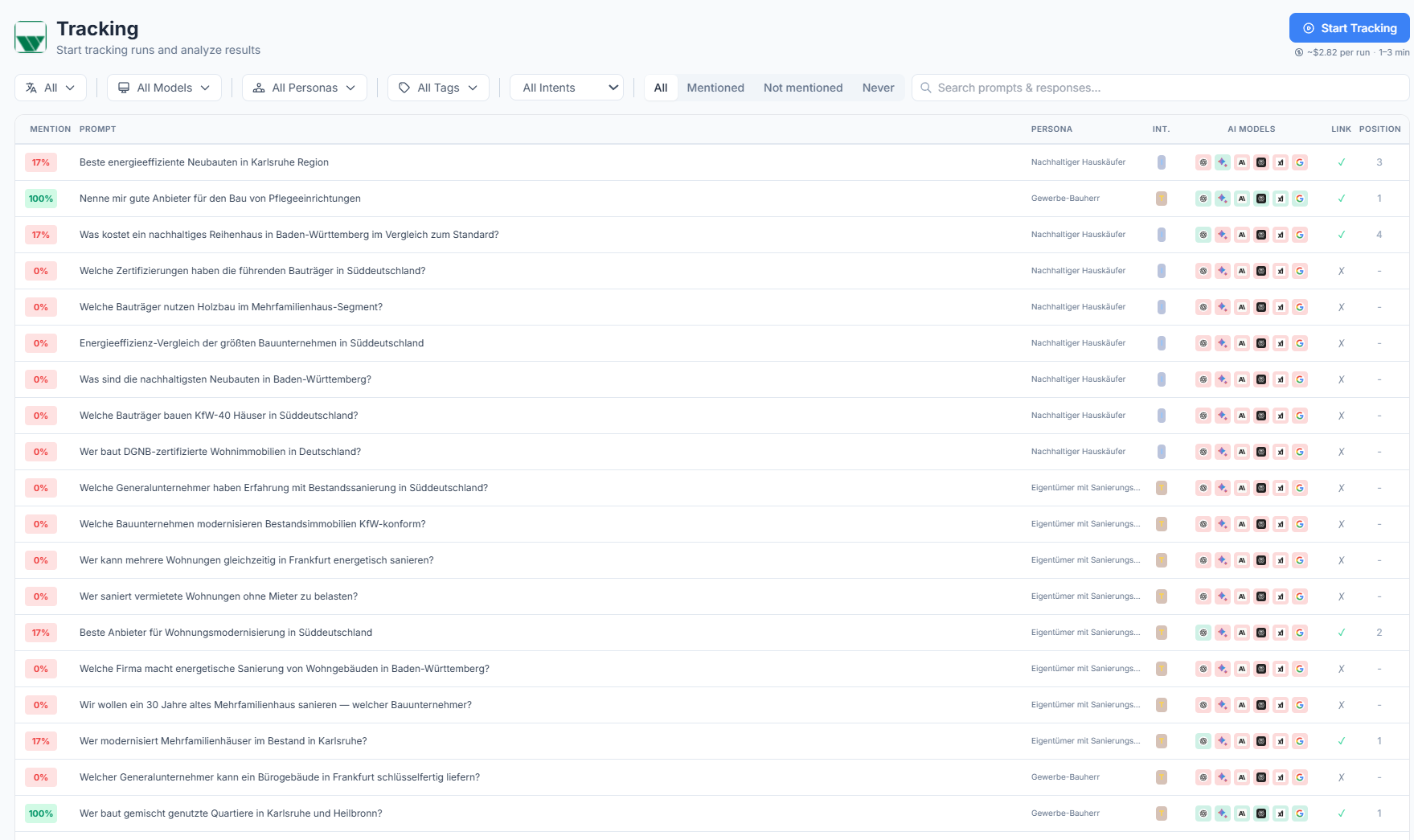
2Persona and segment-level tracking, not flat prompts
A "best project tool for a solo freelancer" query and a "best project tool for a 200-person agency" query return different brands. If a platform tracks one flat list of prompts, it averages away the segments where you win or lose. Persona-level tracking shows you which buyer sees you and which doesn't.
3Narrative insight over metric dumps
A score of 41 tells you nothing you can act on. You want to know why Perplexity stopped citing you last week, or which competitor took the position you held. Good software reads the pattern and says what changed.
4Native GSC and GA4 correlation
AI visibility means little in a vacuum. Tie it to clicks and conversions so you can show whether a mention in ChatGPT moved anything real. A platform that plugs into Search Console and GA4 turns "we got mentioned more" into "here's the traffic it drove."
5A free check and honest pricing
You should be able to run your own brand through the tool before you pay, and read the price without booking a sales call. Vague enterprise-only pricing is a signal the product isn't confident on its own.
For the deeper method behind this, the generative engine optimization guide and our AI visibility index go further.
See where your brand stands across every engine
Run your own brand through the free check and read the first score for yourself before you commit to anything.
Run the free check →FAQ
Is AI SEO software the same as a rank tracker?
No. A rank tracker records your position in Google's results. AI SEO software, in the visibility sense, records whether AI assistants name and cite your brand in their answers. Those are separate surfaces, and a strong result on one doesn't guarantee the other.
Do I still need traditional SEO tools if I use an AI visibility platform?
Usually yes. AI engines draw heavily from pages that rank and read well, so classic content and technical work still feeds your AI visibility. The two categories complement each other. One produces and cleans pages, the other measures how those pages surface inside AI answers.
How do I know if I have an AI visibility problem?
Ask a few assistants the questions your buyers ask, and see if you show up. If competitors get named and you don't, or you appear for some phrasings but not others, that's the gap a dedicated platform quantifies and tracks over time.
Related reading
- The AI SEO pillar guide — foundational methodology
- GEO explained — Generative Engine Optimization definition
- SEO software for AI search — the AI-visibility category
- Generative engine optimization guide — the deeper method
- AI visibility index — how the scoring works
- Truffle pricing — model catalog and tiers
Want to see where you stand before you commit to anything?
Run your brand through the free check and read the first score for yourself. No signup needed.
Run the free check →