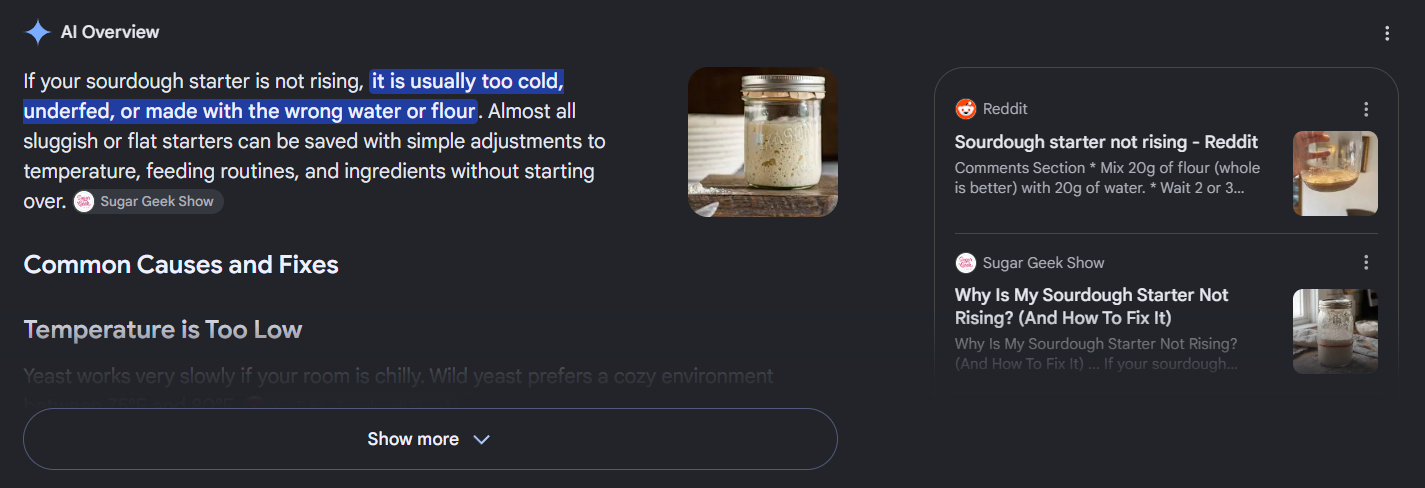
What counts as an AI Overview
Google runs three different things on the same results page, and they are routinely confused.
Classic search results are the ranked list of links. No generated text.
AI Overviews sit above that list. Google describes them as helping people "get to the gist of a complicated topic or question more quickly" while providing "a jumping off point to explore links to learn more". They are not shown on every query. Google states that AI Overviews "are only shown when our systems determine that it is additive to classic Search, and as such, often don't trigger."
AI Mode is a separate surface for queries "where further exploration, reasoning, or complex comparisons are needed": questions that would previously have taken several searches.
The distinction that matters for measurement: Google says AI Mode and AI Overviews "may use different models and techniques, so the set of responses and links they show will vary." Appearing in one does not mean appearing in the other, and a tool that reports on one is not reporting on both.
Google runs three different things on the same results page, and they are routinely confused.
Classic search results
the ranked list
The ranked list of links. No generated text.
The reference point. Google’s description of the other two surfaces assumes this list.
AI Overviews
above the list
Sit above that list. Not shown on every query.
“are only shown when our systems determine that it is additive to classic Search, and as such, often don’t trigger”
AI Mode
a separate surface
A separate surface for questions that would previously have taken several searches.
“where further exploration, reasoning, or complex comparisons are needed”
How it works
The query fans out. Google states that both AI Overviews and AI Mode "may use a 'query fan-out' technique — issuing multiple related searches across subtopics and data sources — to develop a response." The user asked one question; the system asks several.
More pages get pulled in. According to Google, while responses are being generated, "our advanced models identify more supporting web pages, allowing us to display a wider and more diverse set of helpful links associated with the response than with a classic web search."
Eligibility is the ordinary kind. To be shown as a supporting link, "a page must be indexed and eligible to be shown in Google Search with a snippet." Google adds: "There are no additional technical requirements."
And it may not trigger at all. AI Overviews appear only where Google's systems judge them additive. On many queries there is nothing to appear in.
Four steps until an answer exists — and one in which none does.
The query fans out
query fan-out
The user asked one question; the system asks several.
“issuing multiple related searches across subtopics and data sources”
More pages get pulled in
supporting links
While the response is being generated, the system looks for further supporting pages.
“a wider and more diverse set of helpful links associated with the response than with a classic web search”
Eligibility is the ordinary kind
no special requirements
No new technology, no special files, no markup of your own.
“a page must be indexed and eligible to be shown in Google Search with a snippet”
And it may not trigger at all
may not trigger
AI Overviews appear only where Google’s systems judge them additive. On many queries there is nothing to appear in.
An absent AI Overview is not a visibility problem — often it was never an opportunity.
What Google says you cannot optimise for
This is the section most guides skip, and it is stated plainly in Google's own documentation.
"There are no additional requirements to appear in AI Overviews or AI Mode, nor other special optimizations necessary."
And more specifically:
"You don't need to create new machine readable files, AI text files, or markup to appear in these features. There's also no special schema.org structured data that you need to add."
That covers a good deal of what is currently sold as AI-search optimisation, including llms.txt-style files and AI-specific markup. Google's position is that the existing fundamentals apply: crawlable pages, internal links that make content findable, important content available as text, structured data that matches the visible page.
None of this means visibility in AI answers is automatic or unmeasurable. It means the lever is the same lever as before, and anyone selling a separate one should be asked which part of the documentation they are working from.
Controlling what appears
Google treats AI features as part of Search rather than as a separate system, which shapes the controls available.
Crawling is managed through robots.txt directives for Googlebot, as with the rest of Search. To limit what is shown from a page, the available controls are nosnippet, data-nosnippet, max-snippet and noindex. A separate control, Google-Extended, governs AI training and grounding in some of Google's other systems.
Two practical notes from the same documentation. Changes take effect on Google's recrawl schedule, which "can take anywhere from several days to several months". And if content still appears after a preview control is set, the first check is whether Googlebot actually received it. The URL Inspection tool shows the HTML as crawled.
There is also a setting aimed at the AI features alone, announced on 3 June 2026 and available to all websites since 31 August 2026. The Search generative AI control in Search Console lets a site be excluded from AI Overviews, AI Mode and generative AI features in Discover. Google says excluded content "won't be eligible to be used as an input to generate an AI response or preview" in those features, and that the control "isn't used as a ranking or inclusion signal affecting other parts of Search". The entry on the AI opt-out covers what it changes and what it leaves.
Measurement, and its edges
Pages appearing in AI features are included in Search Console's overall search traffic, reported in the Performance report under the "Web" search type.
There is also a dedicated generative AI performance report, which counts impressions in AI Overviews and AI Mode. Worth knowing before relying on it: that report lists impressions and four dimensions, and does not list clicks or click-through rate.
Google states that clicks originating from result pages with AI Overviews are "higher quality", meaning users are more likely to spend more time on the site. That is Google's characterisation of its own data, and it is not accompanied by a public figure.
Common mistakes
Treating AI Overviews and AI Mode as one surface. Google says they may use different models and show different links. Measuring one and reporting both is a category error.
Assuming an AI Overview appears for a query. They often do not trigger. An absent AI Overview is not a visibility problem; it may be a query where Google decided one adds nothing.
Buying an AI-specific markup solution. Google's documentation says no new files, no AI text files, no special structured data.
Reading a click-through rate as coverage. The generative AI report counts impressions. Clicks are not in it.
Related terms
- Zero-Click Search: a search that ends without a click to any website, an outcome an AI Overview often produces.
- Answer Engine: a search system built to answer a question directly rather than list links, the category an AI Overview belongs to.
- Generative Engine Optimization (GEO): the practice of shaping content to be cited by generative answer systems such as AI Overview.
- Citation Rate: the share of relevant queries where your brand gets cited as a source.
- Source Attribution: how an AI system credits, or fails to credit, the page an answer actually drew on.
Source
Google Search Console Help: "Generative AI performance report (Search)" (retrieved 26 August 2026). Source of the report's metric and dimensions, and of the absence of click and click-through-rate reporting.
Google Search Console Help: "Search generative AI control" (retrieved 15 September 2026; the page states the control was rolled out to all websites on August 31, 2026). Source of the two quoted sentences on excluding a site.
Frequently asked questions
Is an AI Overview the same as a Featured Snippet?
No. A Featured Snippet extracts one passage from a single page, a format Google has used for years. An AI Overview synthesizes information from several sources into a new generated answer and can cite more than one page at once, and it now appears far more often across informational and comparison searches than a Featured Snippet does.
Does ranking first guarantee a citation in the AI Overview?
No. Google draws from a broader set of sources than the top organic result, and can cite a lower-ranked page if its content answers the specific question more directly and more completely. A page ranking third or fourth with a clearer answer can end up cited ahead of the page in first place.
How often does the AI Overview change for the same query?
Often. The set of cited sources for a query can change between checks, sometimes within days, and can also vary by the searcher's location or device at the same moment. This is why a single check only shows what happened once; a stable read needs the same query checked repeatedly over time.
Does an AI Overview citation replace the need for good SEO?
No. An AI Overview draws on the same indexed content that traditional search rankings rely on, so a page still needs to be crawlable, indexed and clearly written to be eligible for either one. Clear technical SEO and direct, complete answers remain the foundation both systems need to find and use a page.