
LLM Visibility Tool: What It Actually Measures (2026 Buyer's Guide)
A growing share of your buyers no longer start on Google. They open ChatGPT, Claude, Perplexity, or Gemini, describe their problem in a sentence or two, and read whatever answer comes back. If your brand shows up in that answer, you get considered. If it doesn't, you never entered the shortlist, and you have no log file to tell you it happened.
That gap is why LLM visibility tools exist. This guide explains what a good one measures, and how to separate a useful LLM visibility tracker from a dashboard that just makes numbers go up and to the right.
LLM visibility is how often, and how prominently, your brand shows up in AI answers. A real tool measures five things that move independently: mention rate, position, citations, sentiment, and the per-engine split.
The buying decision comes down to two questions. Does the tool track per buyer persona, or does it run one flat prompt list for everyone? And does it hand you a narrative of what changed, or a table of forty metrics you have to decode yourself?
What "LLM visibility" actually means
LLM visibility is how often, and how prominently, your brand appears in the answers language models generate. It is the AI-search equivalent of a search ranking, except the surface is a paragraph of prose instead of ten blue links.
Concretely, an answer engine can treat your brand four ways. It can name you. It can cite or link your site as a source. It can describe you accurately or wrongly. Or it can leave you out and recommend a competitor. A visibility tool watches all four across the engines your buyers use, including Google AI Overviews, which now sits on top of a large slice of commercial searches.
The reason this matters now is behavioral. People ask LLMs the questions they used to type into a search bar, and they act on the reply without clicking through. When the model answers "which tools should I look at for X," that sentence is the shortlist. This shift is the core of what people call generative engine optimization, and you cannot optimize for something you cannot measure.
What a good tool actually measures
Plenty of products will show you a single number and call it visibility. Treat that with suspicion. A real measurement stack tracks a few distinct things, because they move independently and each one tells you something you can act on.
Mention rate. Across a set of buyer questions, how often does the model name you at all? This is your baseline presence. A mention rate of 12% means you show up in roughly one answer in eight.
Position and prominence. Being named first in a recommendation carries more weight than a passing reference in the last line. Good tools record where in the answer you land, not just whether you appear.
Citations and links. Some engines, Perplexity and AI Overviews in particular, attach source links. Tracking which pages get cited tells you what content the models trust, which feeds your AI SEO work.
Sentiment and context. A mention is not automatically good. The model might name you as the expensive option, or repeat a two-year-old criticism. Context tracking catches that.
Per-engine breakdown. ChatGPT, Claude, Gemini, and Perplexity draw on different data and give different answers to the same prompt. A blended average hides the fact that you might dominate Perplexity and be invisible in Gemini. You need the split to know where to spend effort.
| What gets measured | Real LLM visibility tool | Vanity dashboard |
|---|---|---|
| Mention rate | ✓ Tracked per prompt setBaseline presence, not a guess | ✓ ReportedUsually the one number it shows |
| Position / prominence | ✓ Where in the answer you landFirst mention weighted over last line | ✗ Appear / not-appear only |
| Citations & links | ✓ Which pages get citedFeeds content decisions | ✗ Not captured |
| Sentiment / context | ✓ How you are describedCatches "the expensive one" | ✗ A mention counts as positive |
| Per-engine breakdown | ✓ ChatGPT, Claude, Gemini, Perplexity splitShows where to spend effort | ✗ Blended average hides the gaps |
| Persona-level tracking | ✓ Visibility per buyerTells you invisible to whom | ✗ One flat prompt list for everyone |
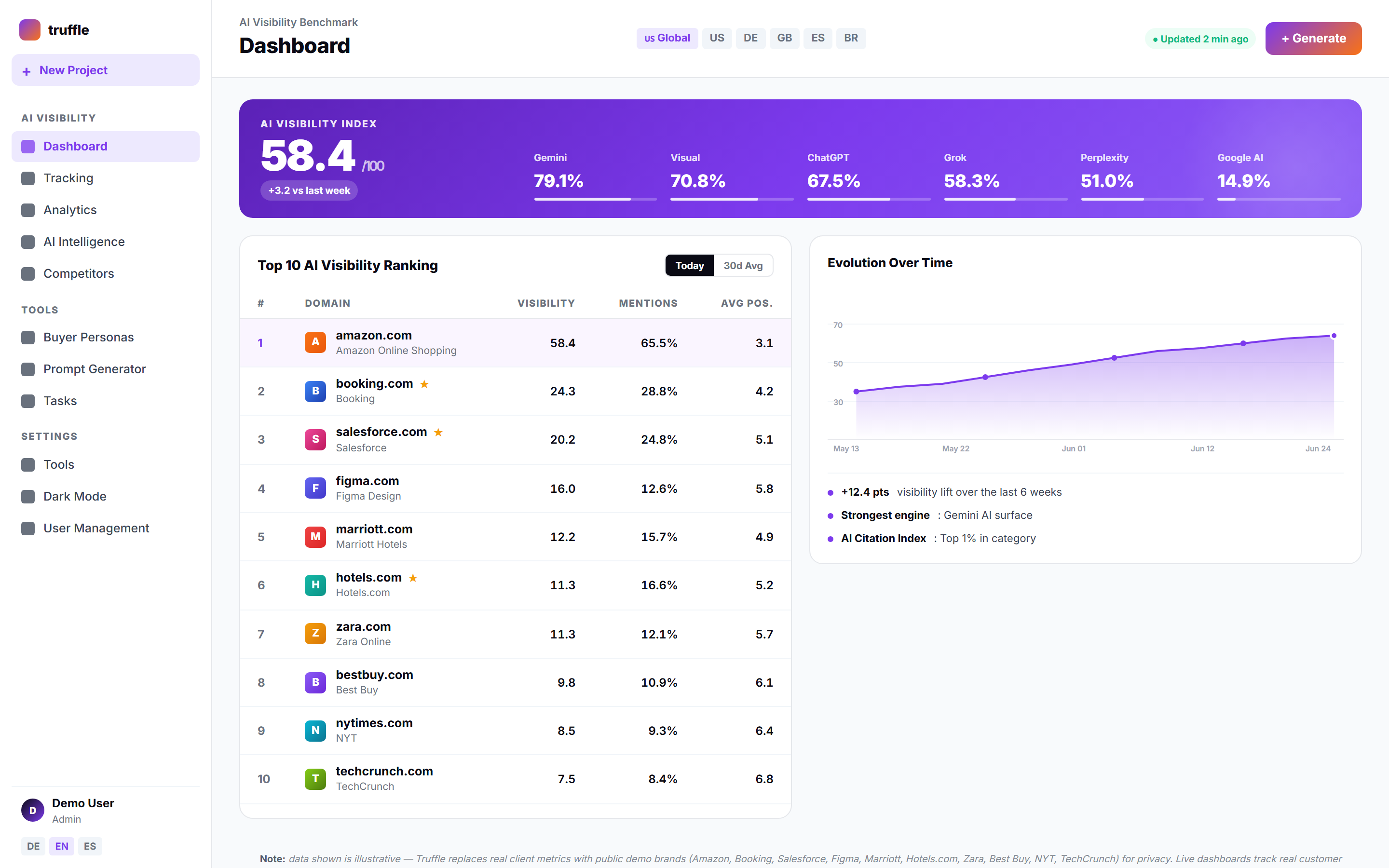
The per-engine point is worth seeing rather than reading. The same brand, run against the same questions, lands very differently depending on which model answers. A blended score would paper over exactly the gap you need to fix.
Blended, this brand looks "about 25% visible." Split by engine, the real story is: strong on ChatGPT and Perplexity, close to invisible on Gemini. A single number hides the one place worth fixing.
The line between insight and vanity metrics
Here is where most tools fall short, and where the buying decision really happens.
A weak tool runs a flat list of generic prompts like "best CRM software" and reports how often you appear. The number looks precise. It is close to useless, because a founder, a procurement lead, and a hands-on engineer ask different questions and get different answers. If your prompt list doesn't reflect who is actually asking, your visibility score describes an audience that doesn't exist.
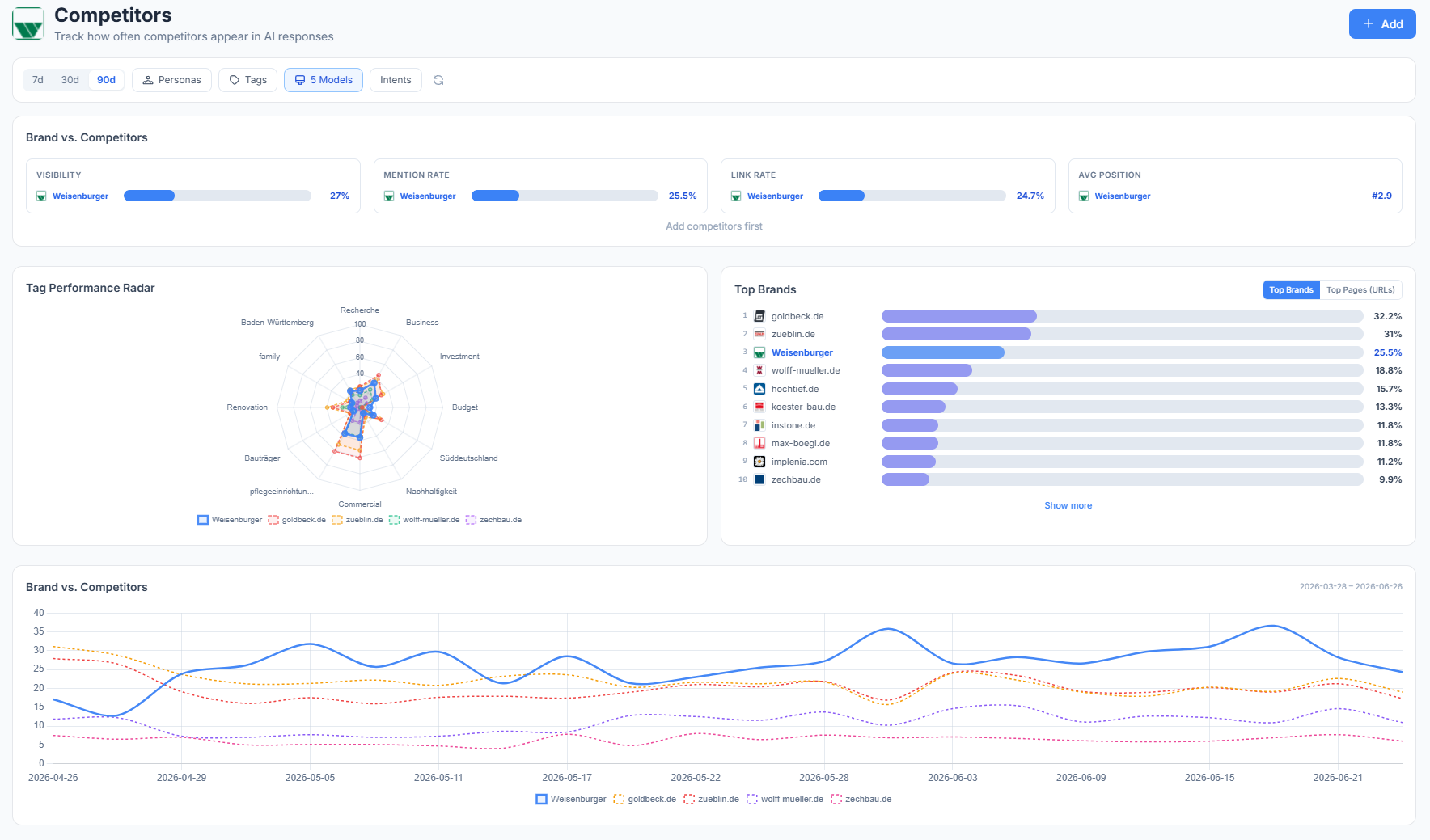
This is the thing Truffle is built around. Instead of a single prompt list, you define buyer personas, and the tracker generates the questions each persona would genuinely ask an LLM: the budget-conscious owner, the technical evaluator comparing integrations, the director who wants a safe, well-known choice. You then see visibility per persona, which tells you not just that you are invisible, but to whom. That is a fixable problem instead of a vague one.
The second differentiator is what the tool hands you at the end. A table of forty metrics is not analysis, it is homework. A useful LLM visibility software product reads the results and tells you what changed and why: which competitor started showing up for the evaluator persona, which of your pages the models stopped citing, which questions you lost ground on. Narrative over raw numbers.
Want your own per-persona, per-engine visibility?
Run your real domain through the free check before you spend on anything else.
Run the free check →What to look for when you choose one
If you are comparing a tool to track LLM visibility, a handful of questions sort the serious options from the rest.
Engine coverage. Does it cover ChatGPT, Claude, Gemini, Perplexity, and Google AI Overviews? Missing one of the big engines is a real blind spot, not a rounding error.
Persona and segment support. Can you track by who is asking, or are you stuck with one flat prompt list for everyone? This is the difference between actionable data and a nice-looking average.
Open model catalog. Models change fast. A tool tied to two or three fixed models will lag. Look for one that lets you add and swap models as the landscape moves.
GSC and GA4 correlation. Visibility is a means, not the end. Being able to line up your AI mentions against real Search Console impressions and GA4 traffic tells you whether the visibility is actually earning you anything. Truffle correlates both.
Your own numbers first. You cannot judge a visibility tool without seeing your own brand's numbers. Truffle's free check shows a first score for your domain before you pay. Once you know where you stand, GEO covers the optimization side.
FAQ
What is an LLM visibility tool?
It is software that measures how often and how prominently your brand appears in answers from AI models like ChatGPT, Claude, Gemini, and Perplexity. It tracks mentions, position, citations, sentiment, and how you compare to competitors across each engine.
How is an LLM visibility tracker different from a rank tracker?
A rank tracker records your position in a list of search results. An LLM visibility tracker measures your presence inside a generated answer, where there are no ranked links, only prose that may name you, cite you, misdescribe you, or ignore you. The measurement has to read language, not count positions.
Do I need to track visibility per persona, or is one prompt list enough?
Per persona is far more useful. Different buyers ask an LLM different questions and get different answers, so a single flat prompt list averages away the detail that matters. Tracking by persona shows exactly which audience you are invisible to, which is the part you can actually fix.
Related reading
- The AI SEO pillar guide — foundational methodology
- GEO explained — Generative Engine Optimization definition
- Generative engine optimization — why answers became the shortlist
- LLM visibility checker — run a quick check on your domain
- Truffle pricing — current tiers and add-ons
Want to see where your brand stands across the major AI engines?
Start with the free check and get a first score for your domain before you spend on anything else.
Run the free check →Note on the visibility panel. The per-engine figures shown above are an illustrative example to make the per-engine point concrete. Your own numbers come from running your domain through the tool. If you spot a factual error in this guide, email us and we'll fix it.