There is no page two
Ranking fourth still got you a click. Being left out of the answer ends the conversation before it starts.
Your buyers stopped scrolling a results page. They ask an assistant, read one answer, and act on it. AI visibility is whether your brand is in that answer.
The free check asks four AI surfaces the questions your buyers actually ask, and gives you one number for where you stand.
No account, no credit card. Most checks finish in one to two minutes.
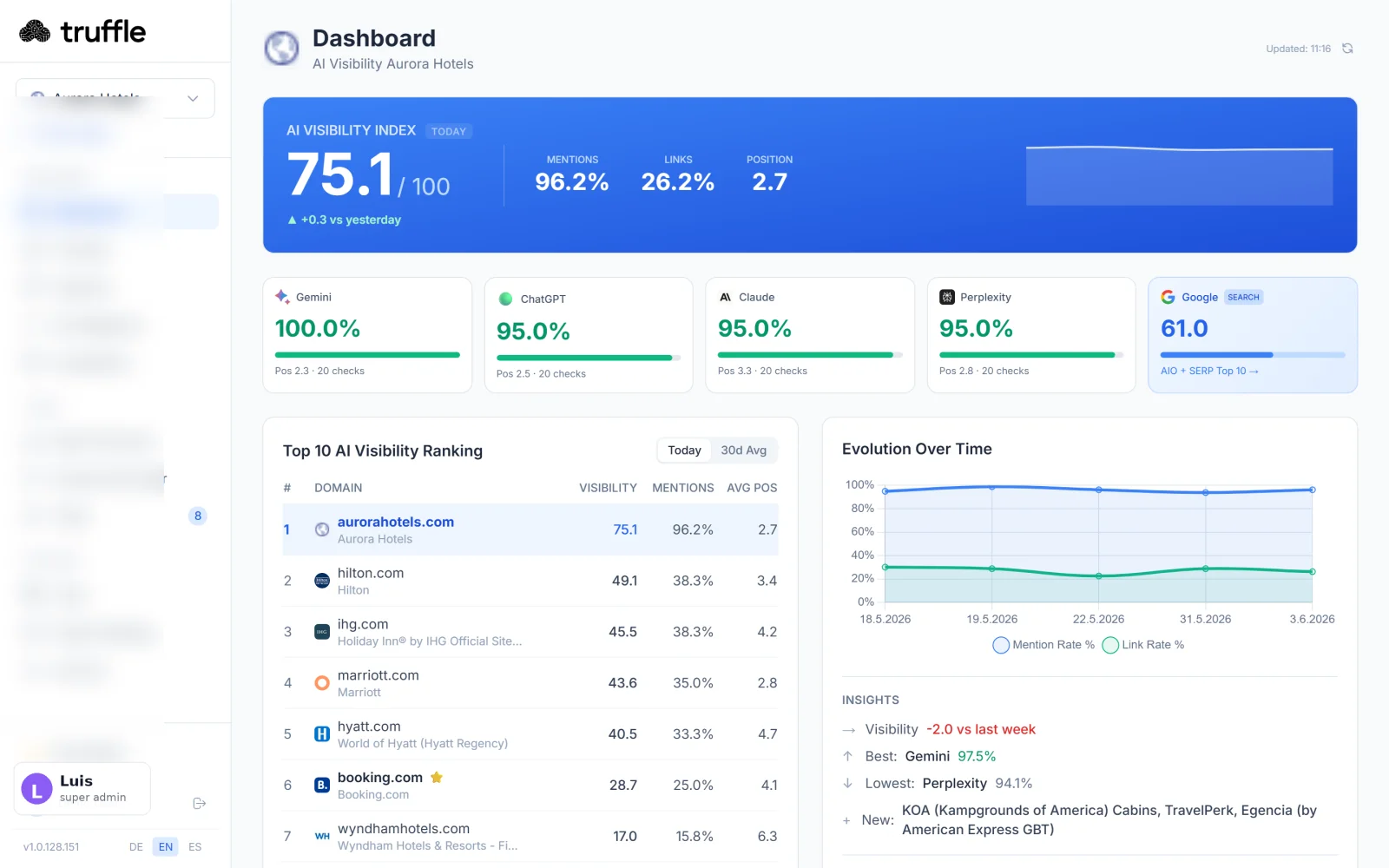
One score, the four measurements behind it, and the same score per engine. Demo account, not customer data.
 ChatGPT
 Claude Haiku
 Gemini
 Perplexity
 Google AI Mode Google AI Overviews
AI visibility is whether ChatGPT, Gemini, Claude, and the other assistants your buyers already use actually mention your brand when someone asks a question your brand should answer.
Search visibility measured whether you ranked on a results page a person had to scan. AI visibility measures something narrower and more consequential: whether the assistant's one answer, the one most people now read and stop, names you at all. A buyer who asks "what's a good project management tool for a five-person team" either sees your name in that answer or doesn't. There's no page two to fall back on, and no impression to bank for later.
Two questions make the difference concrete, and most companies have never checked how they do on either one.
“What's a good CRM for a small agency?”
The assistant has to pick a short list. That list either includes you or it doesn't.
“Is [your product] good for a small agency?”
It already knows your name and is deciding what to say about you, from whatever it can find.
That gap is why the category exists. The assistants pull from your site, from reviews, from forums, from press coverage, and from structured data most companies have never touched. Some of that you control directly. Most of it you don't, which is exactly why tracking it, instead of guessing, is the first step, not an afterthought. A company can rank first on Google for its own name and still be absent from the one answer a buyer actually reads.
The AI Visibility Index is the single number that answers the question above: a 0–100 score built from four measurements (mention rate, citation rate, average position, and share of voice against the competitors you name) combined into one figure you can track over time and compare across engines.
A single "we got mentioned" data point doesn't tell a marketing lead anything a CFO can act on. A score does, because a score moves. Sixty this month against forty-eight last quarter is a trend a team can defend in a meeting; one mention in one chat log is an anecdote. The same score also lets you compare engines against each other instead of guessing which one matters: a brand can sit at 70 on Gemini and 20 on Perplexity, and that gap is often the most useful number on the page, because it points straight at where the next quarter of work should go.
How often an assistant names your brand at all when asked a question you should own.
How often it links or attributes to you, rather than mentioning you in passing.
Where you land when it lists several options. First of five is not fifth of five.
How much of the answer is yours, against the competitors you name yourself.
We built our dashboard around this score for that reason. For the full mechanics (how each KPI is weighted, how the six factor groups behind it are computed, and what moves the number fastest), see our AI Visibility Index guide. This page stays practical: what your score is, and what to do once you have it.
Want to check your brand's AI Visibility Index right now?
Run your free check →Ranking fourth still got you a click. Being left out of the answer ends the conversation before it starts.
Three independent mentions weigh more than one page you control. Winning one engine becomes evidence for the next.
A page can rank well and stay invisible to an assistant if it lacks structured facts, freshness or outside corroboration.
The assistants pull from reviews, forums and press you do not control. Guessing which one cost you the mention is not a plan.
Ranking on Google got you a click and a chance to make your case. Being named inside an AI answer skips that step: the assistant has already made part of the case for you, before the person has opened a single tab.
That's the upside. The downside is symmetrical. If the assistant recommends three competitors and not you, you don't lose a ranking position, you lose the conversation entirely. There's no equivalent of scrolling to result four. Either your brand is part of the answer, or the buyer never learns it exists, and never gets the chance to disagree with the assistant's pick.
There's a compounding effect underneath this that most teams underestimate. An assistant that finds your brand named in three unrelated, independent places treats that as a stronger signal than the same brand appearing once, even from a page the brand controls directly. Being visible on one engine, in other words, doesn't just win that engine; it becomes part of the evidence the next engine draws on. The reverse is also true: staying invisible on one surface doesn't stay contained to that surface.
This is also where AI visibility and traditional SEO stop overlapping as cleanly as most teams assume. A page that ranks well can still be invisible to an assistant if it lacks the structured facts, the freshness, or the third-party corroboration the model is actually weighing. A page an assistant cites heavily can sit outside the top ten organic results entirely. Tracking one and assuming it covers the other is how teams get blindsided by their own LLM SEO gaps, months after they opened.
An AI visibility checker exists to remove that guesswork. It asks the assistants the real questions your buyers ask, in the categories you compete in, and reports back exactly who gets named, including whether it's you, and who it names instead when it isn't.
A number on its own doesn't move anything. A score of 31 and a score of 64 raise the identical question: now what?
That question is where most AI visibility tools stop, and where we start. Every score we hand back comes with the reasons behind it: which questions your brand doesn't answer today, which competitor gets named instead and why, which page is missing the structured data an assistant needs before it will quote you. A gap like that is rarely dramatic on its own: a pricing page with no schema, a product category with no independent review anyone can point to, a question your own FAQ never addresses. Six of them together are what separates a score you'd rather not show anyone from one you would.
Those gaps become tasks: assigned, dated, tracked. Our team works them alongside yours, so the score changes because something on your side changed, not because an engine's mood did. That's the part a dashboard alone can't do. A number tells you where you stand; closing the gap behind it is work, and work needs an owner.

| Score alone | Score + Truffle | |
|---|---|---|
| What you learn | Where you stand today, across four engines | The same, plus exactly what's missing and why |
| What happens next | You guess where to spend the next quarter | Ranked, owned tasks tied to the gaps that produced the score |
| Who does the work | Your team, starting from zero | Your team and ours, working the same task list |
| What moves | Nothing, until someone acts on the number | The score, because the underlying gaps close |
Checking your score is free. Moving it is the product.
See where your brand stands before you decide anything else.
Check your AI visibility score →Your free check polls four AI surfaces with the questions real buyers in your category ask, then reports what each one said: ChatGPT, Claude Haiku, Gemini, and Perplexity. Every paid plan, starting at $69 a month, adds Google AI Mode and Google AI Overviews for all six. Grok is available as an add-on rather than a default, so you're not paying for coverage you didn't ask for.
ChatGPT Claude Haiku Gemini Perplexity Google AI Mode Google AI Overviews The questions themselves aren't generic keyword lists. They're built around the buyer personas for your category, the way an actual prospect phrases a search when they don't know your brand yet, because that's the version of the question an assistant is most often asked. Six engines matter more than one because the same question can get five different answers depending on which assistant is asked, and a brand that only checks the one it happens to use daily is flying blind on the other five.
Most checks return a result in one to two minutes. That's not a countdown rounded down for a landing page: it's what asking four engines the same real question, live, actually takes. Brands with little to no presence tend to finish fastest, in under a minute; brands that already show up well take closer to two, because there's more for the assistants to say. No credit card is required to start.
Plan and surface data: runtruffle.com/api/billing/plans, checked 19 September 2026. Timing: internal log, 21 measured runs, 17 September 2026.
No card, one to two minutes.