

On 6 August 2026, Rippling published what its AI bill was doing, which very few companies do.
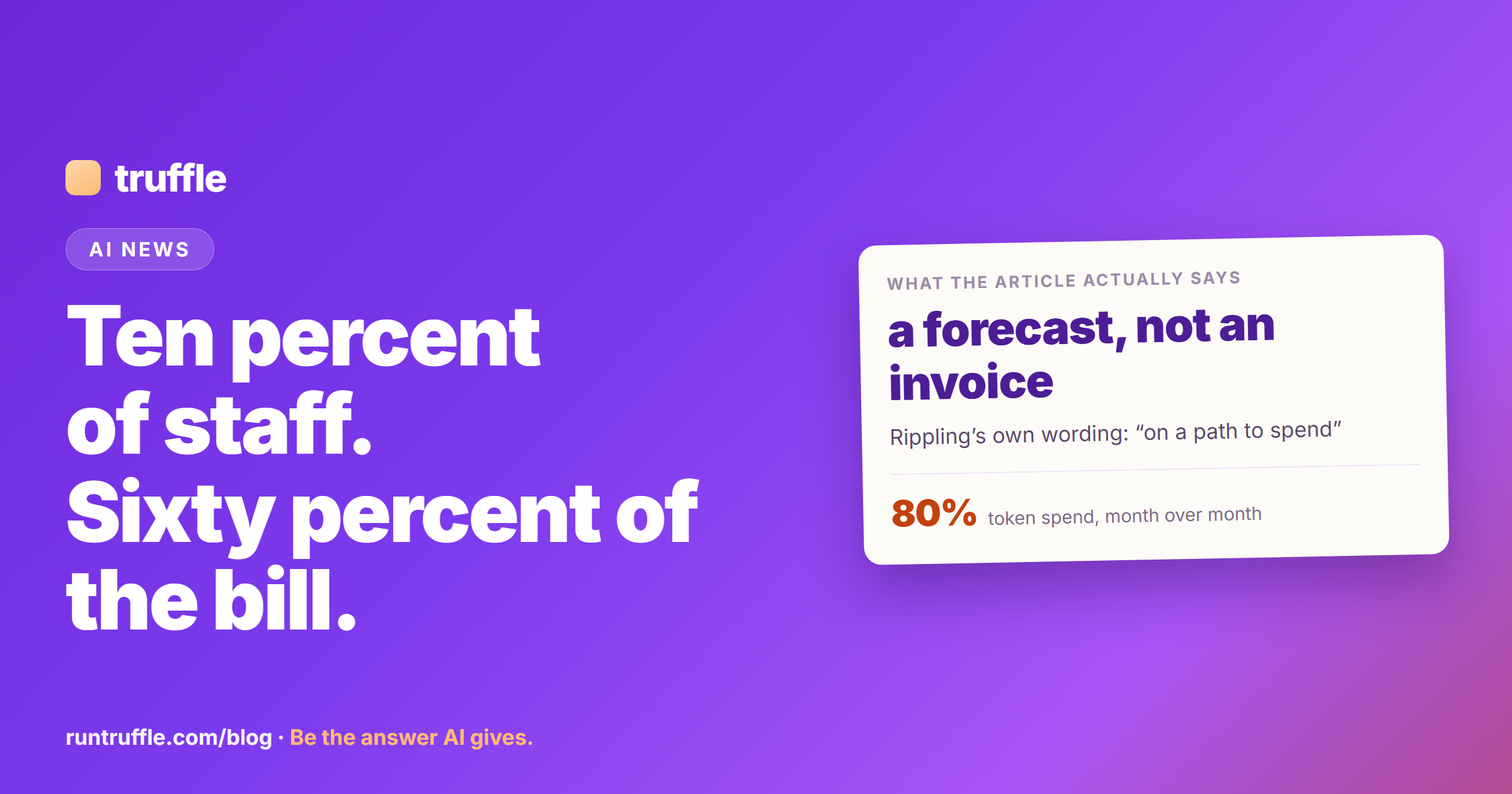
Token spend was growing 80 percent month over month. A cost model put the company on a path to spend 40 percent of its R&D headcount budget on tokens, and, in the following year, to approach 90 percent.
Those are the numbers everyone quotes. The two findings underneath them are the ones worth your time.
First, what these numbers are not
They are forecasts, not invoices. Rippling writes that it was “on a path to spend 40% of our R&D headcount budget on tokens” and later refers to “a forecast of spending 40%”. Several outlets have rendered this as Rippling’s AI bill reaching 40 percent of its R&D budget. It did not. A projection that triggered action is a different thing from an expense that landed, and the difference matters if you plan to cite it.
The 90 percent figure for the following year is a projection too — and it appears in almost none of the secondary coverage, despite being the more striking of the two.
The often-repeated figure of 600 billion tokens does not appear in Rippling’s post at all. Nor does a total dollar amount. The only absolute number given is one engineer at $50,000 a month.
Finding one: the spending was extremely concentrated
“Roughly 10–15% of our employees were driving about 60% of total AI spend.”
This is the sentence to take to your own organisation. It reframes the problem from a pricing question into a distribution question, and those have completely different solutions.
If cost is spread evenly across a team, the lever is the price per token, and you are at the mercy of vendors. If a tenth of the people account for six tenths of the bill, the lever is internal, and you can pull it this week. You cannot know which situation you are in without looking, and Rippling notes that the looking itself was hard: finance was manually collating data from multiple vendor dashboards, and engineers scraped it into a data lake by hand.
Finding two: nobody had chosen the expensive setting
This is the part that generalises furthest, and it is easy to read past.
“Expensive defaults were the norm. The newest models were set to fast mode. That wasn’t because we made that decision internally but rather because nobody had ever looked into it and set best practices.”
The costly configuration was not a decision anyone made. It was a decision nobody made. That is a different failure, and no amount of budget discipline catches it, because there is no moment where someone approves the expensive option.
It also connects directly to something we wrote about this week. Meta’s coding agent offers two model identifiers at very different prices, one of which sends your prompts back to the vendor, and the documentation says nothing about which one an installer writes into your config. Same shape, different vendor: the setting that decides the bill, or the data, is one nobody consciously set.
What they did, and what it cost them
Rippling nominated 20 “AI Captains” across the company, responsible for enablement, best practices and governance, and built a console to track spend by person and by model.
The result, in their words: “For R&D, we went from a forecast of spending 40% of our headcount budget on tokens to 10 to 15%. That’s tens of millions of dollars a year.”
One line deserves quoting for what it does not claim: “constraints made engineers smarter, not less capable.” That is Rippling’s assessment of its own programme, and it is the sort of claim a company always makes about its own cost-cutting. Read it as their position rather than as a measured result.
Their earlier note on productivity is more careful and more interesting: “The productivity signal was real, but not linear.”
What to take from it
Find out whether your spend is concentrated before you negotiate a price. The two problems look identical on an invoice and have nothing else in common.
Look at what your defaults are set to, and when anyone last chose them. Newest model, fastest mode and largest context are the settings most tools ship with, and they are the settings least likely to have been decided.
Treat a forecast as a forecast, including this one. Rippling acted on a projection, which was the right call. Quoting that projection as a historical cost is not.
Sources
- Rippling, “From unchecked AI spend to complete control: How Rippling built AI Spend Console”, published 6 August 2026, by Whitney Zack and Catalina Zhao: https://www.rippling.com/blog/introducing-ai-spend-console (retrieved 28 August 2026). Source of the 80 percent month-over-month growth, both forecast figures, the concentration of spend among 10–15 percent of employees, the $50,000 monthly figure for a single engineer, the quoted passage on expensive defaults, the AI Captains programme, and the quoted outcome and productivity assessments. All quotations verified against the page source rather than a summary. The post contains no total dollar figure and no token count; the frequently cited figure of 600 billion tokens does not appear in it, checked against the retrieved text with “token” as a control term (14 occurrences, so the retrieval was intact).