

On 19 August 2026, OpenAI announced Zero Data Retention for frontier models. The promise, in the company’s words:
“Zero Data Retention gives eligible API customers a clear promise: OpenAI does not retain their prompts or model responses after a request is processed. Customer content is not available to OpenAI personnel for review¹, and enterprise customer data is not used to train our models unless customers explicitly opt-in.”
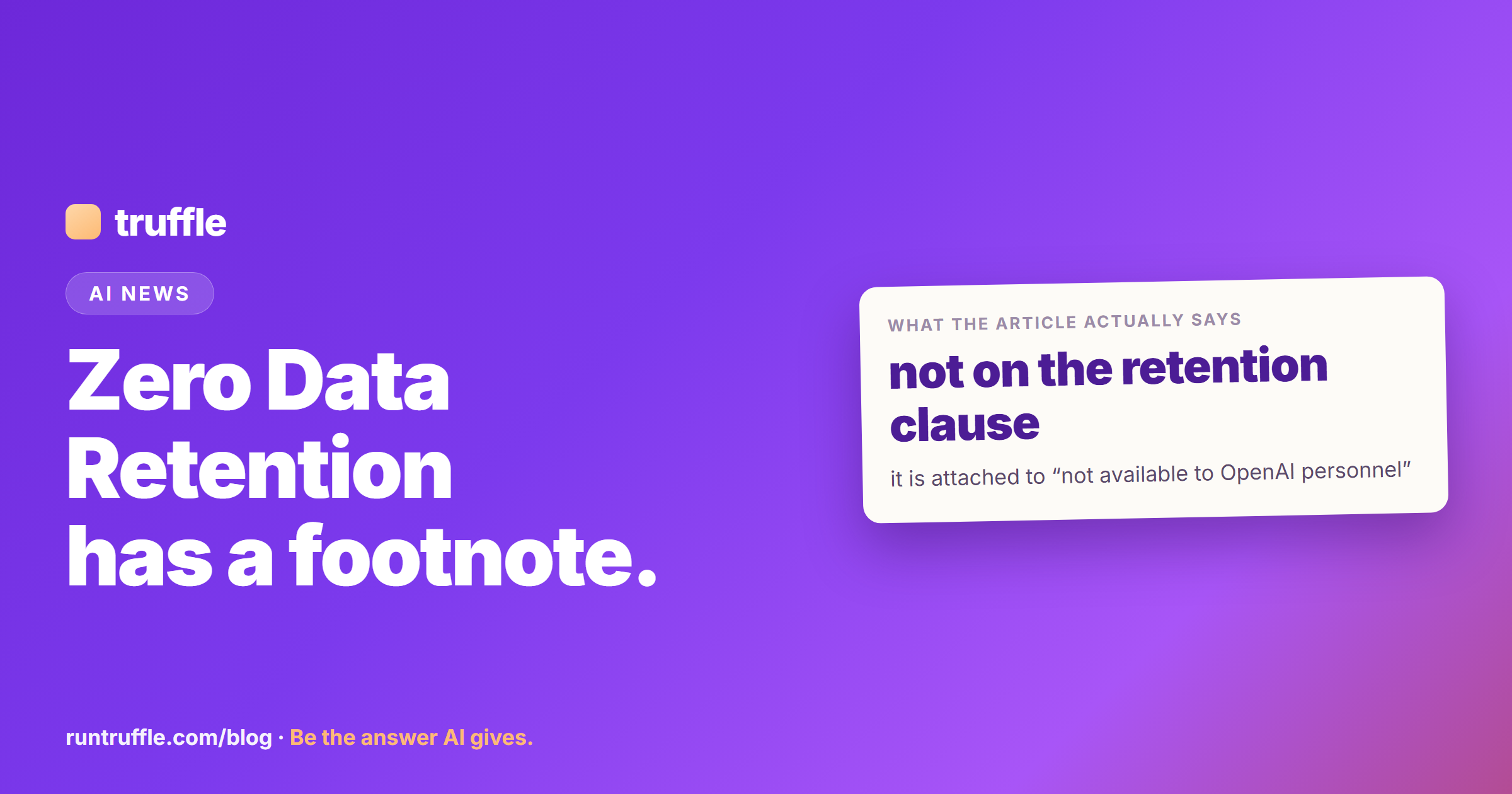
Note where that footnote marker sits. Not at the end of the paragraph, and not on the retention clause. It is attached to “not available to OpenAI personnel for review”, which is the sentence it qualifies.
What the footnote says
“Like other frontier model providers, OpenAI is required by law to report apparent child sexual abuse material (CSAM). Images flagged for potential CSAM will continue to be retained for manual review and reporting purposes, even in Zero Data Retention deployments, as they are today.”
Four things are worth separating out of that sentence, because they get merged in the retelling.
It is a legal requirement, not a product choice. OpenAI names the obligation and says other frontier providers carry it too.
It covers images, not text. The footnote says images flagged for potential CSAM.
Retention and human review both apply. The material is kept and looked at by a person. That is the part the main promise says does not happen.
It is not new. “As they are today” means this was already the case before the announcement. Nothing was taken away here; something was written down.
Why this is not a scandal, and still matters
A company that publishes the exception in the same document as the promise is doing the right thing. The alternative, which is common, is a promise with no footnote and the same legal obligation quietly in force.
The problem is what happens downstream. “Zero Data Retention” is an absolute phrase in a product name, and product names travel. A vendor who builds on the OpenAI API and tells their own customers “zero data retention, nothing is kept” has now made a promise that is narrower in the original than in the retelling.
If you are that vendor, the exception is yours to disclose. Nobody at OpenAI is going to be in the room when your customer asks.
This is the mirror image of a trade we looked at in Meta’s coding agent pricing, where the cheaper model costs a fraction of the standard one because prompts and completions are used to improve the vendor’s products. There you pay less and give data. Here you pay for the assurance that data does not stay. Two vendors, opposite directions, the same currency — and in both cases the exact wording is narrower than the summary.
What is a preview, and what is available
The announcement also covers Private Safety Processing, and the two need keeping apart.
Private Safety Processing is designed to identify patterns across related interactions without giving OpenAI personnel access to the underlying content. It appears throughout the announcement, and it is not shipped. OpenAI writes: “We plan to start rolling out Private Safety Processing, and share a technical white paper, in September.”
So: Zero Data Retention is the offer, Private Safety Processing is a preview of something meant to work alongside it. Anyone planning around the second one is planning around a September date and a white paper that does not exist yet.
The word doing the most work
“Eligible.”
The promise applies to “eligible API customers”, and the announcement does not say who qualifies. The phrase “all customers” does not appear on the page. We checked the retrieved text, using “eligible” itself as a control term to confirm the retrieval was intact; it occurs once.
That is a gap in the public information, and naming it is not a criticism. If ZDR is part of a procurement conversation you are in, eligibility is the first question, and the answer is not on the announcement page.
What to do with it
Read the footnote before you repeat the phrase. Especially if you resell, integrate or certify on top of the API.
Separate what is offered from what is previewed. One is available now, the other has a target month.
Ask what eligible means for you, in writing. The public page will not answer it, and a promise you cannot confirm you qualify for is not yet a promise you have.
Sources
- OpenAI, “Offering Zero Data Retention for frontier models”, 19 August 2026: https://openai.com/index/offering-zero-data-retention-for-frontier-models/ (retrieved 28 August 2026; the page returns 403 to a plain HTTP fetch and was read from the fully rendered page). Source of the quoted Zero Data Retention promise and its footnote marker placement, the full text of footnote 1 on CSAM retention and manual review, the description and preview status of Private Safety Processing, and the quoted September timing for rollout and white paper. The page does not state who qualifies as an “eligible API customer” and does not contain the phrase “all customers”; that absence was counted in the retrieved text with “eligible” as a control term, which occurs once, confirming the retrieval was intact.