

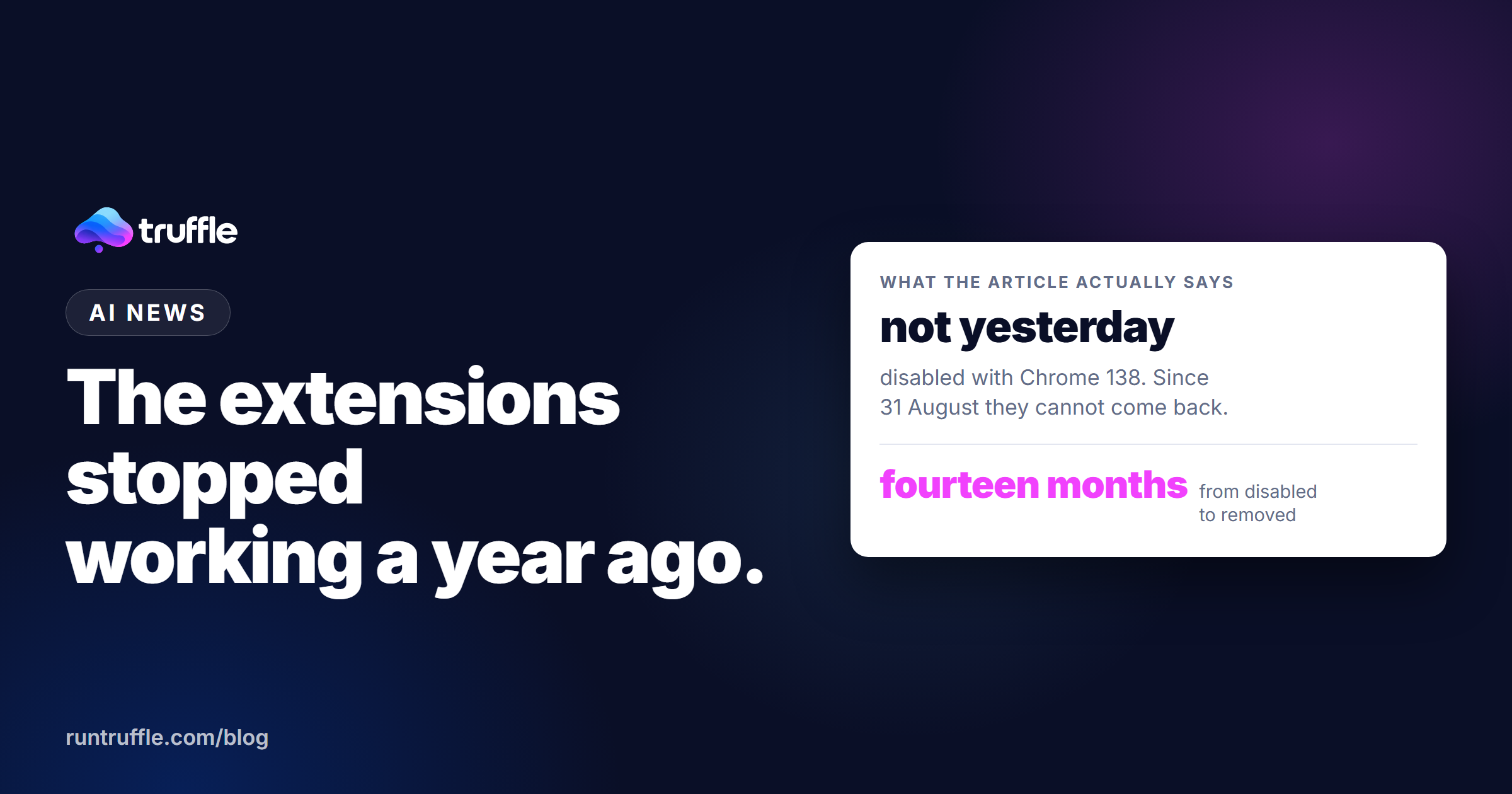
Yesterday was the date on Google’s own timeline. From the Chrome documentation, verbatim:
“Aug 31st 2026: All remaining Manifest V2 extensions removed from the Chrome Web Store”
Coverage of this will reach for a victim, and the victim framing gets the story wrong. This was announced years in advance, it applies to every remaining Manifest V2 extension, and the substantive change happened long before yesterday.
The three dates, in order
24 July 2025. The same page records that with Chrome 138, Manifest V2 extensions were disabled for all users on all channels, and that “Users can no longer turn them back on.” Not removed. Disabled. On any current Chrome, an MV2 extension has not been doing anything for over a year.
Chrome 139. The escape hatch for organisations closed. The ExtensionManifestV2Availability policy, which let an administrator keep MV2 extensions enabled on managed machines, was removed with that release.
31 August 2026. The copies in the store went. That is what happened yesterday.
What actually changed, and it is narrower than it sounds
The extensions did not stop working yesterday. They stopped working in July 2025. What ended yesterday is the ability to get them back. Google’s wording is precise about the consequence, and worth reading twice:
“Manifest V2 extensions installed on Chrome 138 or earlier will remain installed, but will be unable to receive any updates and cannot be reinstalled from the Chrome Web Store once removed from Chrome.”
Two things follow. An MV2 extension still sitting on an older machine is now frozen: no updates, including security updates. And once it is removed from that machine, for any reason, it is gone. There is no source to reinstall from.
That turns a dormant compatibility issue into a rebuild problem. A workstation that is behind on Chrome and carries an MV2 extension is no longer a machine you can reimage and restore to the same state.
Why the popular framing is wrong
The story that will circulate is that Google removed a specific well-known content blocker. It is easy to check that this is not what the source says. The timeline covers all remaining Manifest V2 extensions, the sequence has been published and revised since 2025, and the widely quoted extension is one item in a category rather than a target.
Writing it as a surprise means writing something you have to withdraw later, and the actual sequence is more useful to a reader anyway: a platform change with a published schedule reached its final step, and most people affected by it were affected fourteen months ago without noticing.
What this does not say
It does not say your extensions stopped working yesterday. If you are on a current Chrome, anything Manifest V2 has been inactive since Chrome 138.
It does not say Manifest V3 is equivalent. Whether the replacement platform can do what a given extension did is a separate argument with a long history, and this timeline page does not address it.
It does not say enterprises have an exemption left. They had one, in the form of a policy, and that policy was removed with Chrome 139.
What to do with it
Find out whether any workflow still depends on a Manifest V2 extension. Not whether one is running, because on a current browser it is not. Whether something in your process quietly assumed it was there and has been failing or degraded since last year.
Check whether any machine is on Chrome 138 or earlier. Those are the only places where an MV2 extension can still be installed, and they are now unrepeatable configurations. Anything frozen there receives no security updates.
If an extension mattered, find its successor now rather than at the next reimage. The window in which you could reinstall the old one to buy time closed yesterday.
Treat this as a rehearsal. A platform vendor published a schedule, kept it, and removed a capability in stages over fourteen months. The organisations that were surprised yesterday are the ones that will be surprised by the next one, and the fix is not vigilance about browsers. It is knowing which of your workflows depend on someone else’s platform decision.
Sources
- Google, “Manifest V2 support timeline”, Chrome for Developers: https://developer.chrome.com/docs/extensions/develop/migrate/mv2-deprecation-timeline (retrieved 1 September 2026). Source of the quoted 31 August 2026 entry on removal from the Chrome Web Store, the quoted consequence for extensions installed on Chrome 138 or earlier, the 24 July 2025 entry recording that Manifest V2 was disabled for all users on all channels with Chrome 138 and could not be re-enabled by users, and the removal of the
ExtensionManifestV2Availabilitypolicy with Chrome 139. Control terms confirming the retrieval was intact: “Manifest V2” (29 occurrences), “ExtensionManifestV2Availability” (4), “Chrome 139” (5). - All dates and quoted wording in this article come from that page rather than from secondary coverage. The page is Google’s own documentation of its own schedule, which makes it authoritative for what was announced and not for how well the transition worked.