

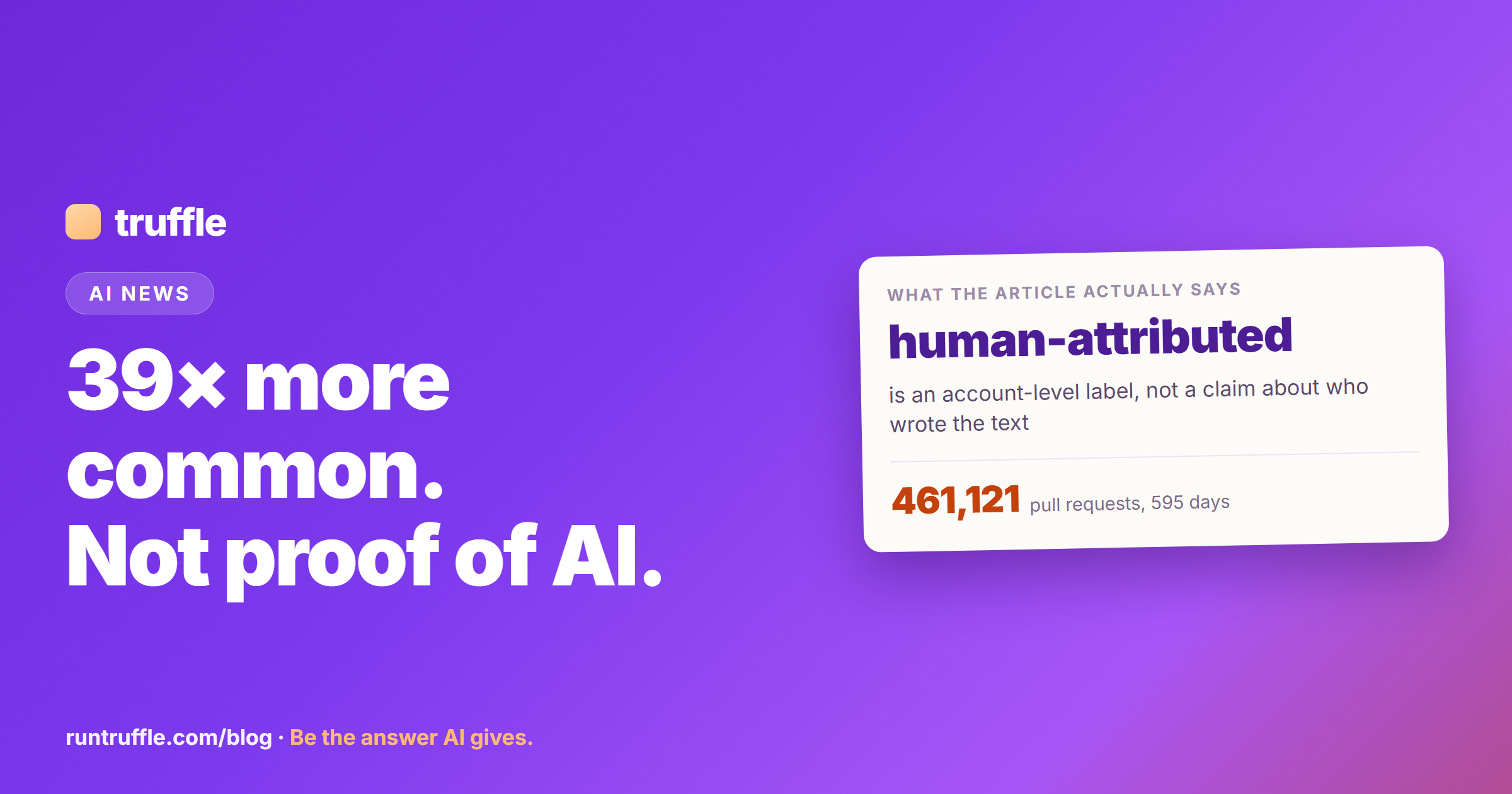
Louis Abraham has been scraping 1,000 GitHub pull requests a day and counting the words. The corpus so far: 595 days, 461,121 pull requests, 51,079,244 words.
Grouping the vocabulary into ten clusters with KL-divergence k-means produced one that did not exist before 2026. Last month it covered 40 percent of all human-attributed pull requests.
Inside that cluster, “load-bearing” runs 39.47 times more frequent than in the corpus as a whole: 95 per million words at the peak, against 20 across everything.
The word carrying the whole finding
Human-attributed.
It is not a synonym for human-written. It is an account-level classification: pull requests from accounts that do not identify themselves as bots. Someone using a coding agent from their own account is human-attributed. So is someone pasting a model’s output into a PR description.
The study’s own framing is careful about this. It presents a vocabulary trend and does not claim to detect AI-written text. “40 percent of pull requests are written by AI” is not in the source, and it is the sentence most people will take away.
One detail is worth naming for anyone who goes and looks: the front page uses the term “human-attributed” without defining it there. We counted the word “bot” on that page — zero occurrences. How the attribution works is in the methodology repository, one link away. A reader who stops at the chart gets a precise number attached to a term whose meaning has been left off the page.
What it does show, which is plenty
A vocabulary appeared in 2026 that did not exist before and now dominates a large share of the corpus. The words in it will look familiar to anyone who has read model output for a living: load-bearing, plainly, quietly, deliberately, genuinely, premise, outright, asserted, re-derived, byte-identical.
That is a real, measured, dated shift in how software gets described, across half a million pull requests. It says something changed in 2026 and roughly when. It does not say who typed it.
Those are two different claims, and only one of them is supported.
Why we measured our own writing
The obvious next move is to take the word list and search your own text. We did it, and the result is a good demonstration of why it does not work.
Across 21 of our own English articles, 20,651 words:
specific cluster markers   (load-bearing, re-derived, byte-identical, …)     0 hits
common cluster words       (nobody, plainly, quietly, deliberately, …)      38 hits
Zero on the distinctive terms. But “nobody” at 920 per million and “plainly” at 387 per million, which sounds alarming and means nothing. Those are ordinary English words that happen to sit in the cluster, and a flat count of the full list will flag any sufficiently plain prose. A colleague running the same naive check found a German-language legal notice scoring just as high.
The study does not count words flatly. It uses KL-divergence against a baseline corpus, which is what separates a word that is characteristic of a cluster from a word that is merely present in it. Reproducing the headline with a text search reproduces the number and loses the method.
So our own honest result is: no distinctive markers, some shared everyday vocabulary, and no conclusion available from either.
The same error, one week earlier
This is the second time this month that a correct number has travelled with the wrong noun attached.
On 14 August, a dozen outlets reported that Google had open-sourced HEIR, its homomorphic encryption compiler. The repository has been public since 17 April 2023, carries 880 stars, builds nightlies daily, and had no release on 14 August. Google’s own post says “Since announcing our intentions in 2023”. What was new was an expansion and four demonstrated use cases. Nothing was open-sourced that week.
Both cases have the same shape. The measurement is sound, the figure is real, and the word next to it is wrong. In one it is “open-sources”, in the other it is “human”. A fact-check that verifies the number passes both.
What to do with it
Do not use this to audit your team. The study does not support it, and the author says so.
If you run the word list against your own text, use the distinctive terms, not the common ones. And know that a hit tells you a word appeared, not who wrote it.
Watch the noun, not the number. The most reliable warning sign in a statistic is not an implausible figure. It is a plausible figure with a word beside it that nobody checked.
Sources
- Louis Abraham, “The load-bearing vocabulary of Claude”: https://louisabraham.github.io/load-bearing/ (retrieved 28 August 2026). Source of the corpus size of 595 days, 461,121 pull requests and 51,079,244 words, the ten KL-divergence k-means clusters, the cluster that appeared in 2026 covering 40 percent of human-attributed pull requests, the 39.47× figure for “load-bearing” with 95 per million at peak against 20 across the corpus, and the cluster’s representative word list. The page renders client-side and returns almost no text to a plain HTTP fetch; it was read from the fully rendered page, using “load-bearing” and “cluster” as control terms. The term “human-attributed” is used on that page without being defined there; the word “bot” does not occur on it. Methodology and code: https://github.com/louisabraham/load-bearing
- Google, “How Google is making private AI practical with homomorphic encryption”, 14 August 2026: https://blog.google/security/how-google-is-making-private-ai-practical-with-homomorphic-encryption/ and the HEIR repository https://github.com/google/heir (repository metadata checked via the GitHub API on 28 August 2026: created 17 April 2023, 880 stars, nightly builds, no release dated 14 August 2026).
- The measurement of our own English articles was carried out on 28 August 2026 across 21 files and 20,651 words, counting whole-word matches for the terms listed.