

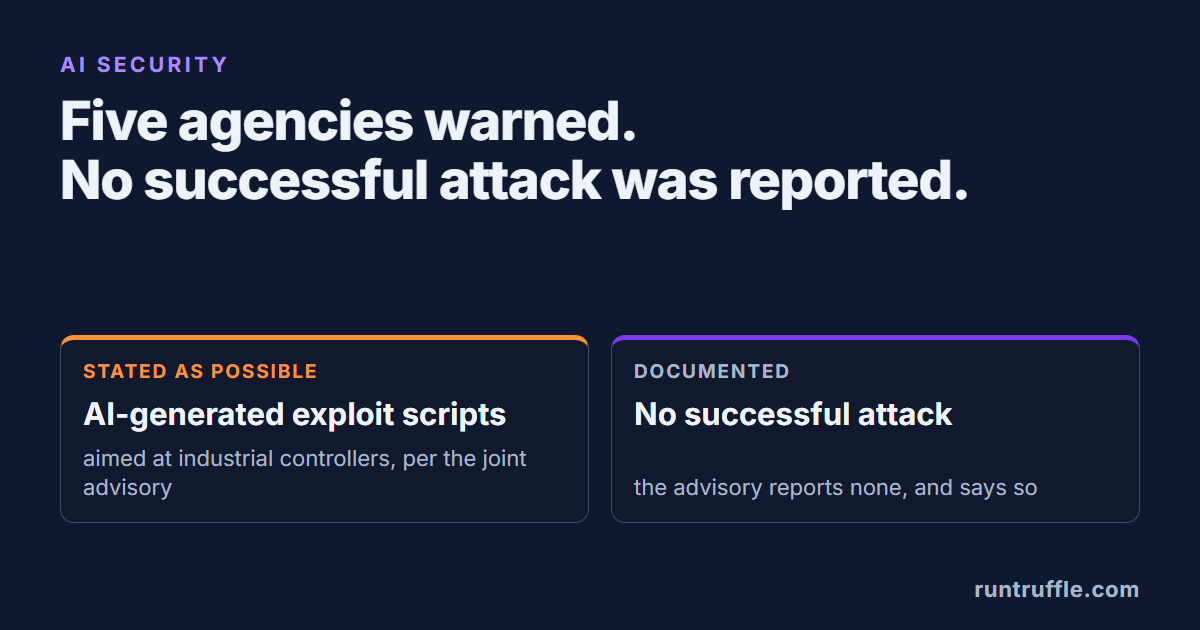
Five United States agencies put their names on the same advisory on 20 August 2026: the NSA, CISA, the FBI, the Department of Energy and the Environmental Protection Agency. They warned of an “active threat” to critical infrastructure involving AI-generated exploit scripts.
Five agencies signing one document is signal enough. It does not need to be inflated, and the advisory itself is careful about what it claims.
What is documented
The activity targets Siemens S7 Series programmable logic controllers for reconnaissance and capability development, and the advisory assesses the broader targeting to extend beyond Siemens hardware.
The method is unglamorous. Actors use internet scanning services such as Censys and ZoomEye to find internet-exposed controllers running outdated software or otherwise poorly protected. The affected sectors named are Critical Manufacturing, Energy, Water and Wastewater Systems, Chemical, Food and Agriculture, and Commercial Facilities.
The AI element is stated plainly: “Threat actors are using AI assistance to generate exploitation scripts using publicly available information on these Siemens S7 Series PLCs for initial access, credential access, denial of service, and other objectives.”
Among the tools is a custom Python script built on open-source industrial automation libraries such as snap7.dll and python-snap7, which makes it resemble a legitimate monitoring utility. It provides read and write access to controller memory, configuration data and ladder logic over the S7comm protocol.
The agencies did not attribute the activity to a known actor or group.
What is possible, and stated as possible
Here is where the advisory is more disciplined than most coverage of it.
The consequences are written conditionally: exploitation of poorly secured controllers “could result in disruption of critical industrial processes, safety incidents, downtime or equipment damage, compromise of sensitive data, and compliance violations.”
Could. The advisory describes reconnaissance and capability development as ongoing. It does not describe a successful attack with damage that has actually occurred, and it names no incident.
That is not a weakness of the warning. Reconnaissance against exposed industrial controllers is worth an advisory on its own, and five agencies agreeing on that is the finding. But an article that converts “could result in safety incidents” into “safety incidents are happening” has invented the part that would matter most.
The asymmetry underneath
The advisory’s most quotable line is about capability rather than incident: the use of AI to generate exploit scripts and iterate them rapidly marks an “evolution” in offensive capability, lowering the technical barriers to industrial control system attacks along with the expertise and time required.
That sentence generalises well beyond controllers. The cost of running a competent attack has fallen. The cost of defending against one has not, because defence still requires inventory, segmentation, patching and people who know the estate.
Note what has not changed: the entry point here is an internet-exposed controller running outdated software. AI did not create that exposure, and removing the AI element would not close it. What AI changed is how many people can write the script that walks through the door.
Why this reaches past industrial operators
Most readers of this do not run a water treatment plant. Two things still transfer.
The first is the shape of the attack. Publicly available documentation plus open-source libraries plus AI assistance produces a tool that resembles a legitimate one. Nothing in that chain is exotic, and nothing in it is specific to controllers.
The second is the reporting discipline. This advisory separates what is observed from what is possible, in its own wording, on a topic where alarm would be easy to sell. That separation is the thing to imitate, and it is the thing most retellings remove first.
What to take from it
If you operate anything with a management interface reachable from the internet, the scanning services named in the advisory can already see it. That was true before AI-assisted scripting and it remains the precondition.
If you write or approve security communications, look at how the conditional survives here. “Could result in” is doing real work in that sentence, and it took five agencies to agree on the phrasing.
And when the next version of this story reaches you with a damage figure attached, check the advisory. As published, it contains none.
Sources
- The Hacker News, “AI-Generated Exploit Scripts Target Critical Infrastructure”, 20 August 2026: https://thehackernews.com/2026/08/ai-generated-exploit-scripts-target.html (retrieved 26 August 2026). Source of the joint advisory by NSA, CISA, FBI, DOE and EPA, the targeting of Siemens S7 Series controllers and the assessment of broader scope, the use of Censys and ZoomEye, the named sectors, the quoted description of AI-assisted script generation, the custom Python tooling built on snap7 libraries, the absence of attribution, the conditionally worded consequences, and the characterisation of the development as an evolution in offensive capability.